

Cash Flow Forecasting for Small Businesses: A CEO's Guide
Oct 12, 2026
Cash Flow Forecasting for Small Businesses: A CEO's Guide to Making Better Financial Decisions
FINANCIAL VISIBILITY™ | EXECUTIVE INSIGHT
By Jasmyn Camp
Founder & CEO, Biz Wealth Builders Consulting®
There is a difference between having money in your business account and knowing what your business can afford.
A founder can look at a healthy bank balance on Monday and feel confident about hiring, investing in marketing, or expanding services.
By Friday, payroll clears. A software renewal processes. A client payment arrives later than expected.
Suddenly, the decision that seemed financially reasonable earlier in the week feels uncertain.
The problem isn't always insufficient revenue.
Sometimes, it's insufficient visibility into when money will enter and leave the business.
This is where cash flow forecasting becomes an essential leadership tool.
Not because every CEO needs to become an accountant.
Because every CEO needs to understand the financial consequences of the decisions they're making.
What Is Cash Flow Forecasting?
Cash flow forecasting is the process of estimating how much money will enter and leave your business over a future period.
Unlike a profit and loss statement, which summarizes revenue and expenses, a cash flow forecast focuses on the timing of actual cash movement.
It helps answer questions such as:
-
Will we have enough available cash to cover payroll next month?
-
What happens if a major client pays two weeks late?
-
Can we afford to hire another employee?
-
How much cash should remain available before we invest in expansion?
-
Will our upcoming obligations exceed expected collections?
For growing service-based businesses, these questions become increasingly important as client contracts, payroll, contractors, subscriptions, taxes, and operational commitments become more complex.
A business can be profitable on paper and still experience a cash shortage.
Understanding that distinction is part of Financial Visibility™.
Why Your Bank Balance Doesn't Tell the Whole Story
Imagine your consulting firm has $35,000 in its operating account.
At first glance, that may appear to be more than enough to invest in additional support.
But over the next four weeks, the business expects to pay:
| Upcoming obligation | Amount |
|---|---|
| Payroll and contractors | $14,000 |
| Operating expenses | $5,000 |
| Tax payments | $4,000 |
| Debt and other commitments | $3,000 |
| Total upcoming cash outflows | $26,000 |
That leaves $9,000 before considering any additional incoming payments or unexpected expenses.
Now imagine a $12,000 client payment is expected during that same period.
If the client pays on time, the company's available cash position improves.
If payment is delayed, the company may need to reconsider the timing of its next investment.
The bank balance didn't reveal that distinction.
A cash flow forecast would.
And that's the value of financial visibility: understanding what the business can support before committing resources.
The Difference Between Profit and Cash Flow
Profit and cash flow are related, but they measure different things.
Profit reflects revenue minus expenses under the accounting method used.
Cash flow reflects money actually entering and leaving the business.
For example, a consulting firm using accrual accounting may record $20,000 in revenue when services are earned and invoiced, even though the client won't pay for another 30 days.
The revenue appears on the income statement.
The cash hasn't arrived.
Meanwhile, employees and contractors still expect payment.
This creates a timing difference between reported financial performance and available cash.
Other differences can arise from loan principal payments, equipment purchases, owner distributions, and prepaid expenses.
That's why a CEO needs both accurate financial reporting and forward-looking cash flow planning.
One explains financial performance.
The other helps anticipate financial capacity.

How to Build a 13-Week Cash Flow Forecast
One practical approach for small and growing service businesses is a rolling 13-week cash flow forecast.
It provides a weekly view of expected cash movement over approximately three months.
The objective isn't to predict every transaction perfectly.
It's to make upcoming financial commitments visible early enough to support better decisions.
Step 1: Establish Your Starting Cash Position
Begin with the cash actually available in your business accounts.
Use reconciled balances and account for outstanding transactions that haven't cleared.
Avoid assuming that every dollar in the bank is available for discretionary spending.
Some of that cash may already be committed to taxes, payroll, or upcoming obligations.
Step 2: Estimate Expected Cash Collections
Identify the money you reasonably expect to receive each week.
For a service-based business, this may include:
-
Outstanding client invoices
-
Recurring monthly retainers
-
Contract milestone payments
-
Confirmed deposits
-
Other expected operating receipts
Separate confirmed or highly predictable collections from uncertain opportunities.
A proposal awaiting approval is not the same as an invoice with an established payment date.
That distinction prevents the forecast from overstating available cash.
Step 3: Map Upcoming Cash Payments
List expected payments by week.
Include payroll, contractor payments, software subscriptions, rent, insurance, loan payments, taxes, and other recurring commitments.
Then add known one-time expenses.
For example, if you're considering purchasing equipment or hiring an employee, include the anticipated cash impact in the relevant weeks.
This helps you see whether the business can absorb the commitment without jeopardizing existing obligations.
Step 4: Calculate Your Projected Ending Cash
For each week, use the following formula:
Beginning Cash + Expected Cash Inflows − Expected Cash Outflows = Projected Ending Cash
The projected ending balance becomes the following week's starting balance.
Repeat this across the forecast period.
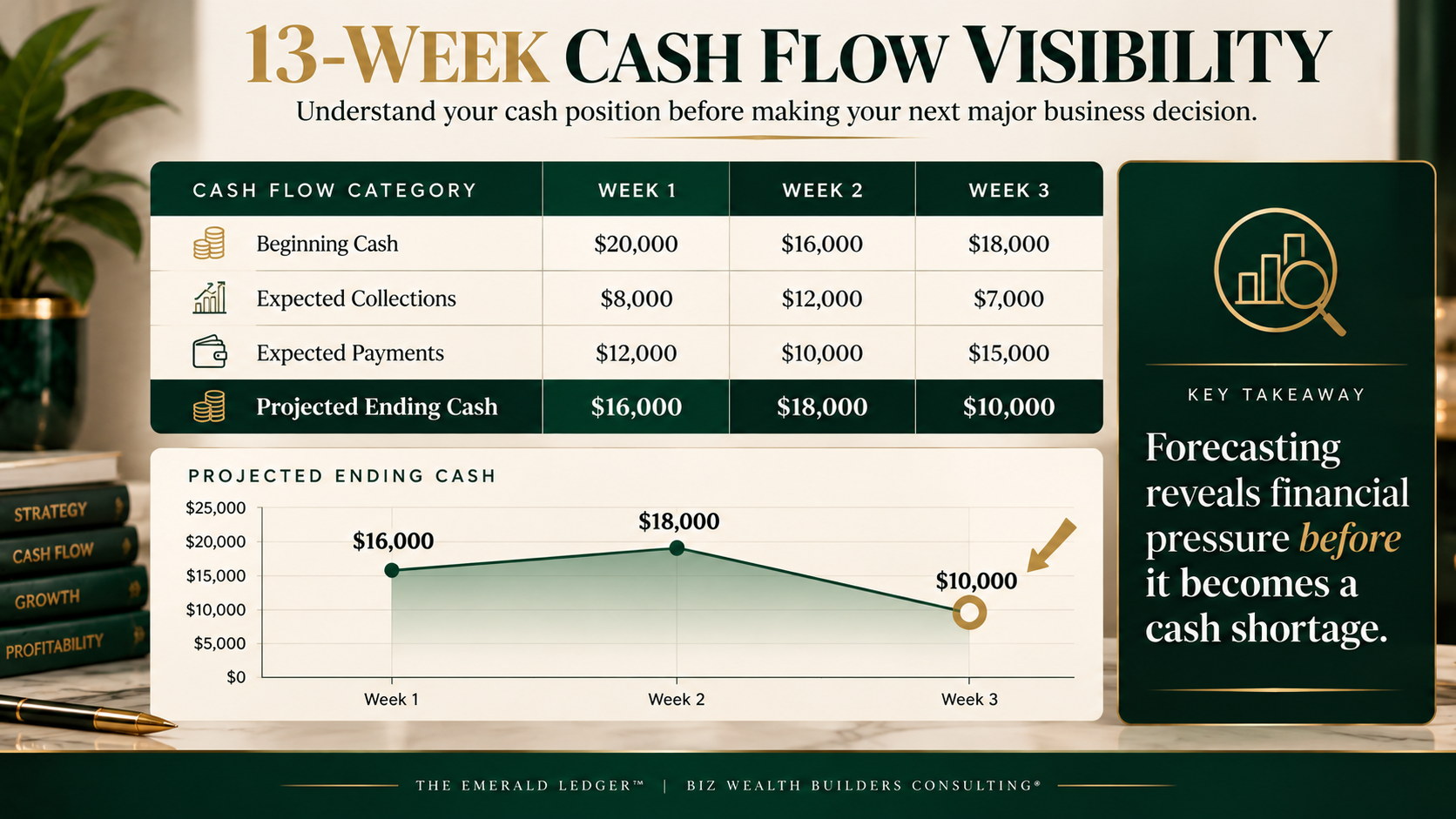
A simple forecast might look like this:
| Cash flow forecast | Week 1 | Week 2 | Week 3 |
|---|---|---|---|
| Beginning cash | $20,000 | $16,000 | $18,000 |
| Expected collections | $8,000 | $12,000 | $7,000 |
| Expected payments | $12,000 | $10,000 | $15,000 |
| Projected ending cash | $16,000 | $18,000 | $10,000 |
Illustrative figures only.
Notice that the business receives cash every week, yet its projected balance declines to $10,000 by Week 3.
Without forecasting, the founder might not recognize that pressure until the cash has already left the account.
Step 5: Test Different Scenarios
A forecast becomes more useful when it helps leadership consider uncertainty.
What happens if your largest client pays 15 days late?
What happens if revenue falls 20% next month?
What happens if contractor costs increase?
What happens if you hire now instead of waiting six weeks?
Scenario planning allows you to examine potential outcomes before making a commitment.
You may discover that an investment is affordable under several reasonable scenarios.
Or you may discover that the business needs additional reserves, faster collections, or a different implementation timeline.
Either outcome improves decision-making.

Cash Flow Forecasting Is Not Just an Accounting Exercise
This is where I believe many growing businesses miss an important opportunity.
They treat cash flow as something to review after the month closes.
But a CEO doesn't only need to understand what happened.
She needs to understand what the business can support next.
Consider three common decisions.
Hiring Another Employee
The question isn't simply whether current revenue can cover the employee's salary.
It's whether projected cash flow can support compensation, payroll taxes, benefits, onboarding, and related costs while maintaining sufficient operating reserves.
Investing in Marketing
A campaign may offer promising returns.
But the business still needs to understand when the marketing expense occurs and when the resulting revenue is likely to become cash.
A profitable investment can create short-term cash pressure if its payback period is longer than expected.
Expanding Service Capacity
Adding new clients can increase revenue while also increasing contractor expenses, software costs, and working capital requirements.
Growth creates financial commitments before all the associated cash is necessarily collected.
A forecast helps leadership evaluate that timing.
These are strategic decisions with financial consequences.
And they require more than checking the bank balance.
Five Warning Signs Your Business Needs Better Cash Flow Visibility
Your business may benefit from a more structured forecasting process if:
-
You regularly check your bank balance before making routine decisions. You have financial data, but limited confidence about future obligations.
-
Revenue is increasing, but available cash remains unpredictable. Collections, expenses, and delivery costs may not be moving in alignment.
-
You delay hiring or investing because you can't determine what is affordable. Uncertainty, rather than a clearly identified financial constraint, is driving decisions.
-
Client payment delays disrupt operations. Your business may be overly dependent on collections arriving at specific times.
-
You cannot confidently explain your expected cash position 30, 60, or 90 days from now. You know where the business stands today, but not what its commitments mean for tomorrow.
These signs don't automatically indicate a failing business.
They indicate areas where better financial visibility may improve leadership decisions.
From Cash Flow Reporting to Financial Visibility™
A cash flow forecast is useful.
But the real value comes from what leadership does with it.
If the forecast shows a potential shortfall, the next question becomes:
What's driving it?
Is the business collecting receivables too slowly?
Are delivery costs increasing?
Is pricing failing to account for the resources required to serve clients?
Are expenses growing faster than sustainable revenue?
Has the company committed to more capacity than current cash flow can support?
These questions connect cash flow to profitability, operations, and decision-making.
That's the foundation of Financial Visibility™.
Not simply knowing how much money is available.
Understanding why the financial position is changing and what that means for the decisions ahead.
Cash Flow Forecasting Is Not Just an Accounting Exercise
This is where I believe many growing businesses miss an important opportunity.
They treat cash flow as something to review after the month closes.
But a CEO doesn't only need to understand what happened.
She needs to understand what the business can support next.
Consider three common decisions.
Hiring Another Employee
The question isn't simply whether current revenue can cover the employee's salary.
It's whether projected cash flow can support compensation, payroll taxes, benefits, onboarding, and related costs while maintaining sufficient operating reserves.
Investing in Marketing
A campaign may offer promising returns.
But the business still needs to understand when the marketing expense occurs and when the resulting revenue is likely to become cash.
A profitable investment can create short-term cash pressure if its payback period is longer than expected.
Expanding Service Capacity
Adding new clients can increase revenue while also increasing contractor expenses, software costs, and working capital requirements.
Growth creates financial commitments before all the associated cash is necessarily collected.
A forecast helps leadership evaluate that timing.
These are strategic decisions with financial consequences.
And they require more than checking the bank balance.
Five Warning Signs Your Business Needs Better Cash Flow Visibility
Your business may benefit from a more structured forecasting process if:
-
You regularly check your bank balance before making routine decisions. You have financial data, but limited confidence about future obligations.
-
Revenue is increasing, but available cash remains unpredictable. Collections, expenses, and delivery costs may not be moving in alignment.
-
You delay hiring or investing because you can't determine what is affordable. Uncertainty, rather than a clearly identified financial constraint, is driving decisions.
-
Client payment delays disrupt operations. Your business may be overly dependent on collections arriving at specific times.
-
You cannot confidently explain your expected cash position 30, 60, or 90 days from now. You know where the business stands today, but not what its commitments mean for tomorrow.
These signs don't automatically indicate a failing business.
They indicate areas where better financial visibility may improve leadership decisions.
From Cash Flow Reporting to Financial Visibility™
A cash flow forecast is useful.
But the real value comes from what leadership does with it.
If the forecast shows a potential shortfall, the next question becomes:
What's driving it?
Is the business collecting receivables too slowly?
Are delivery costs increasing?
Is pricing failing to account for the resources required to serve clients?
Are expenses growing faster than sustainable revenue?
Has the company committed to more capacity than current cash flow can support?
These questions connect cash flow to profitability, operations, and decision-making.
That's the foundation of Financial Visibility™.
Not simply knowing how much money is available.
Understanding why the financial position is changing and what that means for the decisions ahead.

What Should You Do Before Your Next Major Business Decision?
Before approving another hire, increasing your marketing budget, purchasing equipment, or expanding your services, review three things:
Your current financial position. What does your business have available today, after accounting for existing commitments?
Your projected cash position. What do expected collections and payments suggest over the next 13 weeks?
Your operational capacity. Can your team and existing infrastructure support the decision without creating additional financial pressure?
You don't need perfect forecasts.
You need information reliable enough to identify risks, compare options, and make an informed decision.
Because the objective isn't to eliminate every uncertainty from business ownership.
It's to stop making avoidable decisions in the dark.
Visibility Before Velocity™
Growth is important.
But growth without a clear understanding of financial capacity can create new pressure rather than greater freedom.
Before asking whether the business can grow faster, ask whether it can sustainably support what comes next.
That's what cash flow forecasting helps you begin to understand.
And that's why Financial Visibility™ belongs in the executive decision-making process—not just the accounting department.
The goal isn't simply to have cash in the bank. It's to understand what that cash needs to accomplish.
How Visible Is Your Business?
If you're leading a growing service-based business and still find yourself questioning what your company can afford, it may be time to examine the financial and operational information behind those decisions.
The Executive Financial Visibility Assessment™ is designed to help founders and CEOs identify gaps in financial understanding, operational structure, decision-making, and sustainable growth readiness.
Before making your next major move, determine what you need to see more clearly.
Take the Executive Financial Visibility Assessment™
Jasmyn Camp
Founder & CEO, Biz Wealth Builders Consulting®
Financial Visibility™ | Executive Decision-Making | Sustainable Growth