

Why Accurate Financial Reports Are Not Enough to Build Visibility
Jul 20, 2026
Accurate Reporting Answers "What Happened?"
Before we can talk about Financial Visibility™, we have to acknowledge the importance of accurate financial reporting.
Every successful business is built on a strong financial foundation, and that foundation begins with bookkeeping and accounting.
Bookkeeping is often viewed as administrative work—categorizing transactions, reconciling bank accounts, and producing financial reports. Accounting takes those records and organizes them into meaningful financial statements that support compliance, tax preparation, and financial management.
These responsibilities are not optional.
They are essential.
Without accurate bookkeeping, leaders cannot trust the information in front of them. Every decision becomes vulnerable to incomplete records, missing transactions, incorrect balances, or misleading financial reports.
Accurate reporting creates confidence in the numbers.
But confidence in the numbers is not the same as confidence in the decisions.
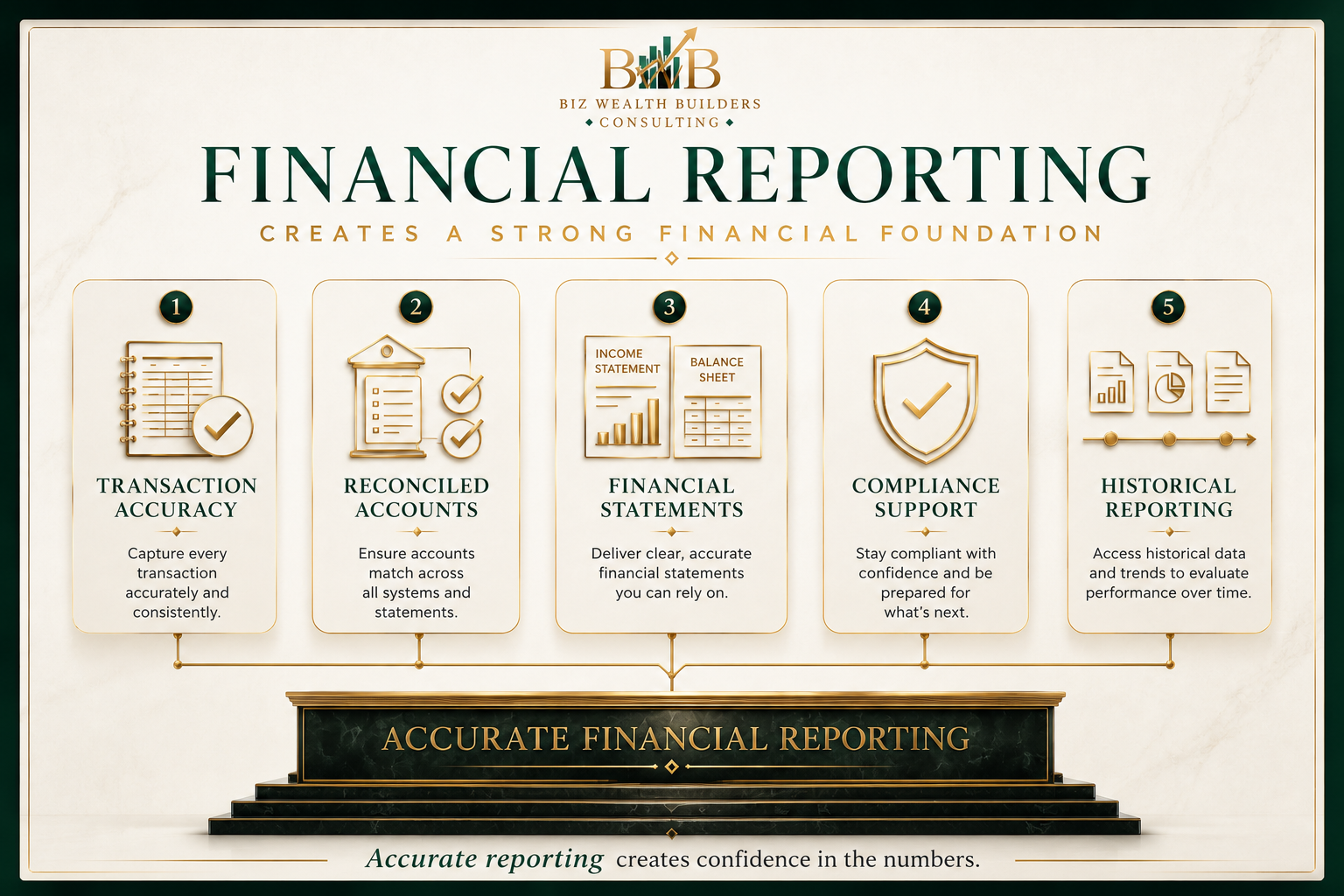
What Accurate Financial Reporting Provides
When your bookkeeping and accounting systems are functioning properly, they provide the financial history of your business.
That foundation includes:
- Transaction Accuracy — Every sale, expense, payroll transaction, and payment is recorded correctly and consistently.
- Reconciled Accounts — Bank accounts, credit cards, loans, and payment processors align with your accounting records, ensuring the information reflects reality.
- Financial Statements — Your Income Statement, Balance Sheet, and Cash Flow Statement provide an organized summary of historical financial performance.
- Compliance Support — Accurate records help support tax filings, payroll reporting, audits, and regulatory requirements.
- Historical Reporting — Financial information is preserved over time, allowing you to compare periods, monitor trends, and understand how your business has performed.
These are the fundamental responsibilities of bookkeeping and accounting.
Without them, a business operates with uncertainty.
The Limitation Most Founders Never Realize
Here's where many business owners unintentionally stop.
Once the books are clean and the reports are available, it's easy to believe the financial side of the business is complete.
After all, the numbers are accurate.
The reports arrive every month.
Everything reconciles.
So why do so many founders still feel uncertain?
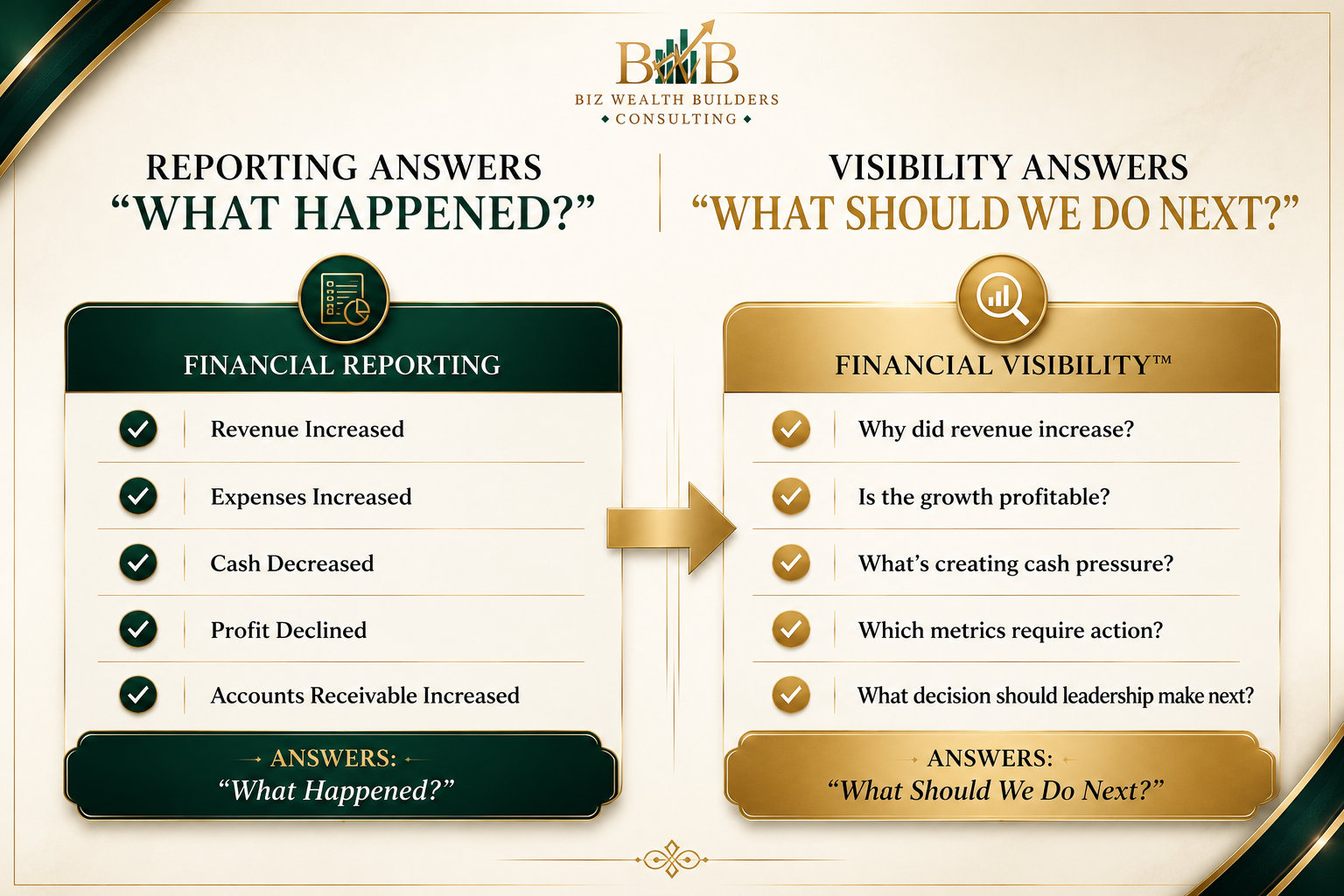
Because historical reporting answers one question exceptionally well:
What happened?
It tells you:
- Revenue increased by 12%.
- Payroll expenses were higher this month.
- Gross profit declined.
- Accounts receivable increased.
- Cash on hand decreased.
Those are valuable insights.
But they don't automatically explain:
- Why revenue increased.
- Whether the growth was actually profitable.
- Which customers or services created the strongest returns.
- Why cash still feels tight despite higher revenue.
- Whether the business is becoming more efficient—or more complex.
- Which decision deserves your attention today.
That is the difference between reporting and visibility.
A perfectly accurate Income Statement may tell you your expenses increased.
It doesn't automatically explain whether those expenses represent strategic investments, operational inefficiencies, poor pricing, unnecessary overhead, or healthy growth.
A Balance Sheet may show that Accounts Receivable has grown significantly.
It doesn't tell you whether your customers are paying later, your invoicing process has broken down, or cash flow problems are quietly developing beneath the surface.
A Cash Flow Statement may confirm that cash declined.
It doesn't tell you whether that decline came from seasonality, hiring, inventory, debt obligations, owner distributions, or an underlying profitability issue.
Historical reporting documents the past.
Leadership requires understanding what the past means for the future.
The Executive Shift
This is where Financial Visibility™ begins.
Financial reporting gives leaders a trustworthy record of the past.
Financial Visibility™ transforms that information into executive awareness.
It helps leaders understand:
- What is happening inside the business.
- Why it is happening.
- What deserves immediate attention.
- Which opportunities are emerging.
- Which risks require action.
- What decision should come next.
The goal isn't simply to produce accurate reports.
The goal is to help leaders make better decisions because they understand the story those reports are telling.
That is the difference between having financial information and leading with Financial Visibility™.
Financial Visibility Answers "What Does It Mean?"
Once your financial records are accurate, a different question begins to emerge.
It's no longer:
"Are the numbers correct?"
Instead, it becomes:
"What are these numbers telling me about my business?"
This is where many founders unintentionally reach the limits of traditional financial reporting.
Their bookkeeping is current.
Their accounts are reconciled.
Their financial statements are accurate.
Yet every important decision still feels heavier than it should.
They have information.
But they don't yet have interpretation.
That is the difference between financial reporting and Financial Visibility™.
Financial reporting organizes the numbers.
Financial Visibility™ transforms those numbers into executive awareness.
It bridges the gap between knowing what happened and understanding what leadership should do next.
Because financial statements were never designed to make decisions for you.
They were designed to record history.
Leadership requires something more.
Leadership requires context.
It requires recognizing patterns before they become problems.
It requires understanding relationships between revenue, profitability, cash flow, operations, and strategic priorities.
It requires seeing the business as an interconnected system rather than a collection of financial reports.
When founders develop Financial Visibility™, they stop simply reviewing reports.
They begin leading from them.
Financial Visibility™ Changes the Questions You Ask
Instead of asking:
"How much revenue did we generate?"
You begin asking:
"What is actually driving revenue growth?"
Which products, services, customers, or pricing decisions are creating sustainable revenue?
Which are creating activity without meaningful profitability?
Revenue alone rarely tells the complete story.
Financial Visibility™ helps you understand where growth is coming from—and whether that growth is healthy.
Healthy Revenue Doesn't Always Mean Healthy Profitability
Many businesses experience increasing revenue while simultaneously experiencing declining margins.
More sales.
More clients.
More activity.
Yet somehow there is less cash available, more operational pressure, and greater uncertainty around future decisions.
Why?
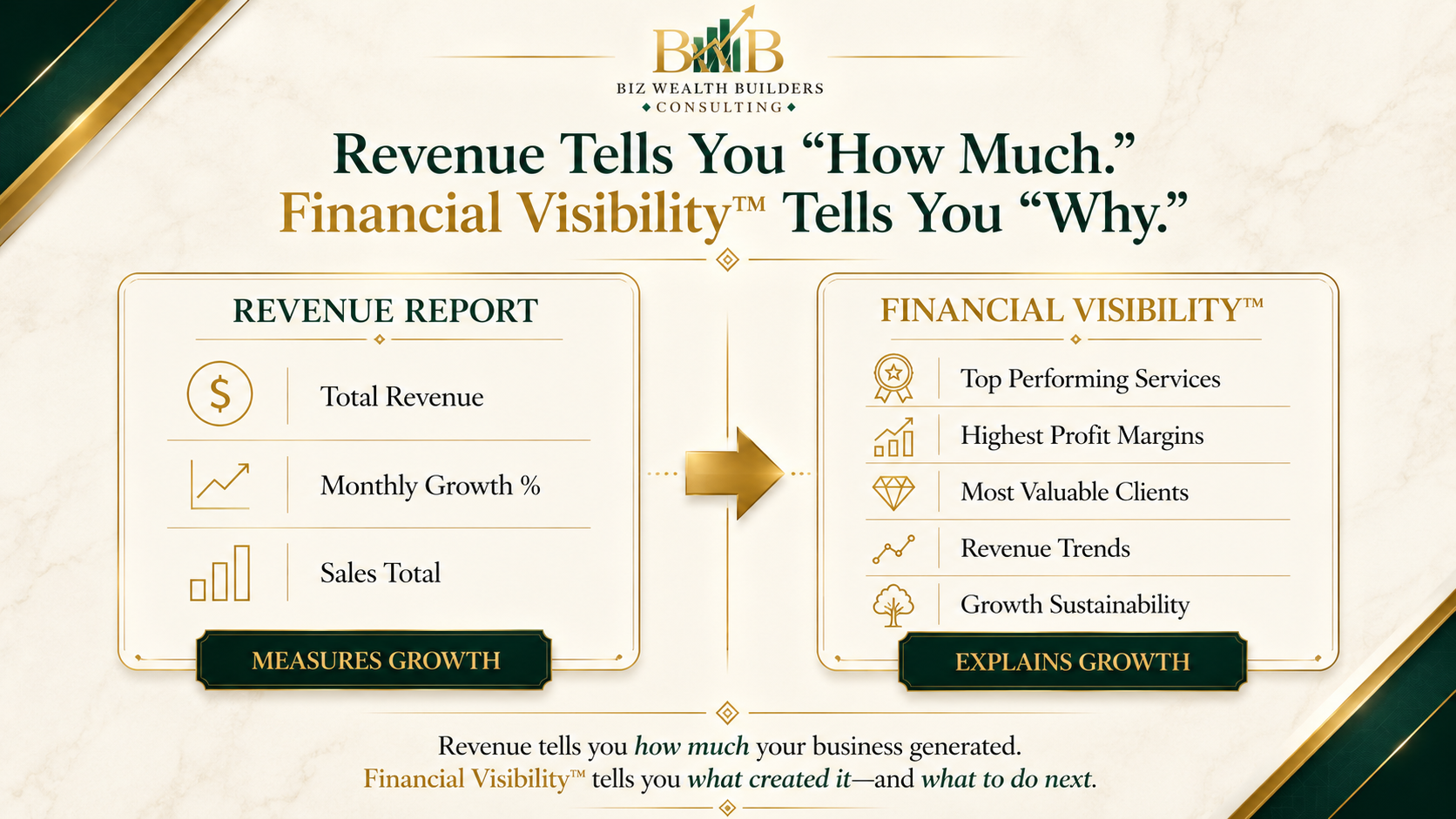
Because revenue tells you how much came into the business.
It doesn't automatically explain how efficiently the business generated it.
Financial Visibility™ helps founders identify:
- Which services generate the strongest margins.
- Which clients create the highest long-term value.
- Which offers consume the most time and resources.
- Whether growth is improving profitability—or quietly reducing it.
A growing business should create greater opportunity.
Not greater confusion.
Follow the Money
One of the most common questions founders ask is:
"We're making more money...so why does cash still feel tight?"
Cash rarely disappears without a reason.
It moves.
Sometimes it moves into inventory.
Sometimes into payroll.
Sometimes into marketing.
Sometimes into debt payments.
Sometimes into inefficient operations.
Sometimes into slow-paying customers.
Financial Visibility™ helps you understand where cash is being absorbed before it becomes a crisis.
Instead of reacting to cash shortages after they occur, you begin recognizing the financial patterns creating pressure.
Because cash flow problems rarely appear overnight.
They develop gradually.
Visibility allows you to see them earlier.

Every Expense Should Support a Strategic Priority
Expenses are not inherently good or bad.
They are investments.
The real question is whether those investments are producing meaningful business outcomes.
Financial Visibility™ encourages founders to move beyond asking:
"How much did we spend?"
Instead, they begin asking:
- Which expenses are producing measurable returns?
- Which investments are improving profitability?
- Which operational costs are increasing without improving performance?
- Which recurring expenses no longer align with our priorities?
Not every expense deserves to remain in the business simply because it has always been there.
Visibility creates permission to evaluate spending through the lens of strategy rather than habit.
Patterns Always Appear Before Problems
Most business challenges don't arrive without warning.
Margin erosion.
Cash pressure.
Operational bottlenecks.
Founder overwhelm.
Decision fatigue.
They all leave clues.
Financial Visibility™ helps founders recognize those clues while there is still time to respond.
Rather than discovering problems after they have become expensive, leaders begin identifying patterns while solutions are still relatively simple.
That shift alone changes the quality of executive decision-making.
Growth Requires Operational Capacity
Revenue growth is exciting.
But growth without operational capacity creates pressure.
Every new client.
Every additional employee.
Every new service.
Every expansion.
Adds complexity.
Financial Visibility™ helps leaders evaluate whether the business has the operational infrastructure required to support continued growth.
Questions become:
- Can our current systems support more customers?
- Is our team operating efficiently?
- Are reporting processes keeping pace with growth?
- Do we have the visibility needed to lead a larger organization?
Growth should strengthen the business.
Not expose hidden weaknesses.
The Executive Shift
Financial reporting tells you where your business has been.
Financial Visibility™ helps you understand where your business is today—and where it is capable of going tomorrow.
It transforms financial information into executive awareness.
It helps you recognize opportunities before they disappear.
Identify risks before they become expensive.
Allocate resources with greater confidence.
Lead with intention instead of reaction.
Because the most effective CEOs aren't simply reviewing reports.
They're interpreting patterns.
Connecting information.
Making informed decisions.
And building businesses that become stronger with every stage of growth.
That is the difference between having financial information and leading with Financial Visibility™.
Five Signs Your Financial Reports Are Accurate—But Your Visibility Is Still Low
One of the biggest misconceptions in business is believing that accurate financial reports automatically create confident decision-making.
They don't.
In fact, many founders receive clean financial statements every month and still feel overwhelmed by the decisions sitting on their desk.
They have the information.
They simply haven't developed the visibility needed to interpret it.
Financial Visibility™ isn't measured by whether your reports reconcile.
It's measured by whether your reports help you lead.
If any of the following situations sound familiar, your business may not have an accounting problem.
It may have a visibility problem.
1. You Receive Financial Reports—but Rarely Use Them to Make Decisions
Your bookkeeper sends the monthly reports.
You glance at the Income Statement.
Maybe you review the Balance Sheet.
Then you file them away until next month.
The reports exist.
The numbers are accurate.
But they rarely influence the decisions you make as a leader.
Instead, hiring decisions, pricing changes, marketing investments, and operational priorities continue to be based on urgency, intuition, or immediate circumstances rather than meaningful financial insight.
Financial reports should become part of your leadership process—not simply another document in your inbox.
When Financial Visibility™ improves, reports stop being historical records.
They become executive decision-making tools.

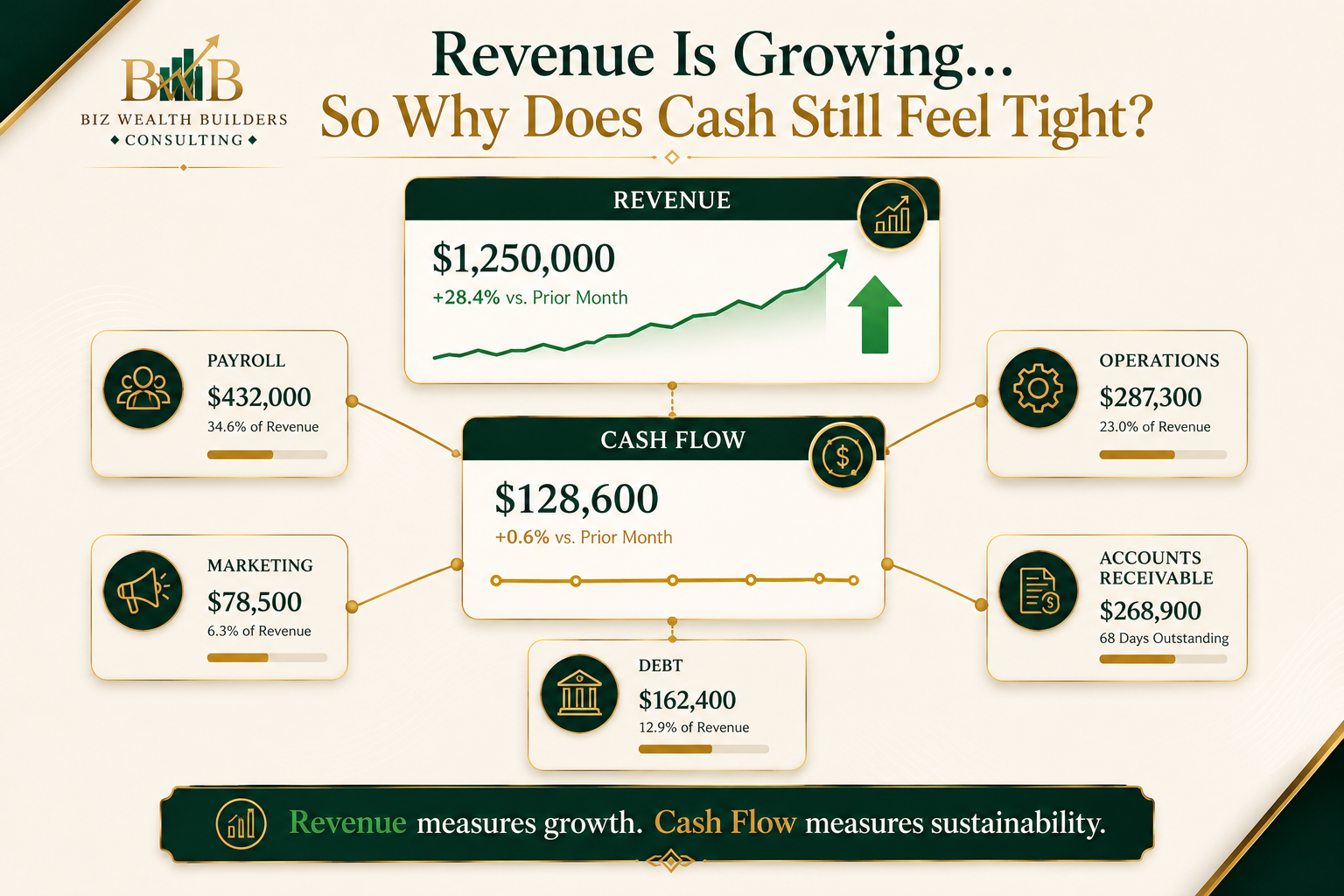
2. Revenue Is Increasing—but Cash Pressure Remains
Revenue growth should feel exciting.
Instead, many founders experience something completely different.
Sales are increasing.
The business is busier than ever.
New clients continue arriving.
Yet payroll feels tighter.
Cash always seems stretched.
And every unexpected expense creates stress.
This disconnect often surprises founders.
"If revenue is growing," they ask, "why doesn't it feel like we're making progress?"
Because revenue tells you how much money came into the business.
It doesn't automatically explain:
- How profitable that revenue is.
- How quickly customers are paying.
- Whether operating expenses are growing faster than sales.
- Whether cash is being absorbed somewhere inside the business.
Financial Visibility™ helps founders move beyond celebrating revenue and begin understanding cash behavior.
Because businesses don't fail from a lack of revenue alone.
Many struggle because they never understood where their cash was going.
3. You Cannot Quickly Explain What Is Driving Profitability
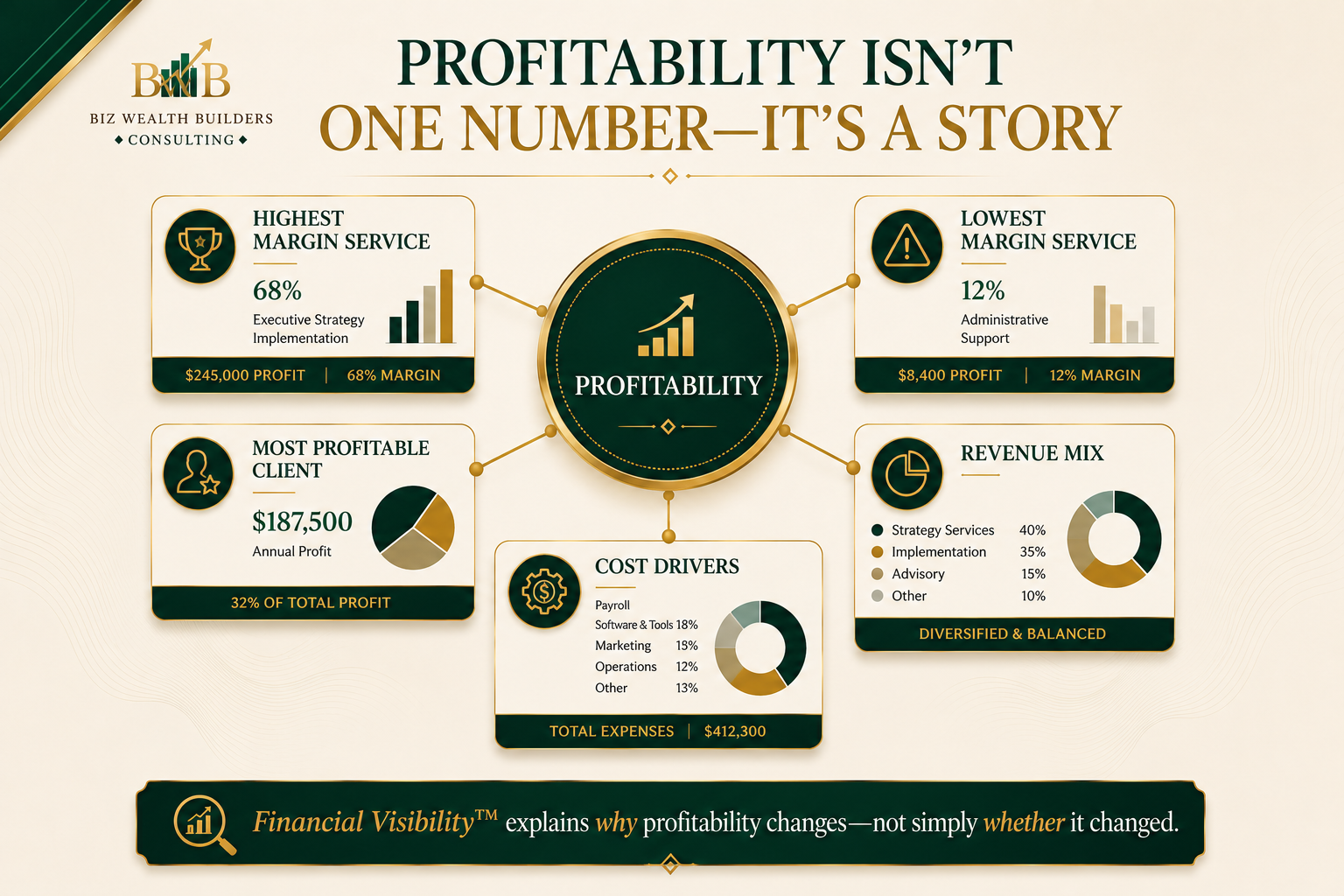
Most founders know their monthly revenue.
Far fewer can immediately answer questions like:
- Which service generates the highest margins?
- Which client relationships are most profitable?
- Which products consume the most resources?
- Which part of the business creates the greatest return?
Profitability is more than knowing whether you made money.
It's understanding why you made money.
Without Financial Visibility™, profitability becomes a number.
With Financial Visibility™, profitability becomes a strategic conversation.
When leaders understand what drives profit, they can confidently invest more resources into what creates the greatest long-term value—and stop investing in activities that simply create busyness without meaningful returns.
4. You Make Hiring, Pricing, or Investment Decisions Primarily from Instinct
Experience matters.
Intuition matters.
Leadership instincts are valuable.
But intuition should support financial visibility—not replace it.
Many founders eventually reach a point where the business becomes too complex to rely on instinct alone.
Hiring another employee.
Increasing prices.
Launching a new service.
Investing in technology.
Expanding operations.
Each decision carries financial consequences.
Without meaningful visibility, those decisions become educated guesses rather than informed strategies.
Financial Visibility™ provides the confidence to ask:
- Can the business truly support this investment?
- What financial outcome are we expecting?
- What indicators will tell us if the decision is working?
- How will we measure success?
The goal isn't to eliminate instinct.
The goal is to strengthen instinct with meaningful financial insight.

5. Financial Conversations Happen After a Problem Appears—Not Before
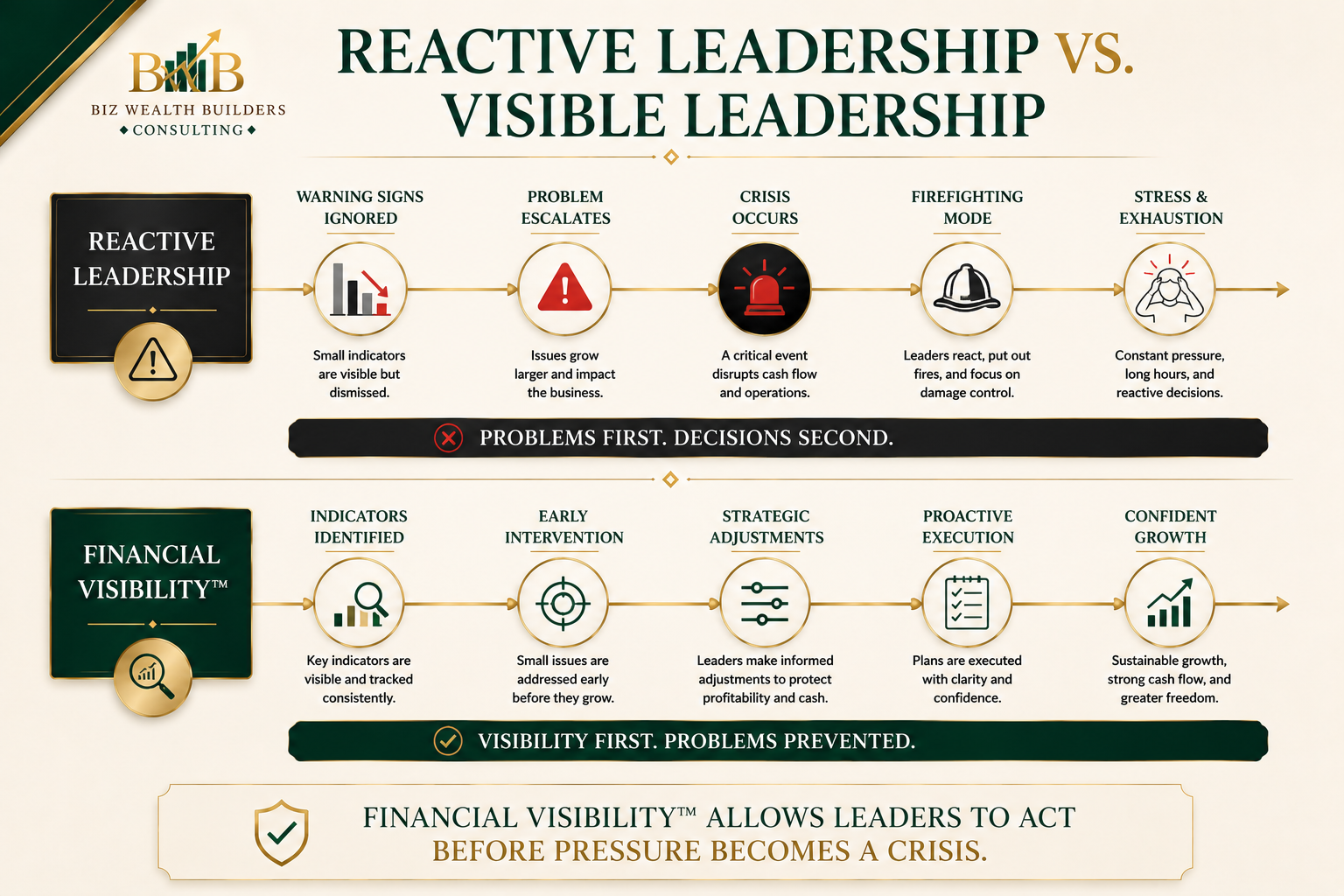
One of the clearest indicators of low Financial Visibility™ is timing.
Most financial conversations begin after something has already gone wrong.
Cash becomes tight.
Profit declines.
Expenses increase.
Margins shrink.
Growth slows.
Leadership responds.
But by then, the opportunity to prevent the problem has already passed.
Financial Visibility™ changes the timing of leadership conversations.
Instead of reacting to problems, founders begin recognizing patterns while they are still small.
Because every major business challenge leaves clues before it becomes a crisis.
Visibility helps leaders recognize those clues early enough to respond with confidence rather than urgency.
That is the difference between managing problems and preventing them.
The Executive Reflection
Reading these five signs isn't about identifying weaknesses.
It's about recognizing opportunities.
Most founders aren't struggling because they lack discipline.
They aren't struggling because they don't care about their business.
They're struggling because growth has quietly increased the complexity of leadership.
The reports are accurate.
The numbers are available.
But leadership requires more than access to information.
It requires understanding what the information is trying to tell you.
That is why Financial Visibility™ is not another financial report.
It is a leadership capability.
And like every leadership capability, it can be intentionally developed.
Why This Gap Becomes More Expensive as Your Business Grows
One of the greatest misconceptions about business growth is believing that success naturally makes leadership easier.
It doesn't.
Growth creates opportunity.
It creates momentum.
It creates new possibilities.
But it also introduces something many founders underestimate:
Complexity.
Every new client.
Every new employee.
Every new service.
Every new system.
Every new market.
Every new investment.
Adds another layer of decision-making.
The business that once felt simple and predictable gradually becomes more interconnected.
What was once manageable through instinct alone begins requiring stronger systems, better information, and greater visibility.
That is why so many founders describe growth as both exciting and exhausting.
The business is succeeding.
Yet leadership somehow feels heavier than it did before.
The reason isn't growth itself.
The reason is that visibility hasn't grown alongside it.
Growth does not create the visibility problem.
It reveals where visibility has not kept pace.
That distinction changes everything.
The pressure you're experiencing may not be a sign that growth is failing.
It may simply be evidence that your leadership systems have not evolved at the same pace as your business.
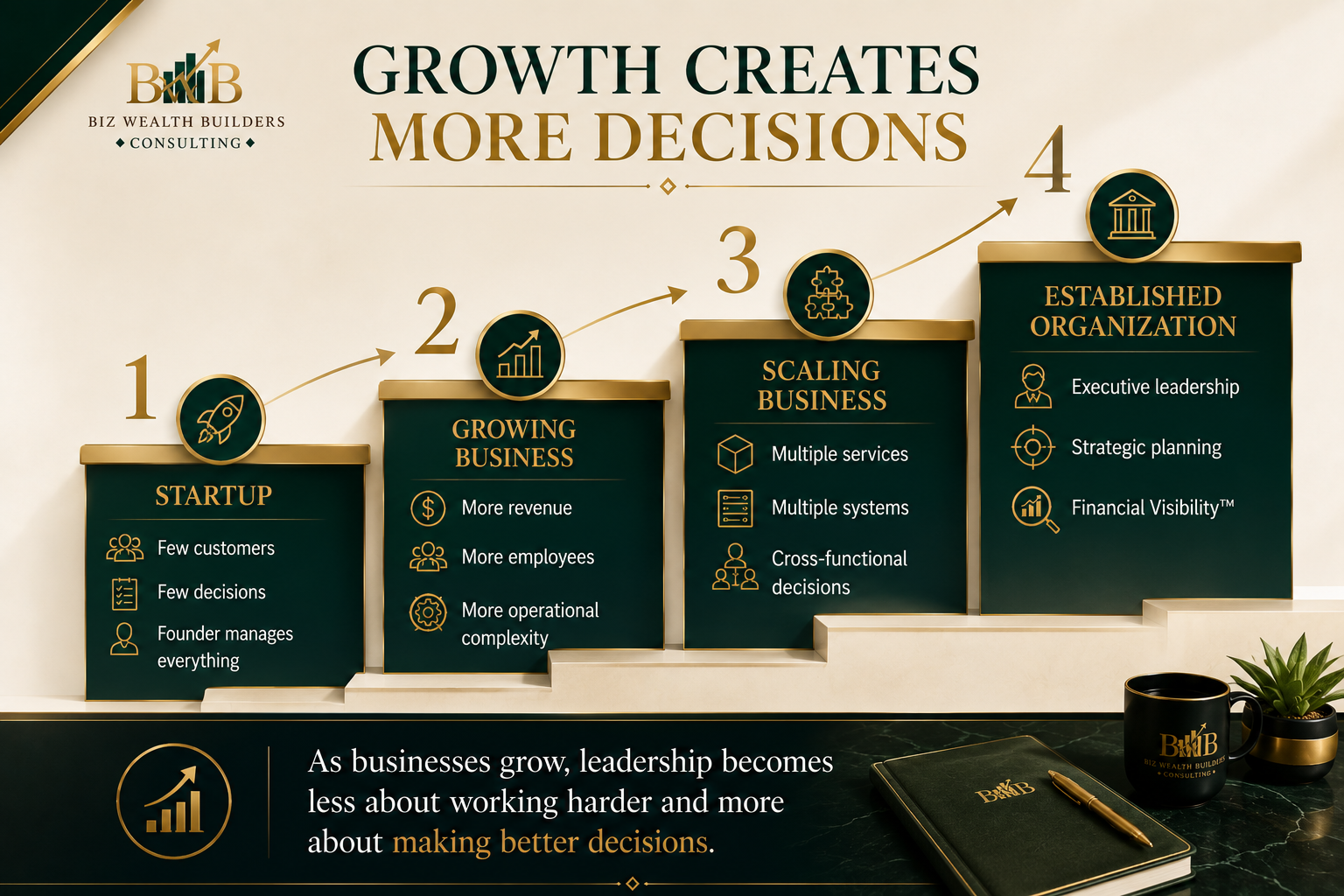
Every New Stage of Growth Creates More Decisions
In the early stages of business, decisions are relatively straightforward.
You know every customer.
You approve every expense.
You understand every project.
The business operates largely from memory and instinct.
As the business grows, that changes.
Instead of making five important decisions each week, you may find yourself making fifty.
Should we hire another employee?
Can we increase payroll?
Is this client profitable?
Should we invest in new technology?
Can we expand into another market?
Should prices increase?
Can operations support more demand?
Each decision carries financial consequences.
And each decision becomes more difficult when leaders lack meaningful visibility into how the business is performing.
Growth doesn't simply increase activity.
It multiplies the number of decisions that shape the future of the business.
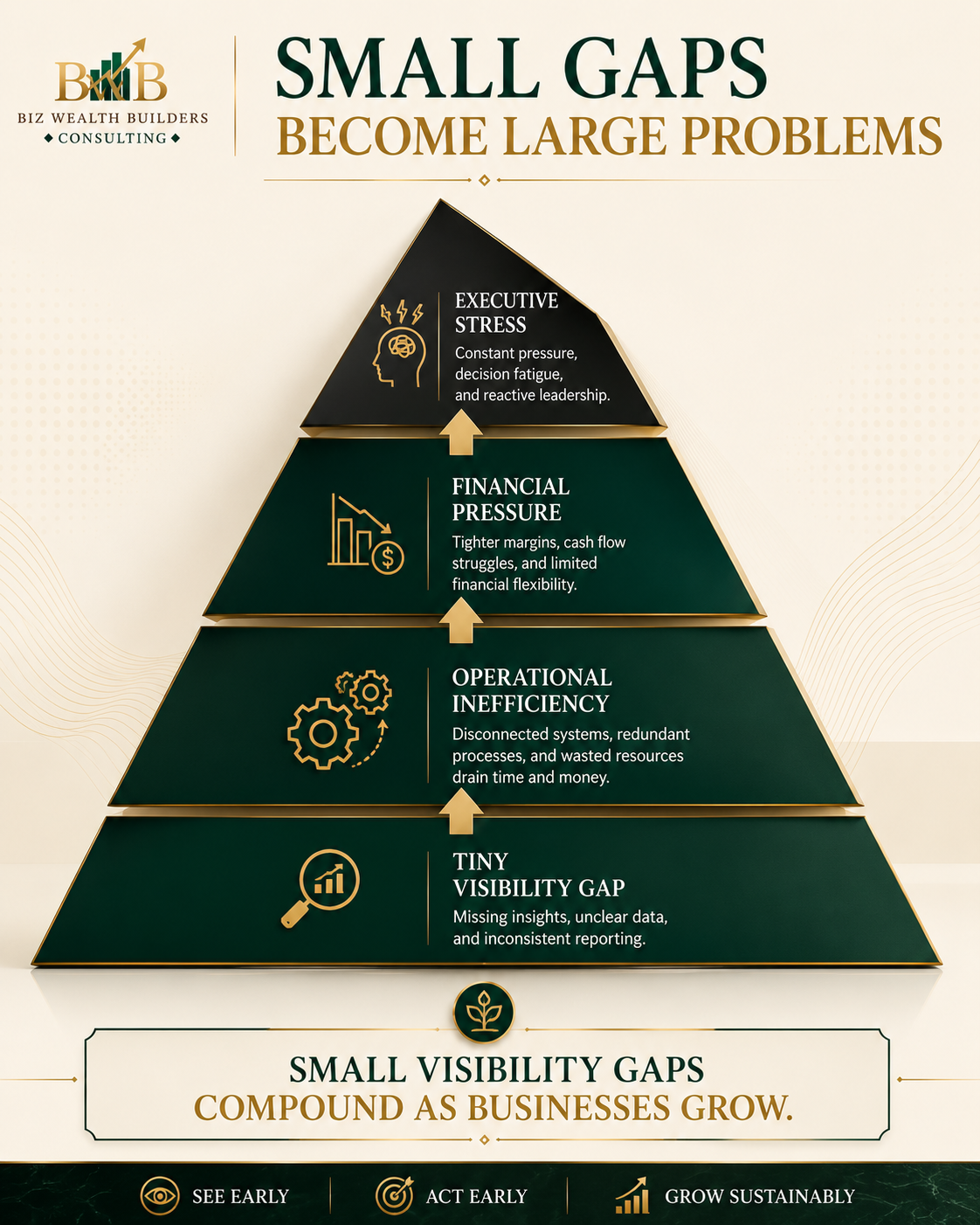
Small Problems Become Expensive Problems
One overlooked expense.
A slightly declining margin.
A few slow-paying customers.
An inefficient process.
One unnecessary subscription.
None of these issues seem significant on their own.
But business growth has a way of amplifying everything.
A small pricing problem affecting ten clients becomes a major profitability issue affecting one hundred.
A minor operational inefficiency repeated thousands of times becomes a substantial financial drain.
A small reporting delay becomes a leadership bottleneck as more people depend on timely information.
Growth magnifies both strengths and weaknesses.
It rewards strong systems.
And it exposes weak ones.
Financial Visibility™ allows founders to recognize these small patterns before they quietly become expensive business problems.
Operational Inefficiencies Rarely Stay Small
As organizations expand, inefficiencies begin multiplying across every department.
A manual process becomes dozens of hours each month.
Communication delays affect multiple teams.
Incomplete reporting slows decision-making.
Poor workflows reduce profitability.
Founder dependency prevents delegation.
What once felt manageable becomes increasingly expensive—not because the work changed, but because the business became larger.
Financial Visibility™ helps leaders identify these inefficiencies before they become embedded into the way the organization operates.
Because every inefficient system eventually becomes a financial issue.
Cash Commitments Become Larger—and Less Forgiving
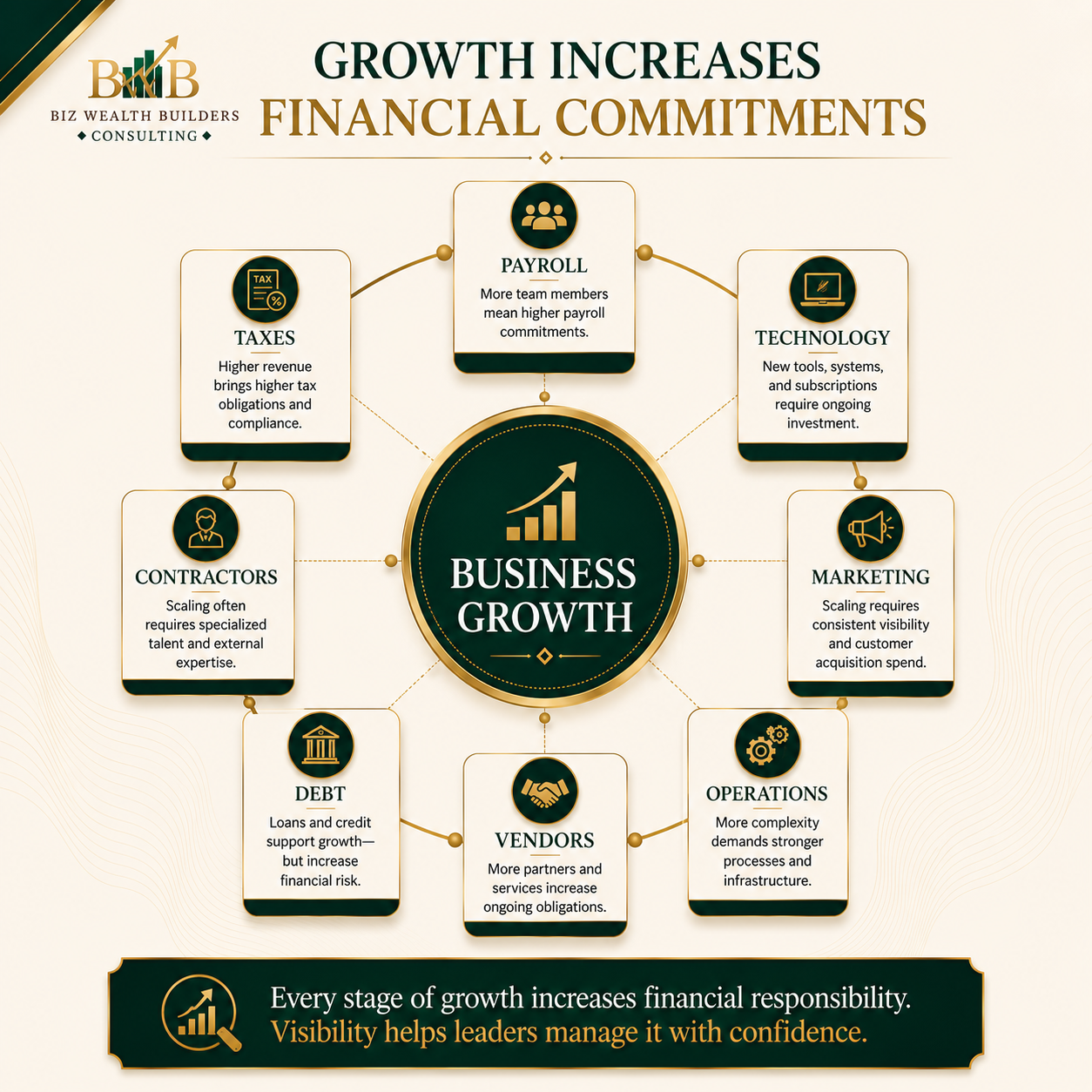
Growth usually increases financial obligations.
Higher payroll.
Larger software investments.
Additional office expenses.
Inventory.
Equipment.
Marketing.
Contractors.
Debt.
The business now has more people depending on every financial decision.
Which means cash management becomes increasingly important.
Without Financial Visibility™, founders often discover cash pressure only after payroll approaches or major expenses become due.
With Financial Visibility™, cash becomes something leaders actively manage rather than something they react to.
That difference protects both the business and the people who depend on it.
Founder Intuition Has Limits
One of the greatest strengths of an entrepreneur is intuition.
It helps founders move quickly.
Recognize opportunities.
Solve problems creatively.
Build something from nothing.
But intuition becomes increasingly difficult to rely on as complexity grows.
When the business served ten customers, intuition may have been enough.
When it serves hundreds—or thousands—leaders need more than instinct.
They need evidence.
Patterns.
Reliable reporting.
Operational insight.
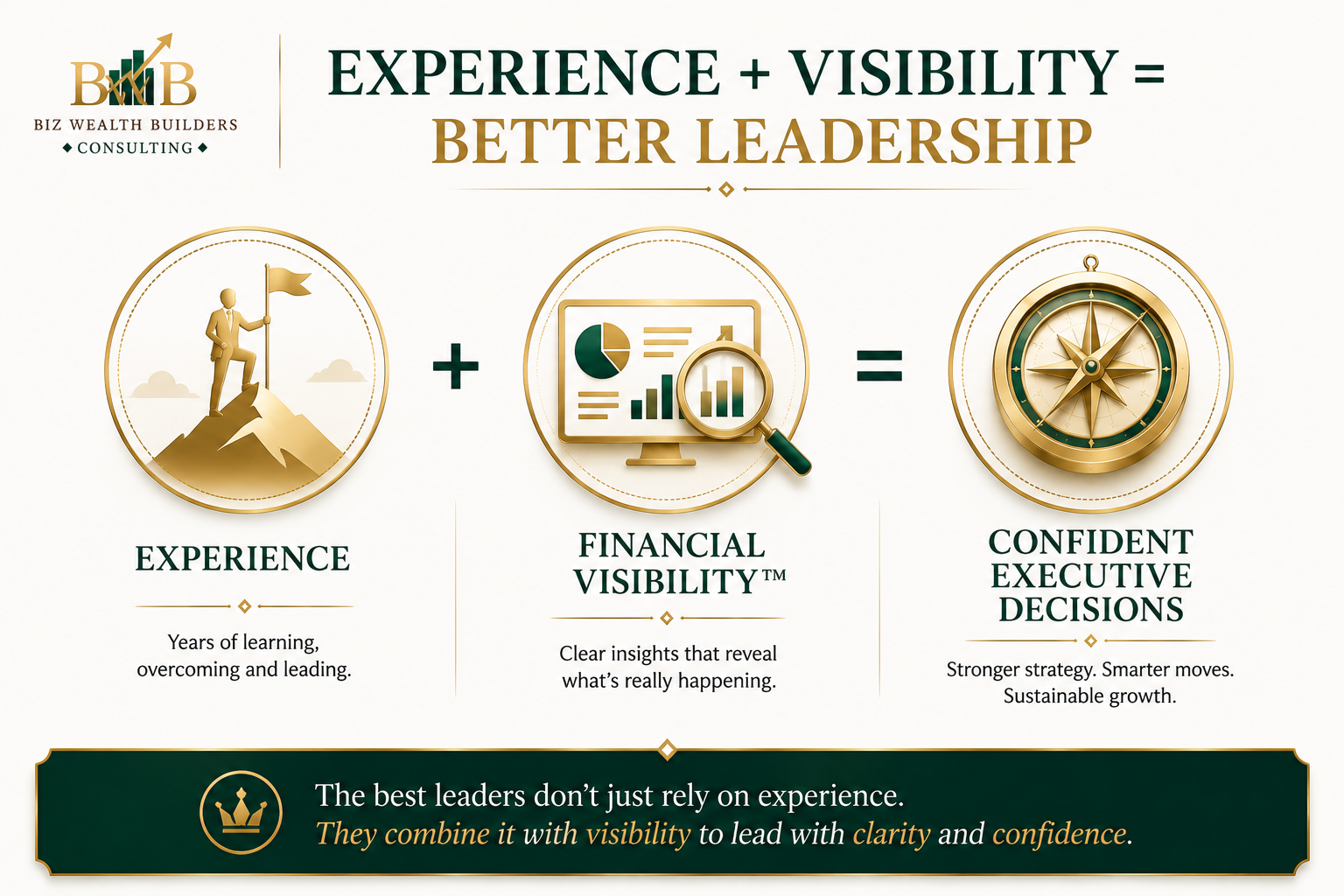
Financial Visibility™ doesn't replace intuition.
It strengthens it.
The best executive decisions combine experience with meaningful information.
Great leaders don't stop trusting their instincts.
They simply stop asking instinct to carry the entire weight of leadership alone.
Delayed Decisions Become More Expensive
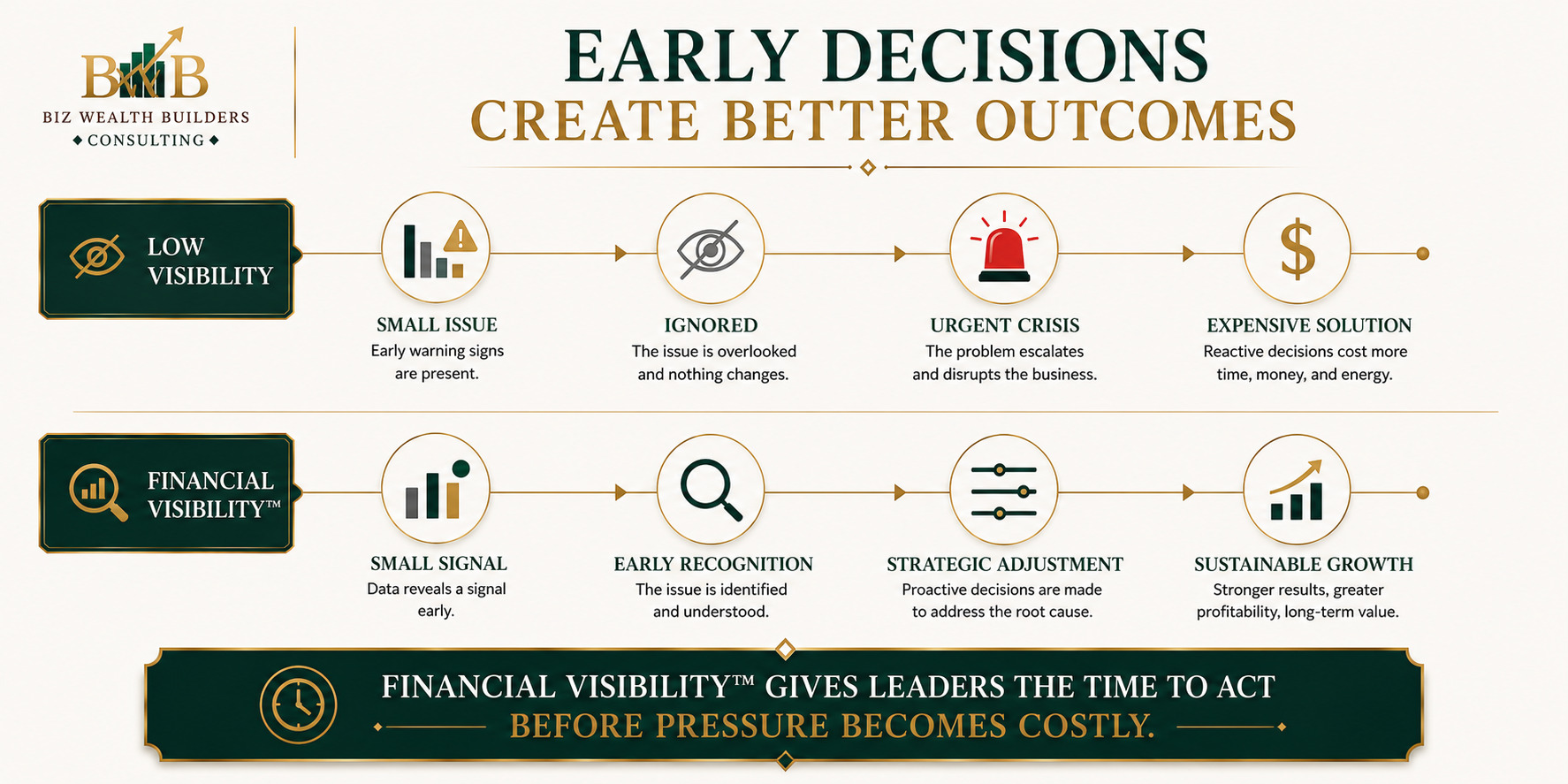
One of the hidden costs of low visibility isn't making poor decisions.
It's making decisions too late.
The longer leaders wait to recognize financial patterns, operational issues, or emerging risks, the fewer options they have available.
What begins as a small pricing adjustment eventually requires a major restructuring.
A manageable staffing issue becomes widespread burnout.
Minor cash pressure becomes an urgent financing need.
Visibility gives leaders time.
Time to prepare.
Time to adjust.
Time to respond before urgency replaces strategy.
Because leadership is rarely measured by how well you solve crises.
It is measured by how effectively you prevent them.
The Executive Shift
Growth isn't what makes leadership difficult.
Complexity does.
Every stage of growth introduces more moving parts, more financial commitments, more operational decisions, and more opportunities for small issues to become expensive ones.
That is why businesses cannot rely on the same level of visibility they had when they were smaller.
Leadership must evolve.
Reporting must evolve.
Decision-making must evolve.
Financial Visibility™ is how leaders evolve with them.
Because the businesses that scale most successfully are not the ones that experience fewer problems.
They are the ones that recognize important patterns earlier, make better decisions faster, and build systems that allow growth to become more sustainable over time.
Remember:
Growth does not create the visibility problem.
It reveals where visibility has not kept pace.
And once leaders recognize that truth, they stop chasing more information.
They begin building greater visibility.
What Financial Visibility™ Looks Like in Practice
By now, we've established an important truth:
Accurate financial reporting is essential.
But accurate reporting alone doesn't automatically create confident leadership.
The next question becomes:
If Financial Visibility™ is more than financial reports, what does it actually look like inside a business?
Many founders assume Financial Visibility™ means having more dashboards, more reports, or more data.
It doesn't.
In fact, one of the biggest misconceptions in business is believing that more information automatically leads to better decisions.
It rarely does.
Financial Visibility™ isn't about collecting more data.
It's about creating the clarity needed to consistently make better decisions.
When Financial Visibility™ becomes part of the way a business operates, leaders stop searching for answers every time an important decision needs to be made.
Instead, they develop systems that continually provide the right information, at the right time, in the right context.
Financial Visibility™ transforms information into awareness, awareness into confidence, and confidence into better leadership.
So what does that actually look like?
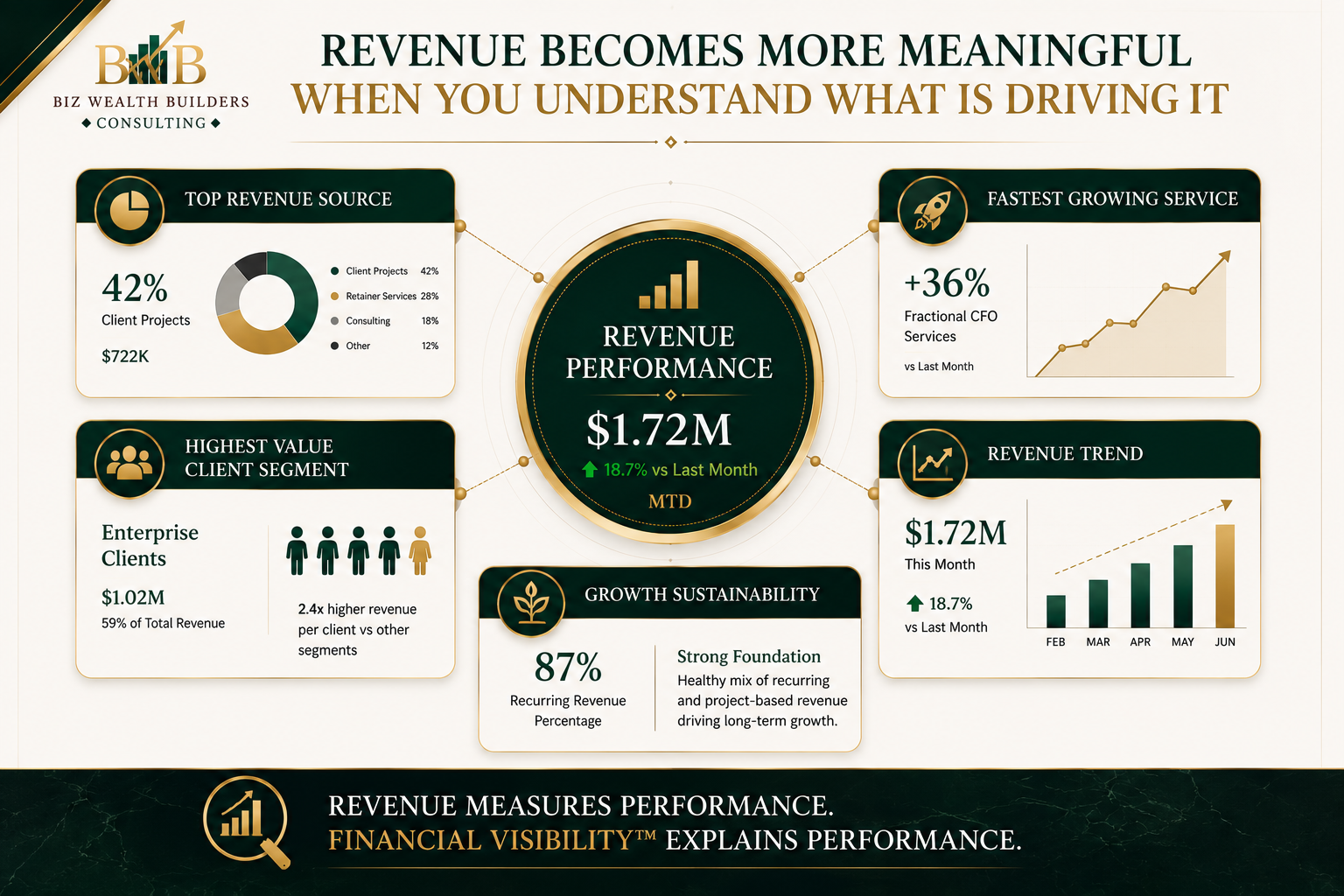
A Clear View of Revenue Performance
Revenue is one of the first numbers founders look at.
And for good reason.
Revenue tells you whether the business is growing.
But Financial Visibility™ goes beyond asking:
"How much revenue did we generate?"
Instead, leaders begin asking:
- Which services are producing the healthiest growth?
- Which customers create the greatest long-term value?
- Which revenue streams are becoming less profitable?
- Are we growing sustainably or simply becoming busier?
Growth should never be evaluated by revenue alone.
Financial Visibility™ provides the context behind the numbers so leaders understand why growth is happening—not just that it happened.
Reliable Profitability Analysis
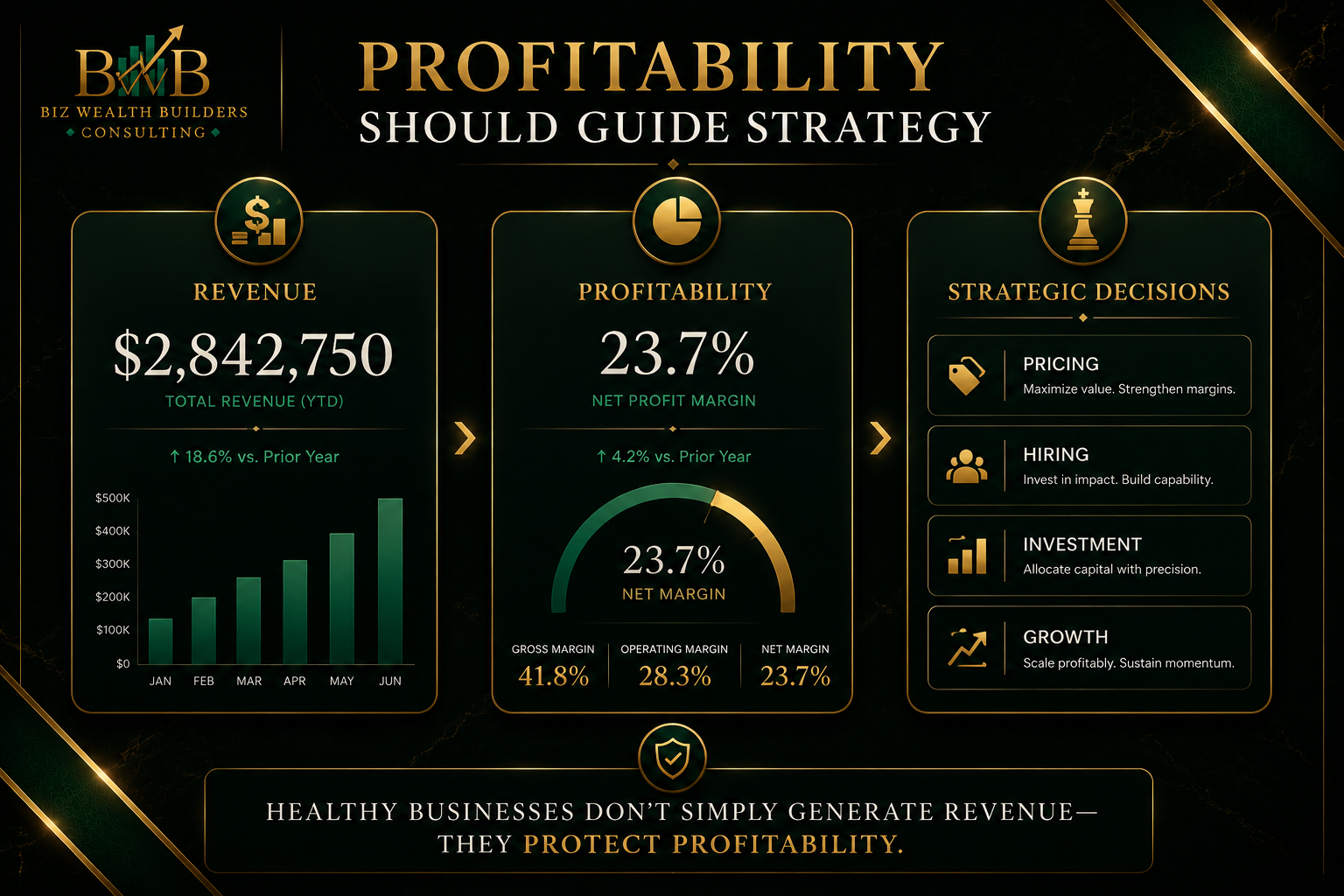
Profitability is where many business decisions either create momentum or quietly destroy it.
Two businesses can generate the same revenue while producing completely different financial outcomes.
Why?
Because profitability is influenced by pricing, delivery costs, operational efficiency, overhead, and resource allocation.
Financial Visibility™ helps leaders move beyond simply asking whether the business is profitable.
Instead, they understand:
- Which services generate the strongest margins.
- Which clients consume the most resources.
- Which investments improve profitability.
- Where profit is quietly leaking from the business.
When profitability becomes visible, pricing decisions become more confident, investments become more strategic, and growth becomes healthier.
Cash Flow Becomes Predictable
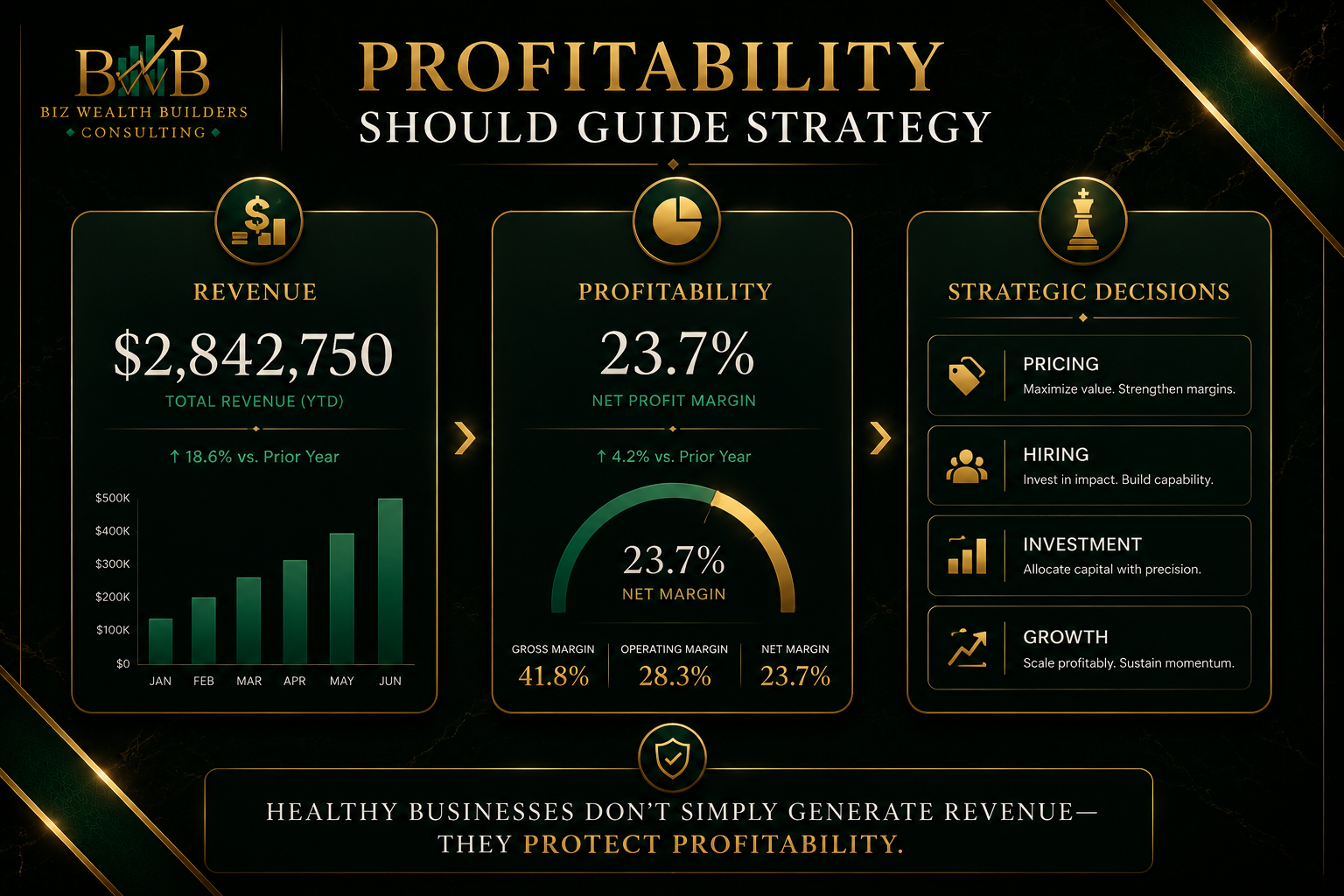
Cash flow should never feel mysterious.
Yet many founders describe cash as one of the most unpredictable parts of running a business.
Financial Visibility™ changes that.
Instead of wondering why cash feels tight, leaders understand:
- Where cash is coming from.
- Where cash is going.
- Which commitments are approaching.
- Which trends require attention.
- Which decisions may affect future liquidity.
Cash becomes something leaders actively manage—not something they react to.
Because sustainable businesses don't wait for cash problems to appear.
They recognize them while solutions are still available.
Cash Flow Becomes Predictable
Cash flow should never feel mysterious.
Yet many founders describe cash as one of the most unpredictable parts of running a business.
Financial Visibility™ changes that.
Instead of wondering why cash feels tight, leaders understand:
- Where cash is coming from.
- Where cash is going.
- Which commitments are approaching.
- Which trends require attention.
- Which decisions may affect future liquidity.
Cash becomes something leaders actively manage—not something they react to.
Because sustainable businesses don't wait for cash problems to appear.
They recognize them while solutions are still available.
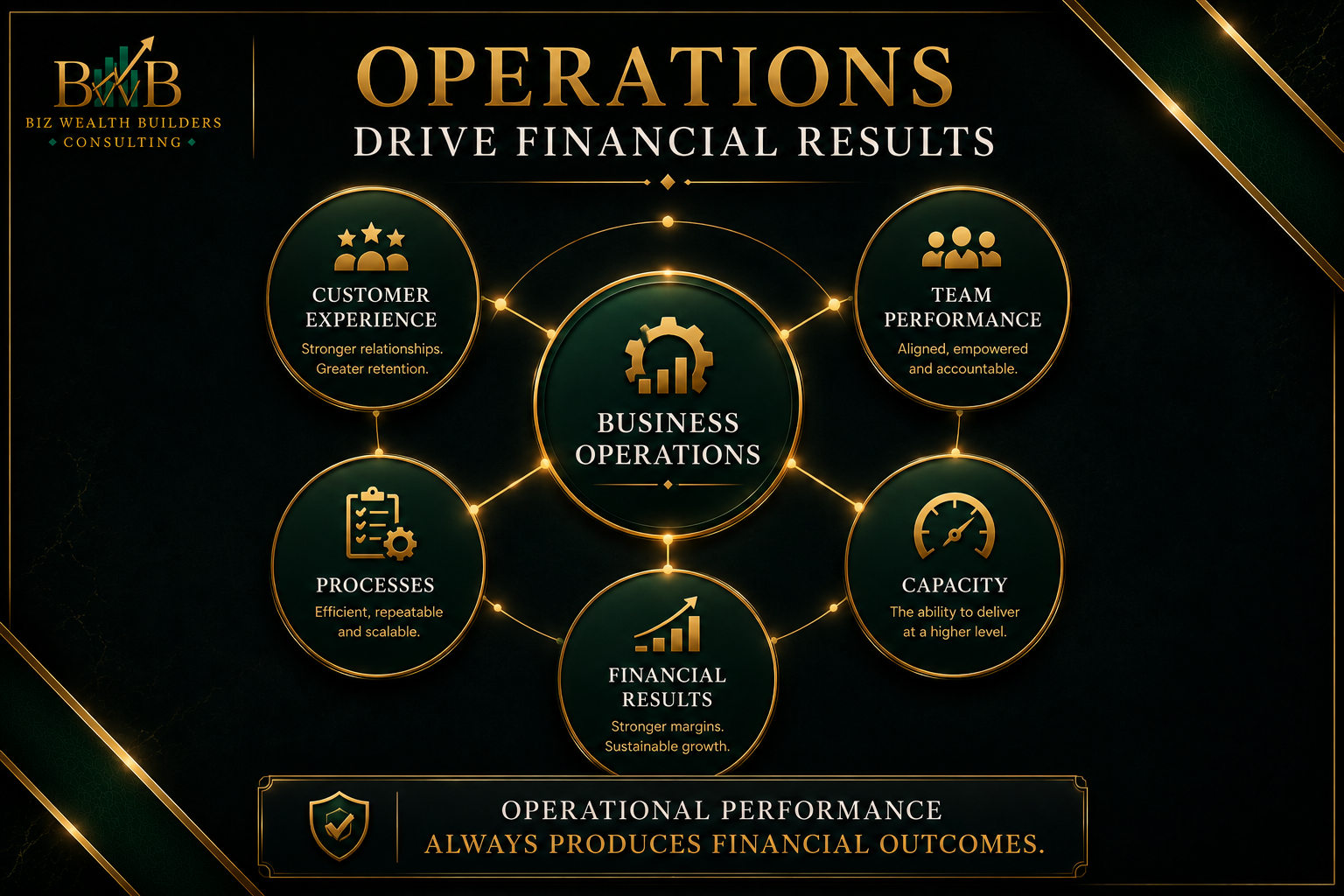
Operational Performance Is Connected to Financial Outcomes
Operations and finance should never exist in separate conversations.
Every operational decision eventually produces a financial result.
Hiring.
Delivery.
Capacity.
Technology.
Customer experience.
Efficiency.
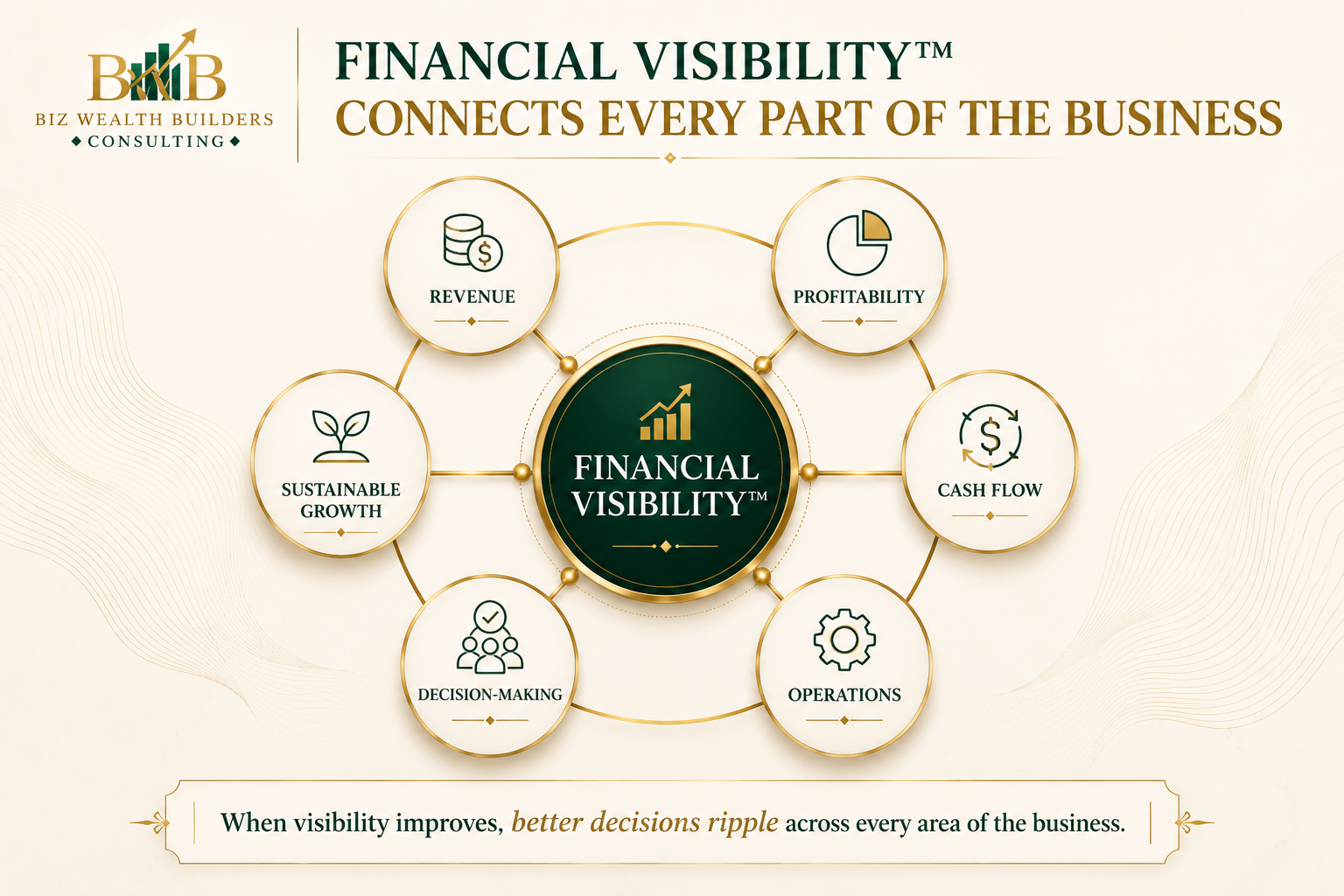
Financial Visibility™ helps leaders understand how operational performance influences profitability, cash flow, and sustainable growth.
Instead of viewing departments independently, leaders begin seeing the business as one connected system.
That perspective changes decision-making.
Because every operational improvement becomes a financial improvement.
Defined Reporting Rhythms
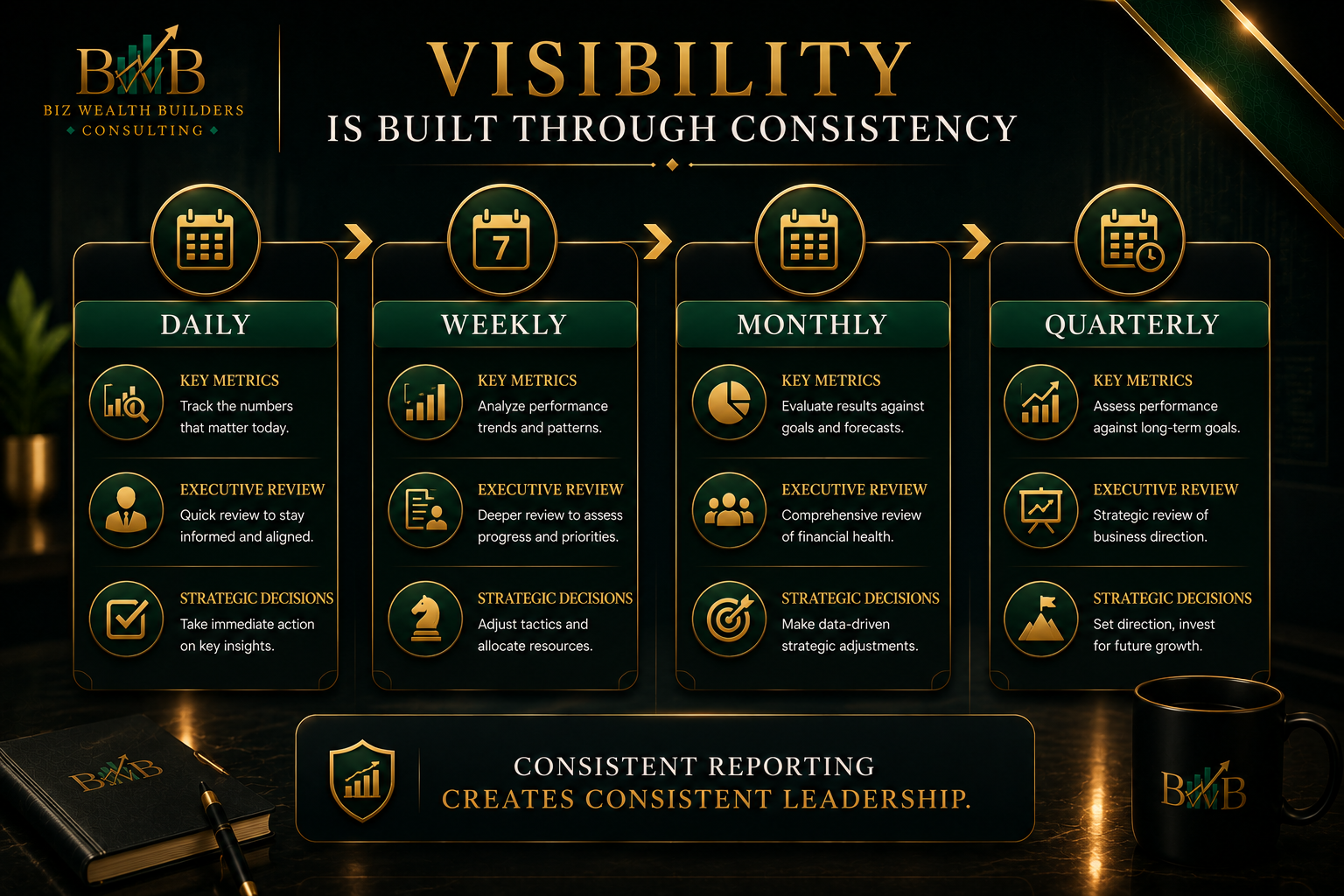
Financial Visibility™ isn't created by reviewing reports only when something feels wrong.
It is created through consistency.
The strongest businesses establish predictable reporting rhythms that support executive decision-making.
Instead of reacting to financial information, leaders review it intentionally.
Daily.
Weekly.
Monthly.
Quarterly.
Each reporting rhythm serves a different purpose.
Some reports monitor performance.
Others identify trends.
Others support strategic planning.
The objective isn't simply producing reports.
It's ensuring leadership receives the right information before important decisions are made.
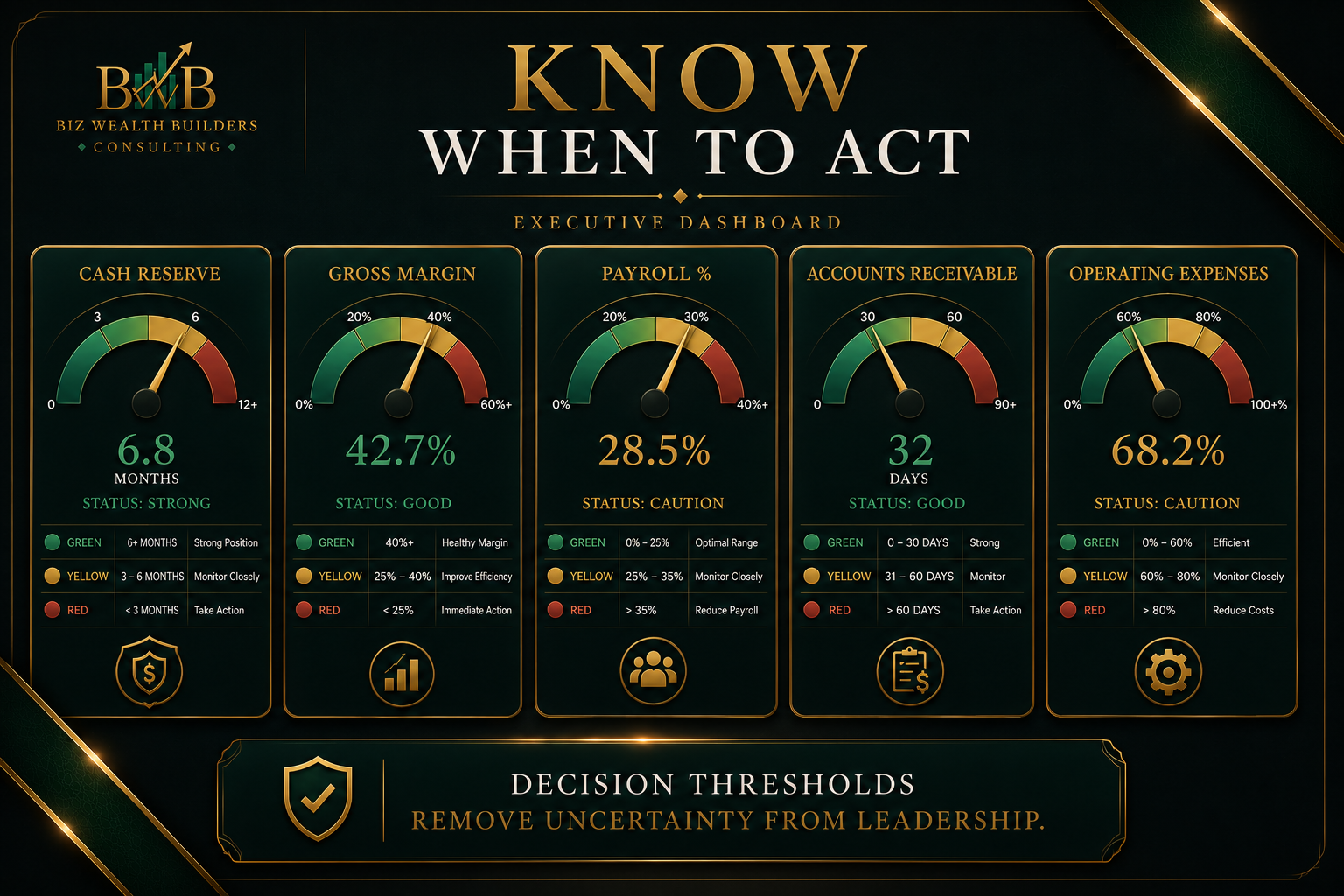
Clear Decision Thresholds
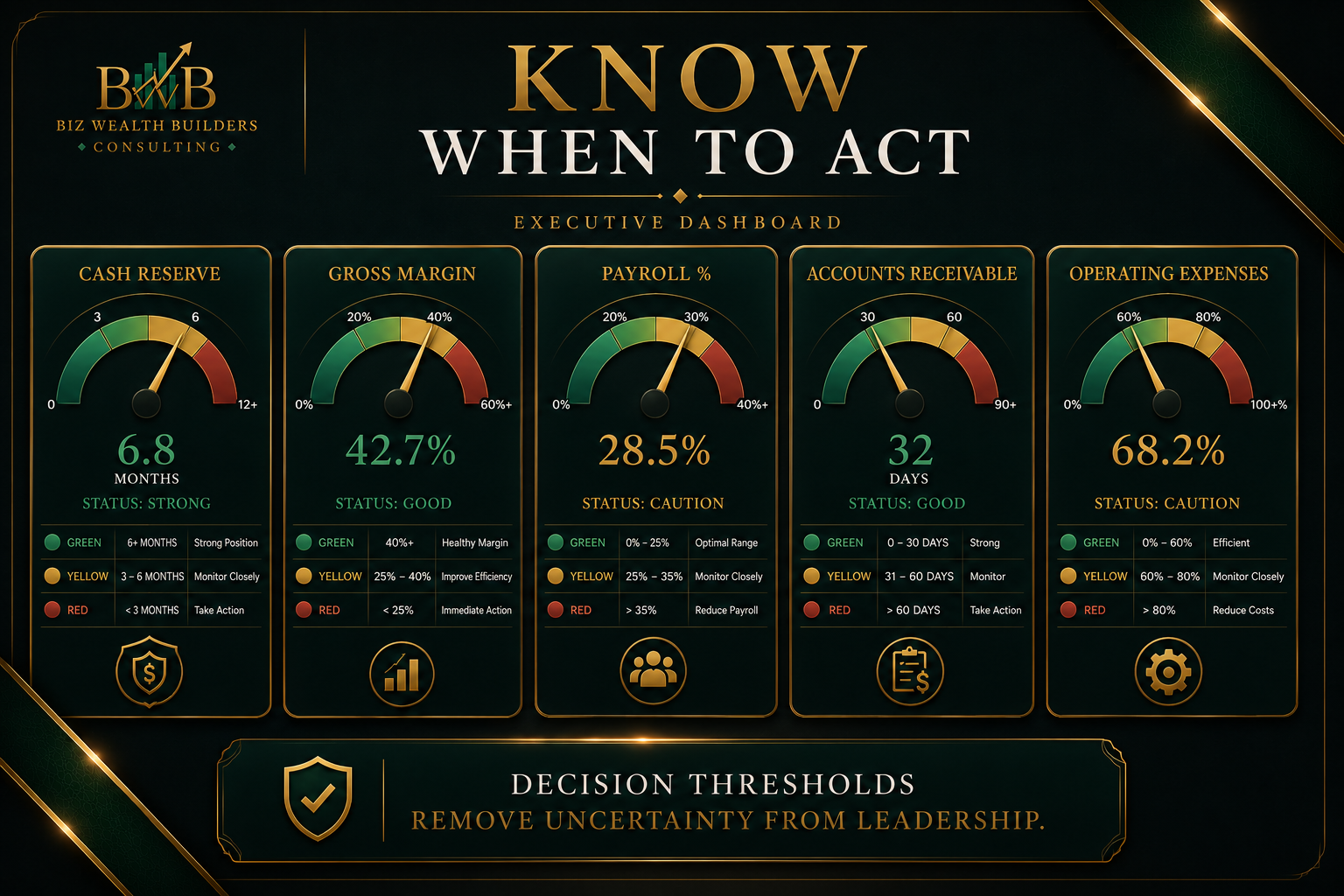
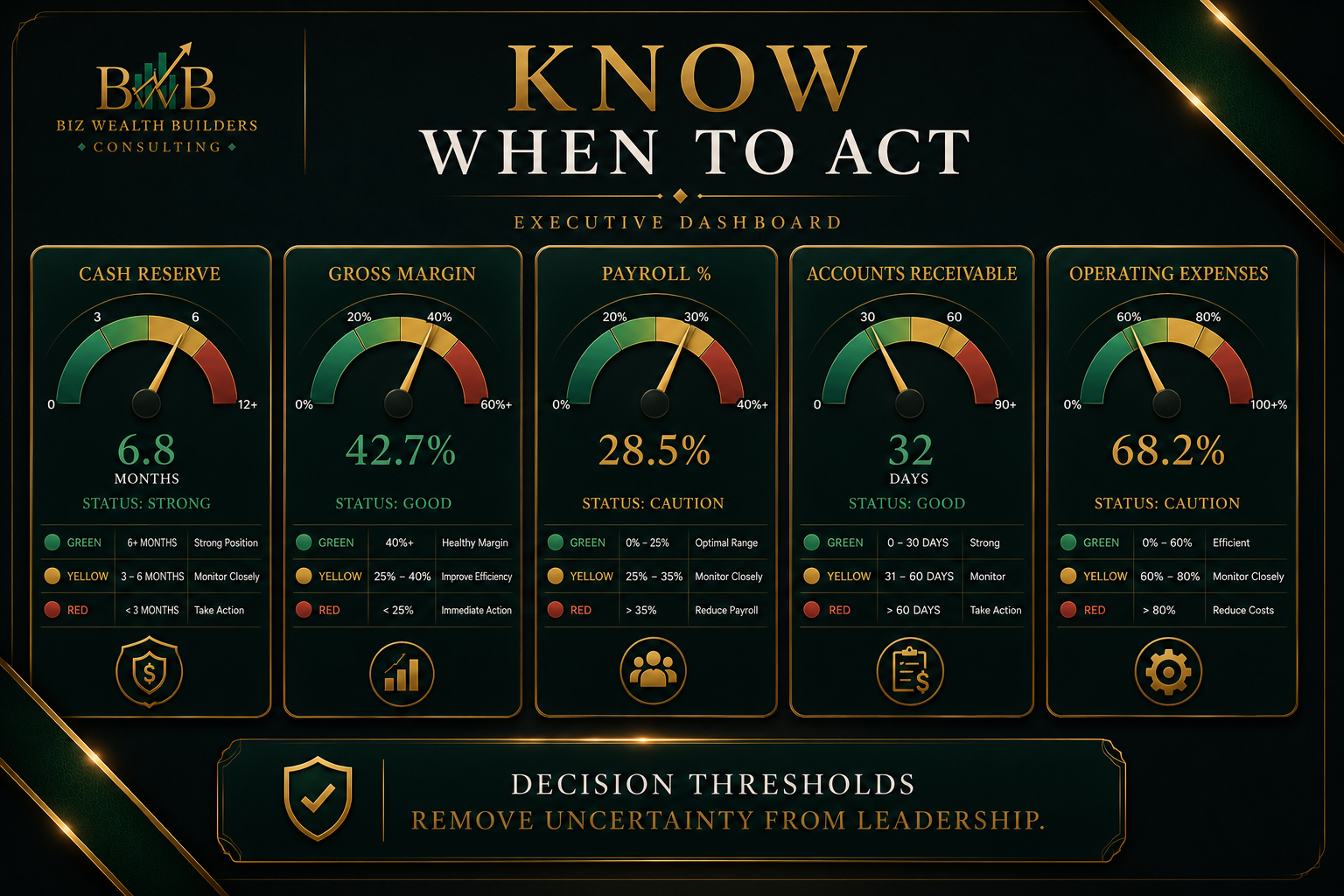
One of the greatest benefits of Financial Visibility™ is removing unnecessary uncertainty.
Leaders stop asking:
"Should I be worried?"
Instead, they know exactly when action is required.
Decision thresholds create predefined signals that guide executive action.
For example:
- Cash reserves fall below a defined level.
- Gross margin drops below target.
- Payroll exceeds a predetermined percentage of revenue.
- Customer acquisition costs rise above expectations.
- Accounts receivable age beyond acceptable limits.
Instead of relying on emotion, leaders rely on agreed-upon indicators.
That creates faster, more objective decision-making.
Accountability for the Metrics That Matter
Not every metric deserves equal attention.
The strongest businesses identify a small number of key indicators that directly influence business performance.
Everyone understands:
What is being measured.
Why it matters.
Who owns it.
How often it is reviewed.
What action should be taken if performance changes.
Financial Visibility™ creates accountability because expectations become visible.
Teams stop guessing.
Leadership stops assuming.
Everyone works from the same information.
The Difference Between Data and Executive Insight
Businesses have never had more access to data.
Dashboards.
Reports.
Software.
KPIs.
Analytics.
Yet many founders have never felt more overwhelmed.
Because information alone doesn't create confidence.
Executive insight comes from understanding what deserves attention, why it matters, and what action should follow.
That is the ultimate purpose of Financial Visibility™.
Not more numbers.
Better leadership.
Not more reports.
Better decisions.
Not more information.
Greater understanding.
The Executive Shift
Financial Visibility™ isn't a report.
It isn't a dashboard.
It isn't a spreadsheet.
And it certainly isn't just another financial process.
It is a leadership capability.
When Financial Visibility™ becomes part of the business, founders stop leading from assumptions and begin leading from awareness.
Revenue becomes more meaningful.
Profitability becomes more intentional.
Cash becomes more predictable.
Operations become more connected.
Decisions become more confident.
And growth becomes significantly easier to support.
Because the strongest businesses aren't built by leaders who simply have access to more information.
They are built by leaders who understand what the information means—and know exactly what to do with it.
The Executive Shift
Throughout this article, we've explored a distinction that many founders never realize until growth begins to outpace clarity.
Accurate financial reporting tells you what happened.
Financial Visibility™ helps you understand what it means.
But understanding the difference is only the beginning.
The real transformation occurs when Financial Visibility™ becomes part of the way you lead.
This isn't a shift in accounting.
It's a shift in executive thinking.
The most effective CEOs don't simply consume financial information.
They interpret it.
They connect it.
They use it to shape the future of the business before circumstances force difficult decisions.
That is the Executive Shift.
It is the moment when financial reports stop being monthly documents and become leadership tools.
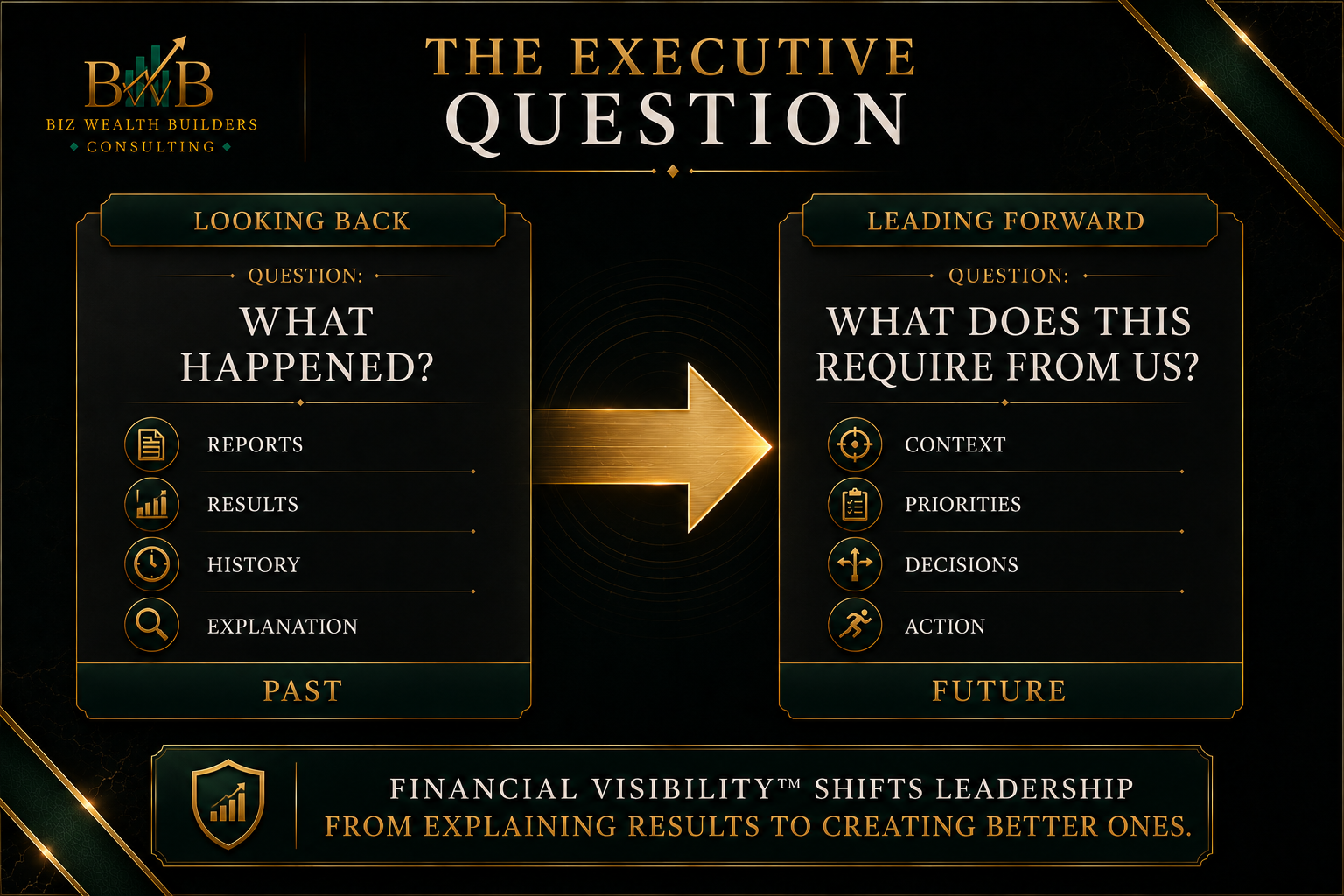
It is the point where founders stop asking, "What happened?" and begin asking, "What does this require from us?"
Because leadership isn't measured by how well you understand the past.
Leadership is measured by how effectively you prepare for the future.
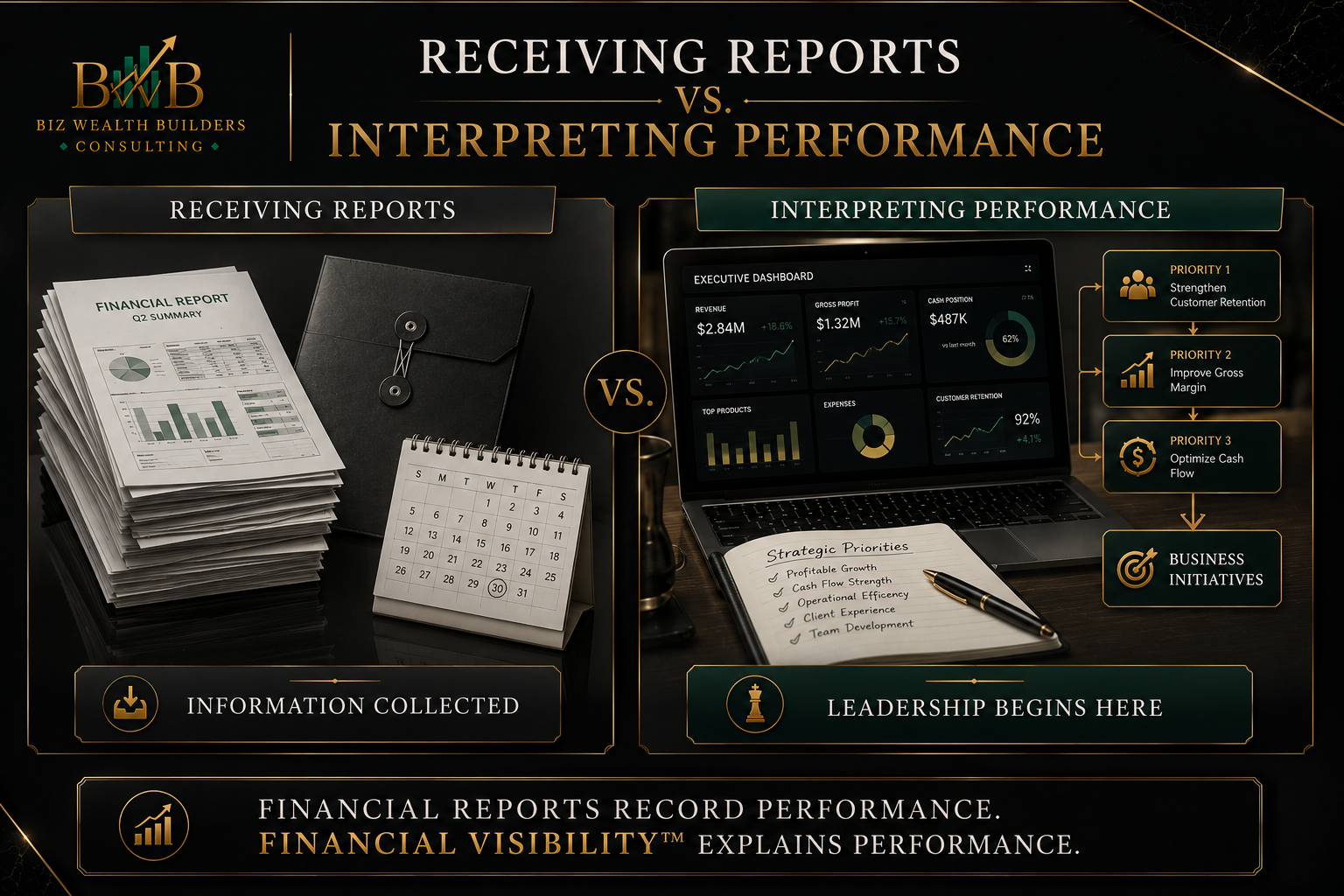
The Shift from Receiving Reports to Interpreting Performance
Many founders receive financial reports every month.
They review revenue.
They glance at expenses.
They check the bank balance.
Then they move on to the next urgent task.
The reports become another item on an already overwhelming to-do list.
Financial Visibility™ changes that relationship entirely.
Instead of simply receiving financial information, leaders begin interpreting business performance.
Every report becomes an opportunity to understand:
- What is improving?
- What is declining?
- What patterns are emerging?
- What deserves our attention this month?
- What decisions should we begin preparing for now?
The reports themselves haven't changed.
The leadership mindset has.
Financial Visibility™ transforms financial reports from historical documents into strategic conversations.
The Shift from Asking "What Happened?" to Asking "What Does This Require from Us?"
Perhaps the most important transformation is not financial.
It is philosophical.
Founders who operate with limited visibility often spend their time looking backward.
Why did revenue decline?
Why is cash tight?
Why are margins shrinking?
Those questions matter.
But they are incomplete.
Financial Visibility™ encourages a different question.
Not simply:
"What happened?"
But:
"What does this require from us?"
That question changes leadership.
It moves the conversation away from explanation and toward responsibility.
It invites action instead of analysis.
It focuses attention on the decisions that will shape the future rather than the circumstances that created the past.
Every financial result is feedback.
Every trend is information.
Every challenge is an invitation to lead more intentionally.
When founders adopt this mindset, financial conversations become less about solving yesterday's problems and more about building tomorrow's business.
Financial Visibility™ Is Ultimately a Leadership Discipline
Many founders believe they need better reports.
Some believe they need better software.
Others believe they simply need more financial knowledge.
Those things can certainly help.
But they are not the true solution.
The greatest advantage isn't having access to more information.
It's developing the ability to consistently interpret that information, identify what matters most, and make decisions with confidence before pressure forces your hand.
That is the Executive Shift.
It is the difference between managing the business and truly leading it.
And once that shift occurs, Financial Visibility™ is no longer something you review at the end of the month.
It becomes the lens through which every strategic decision is made.
Final Executive Reflection
As your business grows, your greatest challenge will rarely be a lack of information.
It will be the ability to distinguish what matters from what merely exists.
The leaders who build resilient, profitable, and sustainable organizations aren't the ones with the most reports.
They're the ones with the greatest visibility.
Because in the end, Financial Visibility™ isn't about seeing more numbers.
It's about seeing your business more clearly.
And when you can see more clearly, you can lead more confidently.
If this article challenged the way you think about financial reporting, ask yourself one final question:
If your financial reports tell you what happened, do they also tell you what your business needs next?
If the answer is no, the opportunity isn't to collect more data.
It's to build greater Financial Visibility™.
Because the quality of your decisions will never exceed the quality of your visibility.
Your financial reports may be accurate.
But accuracy is only the beginning.
The real value of financial information is not found in whether the numbers reconcile.
It is found in whether those numbers help you lead the business more effectively.
Do You Have Financial Reports—or Financial Visibility?
Complete the Executive Financial Visibility Assessment™ to identify where visibility gaps may be limiting your profitability, decision-making, and ability to grow sustainably.