

Why Your Business Income Is Inconsistent Even When You're Signing Clients
May 04, 2026
You're signing clients.
So why does every month still feel like you're starting over?
You close a $7,500 client.
Then another for $4,000.
A past client renews.
Someone pays an invoice.
You look at the money coming in and think:
“Okay. We're finally getting somewhere.”
For a moment, you feel relief.
Then the month changes.
A client finishes.
Another payment gets delayed.
A prospect who sounded ready disappears.
A contract you expected to close gets pushed into next month.
Payroll is still due.
Software still drafts.
Contractors still need to be paid.
Your household still needs your income.
And suddenly you're back doing the math.
Again.
What needs to close?
Who hasn't paid?
What can I move?
How much can I pay myself?
What do I need to bring in next month?
And that's the part nobody sees.
Because from the outside, your business looks like it's working.
You're getting clients.
You're generating money.
You're posting wins.
You're delivering good work.
But privately, you keep wondering:
“Why does it feel like I have to recreate my income every single month?”
That's the question we need to answer.
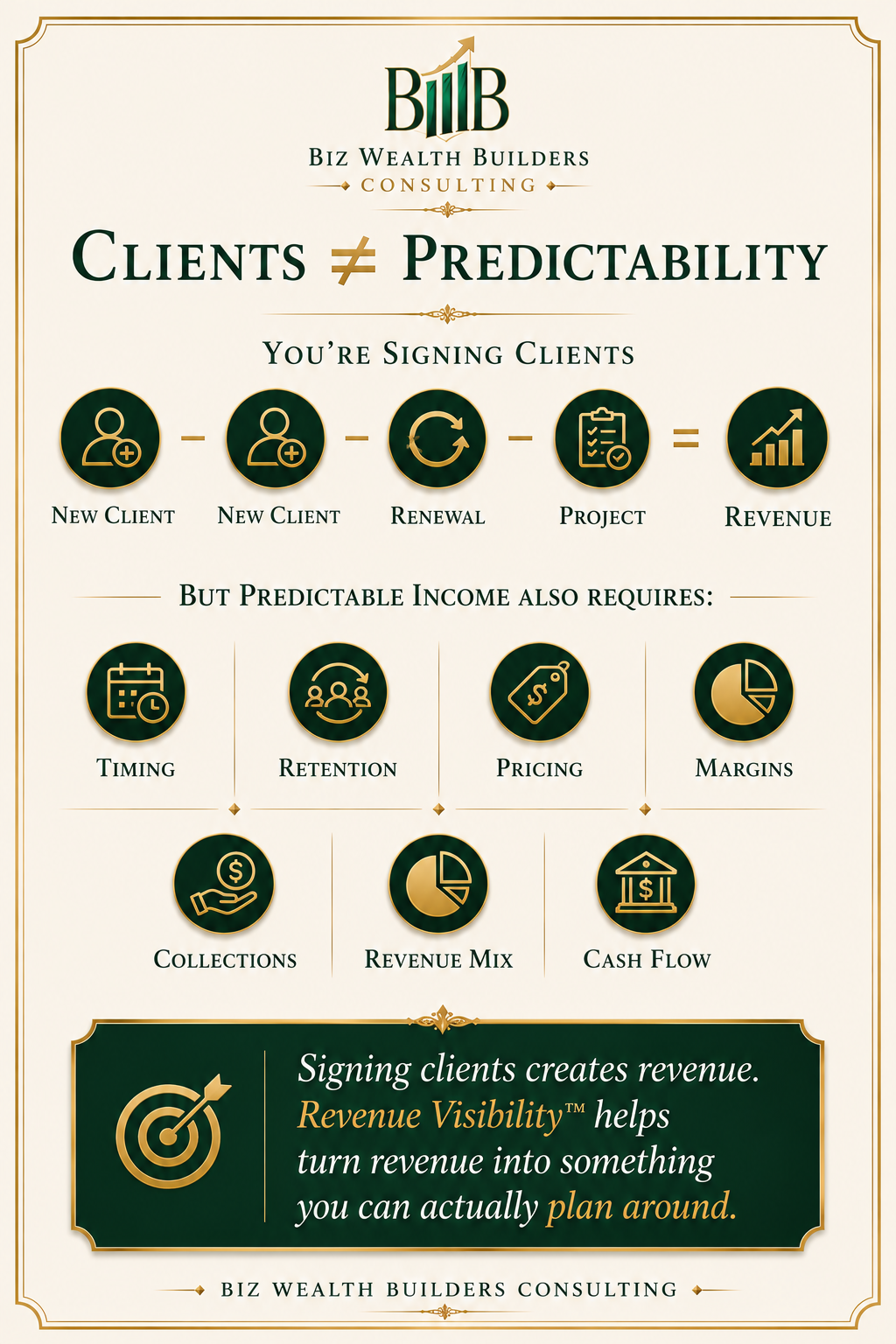
Because signing clients and building predictable income are not the same thing.
Client Acquisition Is Only One Part of Revenue Stability
When income feels inconsistent, most founders immediately look at sales.
You need:
More leads.
More calls.
More clients.
More visibility.
More marketing.
And sometimes that's exactly right.
If you aren't generating enough demand, you have an acquisition problem.
But there's another scenario.
You're already selling.
People are buying.
Money is coming in.
The problem is that you cannot predict how much, when, for how long, or what will actually remain after delivery.
That's not simply a sales problem.
That's a Revenue Visibility™ problem.
And generating more clients without fixing it can leave you working significantly harder while experiencing the same financial uncertainty.
Here's What Inconsistent Income Actually Looks Like
Let's say you're running a consulting business.
Over three months, your revenue looks like this:
January: $38,000
Great month.
February: $17,000
Now you're nervous.
March: $44,000
Relief.
Your three-month average is:
$33,000 per month.
On paper, that may look healthy.
But you're not experiencing $33,000 every month.
You're experiencing:
$38K → $17K → $44K
And your expenses don't necessarily fluctuate the same way.
Payroll doesn't say:
"Revenue was low this month. We'll come back later."
Neither does:
Rent.
Software.
Insurance.
Debt.
Contractors.
Taxes.
Your mortgage.
Groceries.
Your children's expenses.
So the problem isn't necessarily total revenue.
It's the volatility between when revenue arrives and when financial obligations occur.
That's why a business can generate significant annual revenue and still create monthly financial pressure.
Revenue Can Be High and Still Be Unpredictable
Imagine two businesses.
Both generate:
$500,000 per year.
Business A generates roughly:
$40,000–$45,000 every month.
Business B generates:
$75,000.
Then $18,000.
Then $62,000.
Then $24,000.
Then $70,000.
Then $15,000.
At the end of the year, both may report approximately the same revenue.
But the CEOs are operating two very different companies.
Business A can more easily plan:
Payroll.
Hiring.
Owner compensation.
Marketing.
Investments.
Cash reserves.
Business B has to continually adjust.
The annual number doesn't tell you that.
The revenue pattern does.
That's why leadership needs to understand not simply how much revenue the company generates, but how that revenue behaves.
Seven Reasons Your Income May Still Feel Inconsistent
1. You're Replacing Revenue Instead of Building It
This happens constantly in project-based businesses.
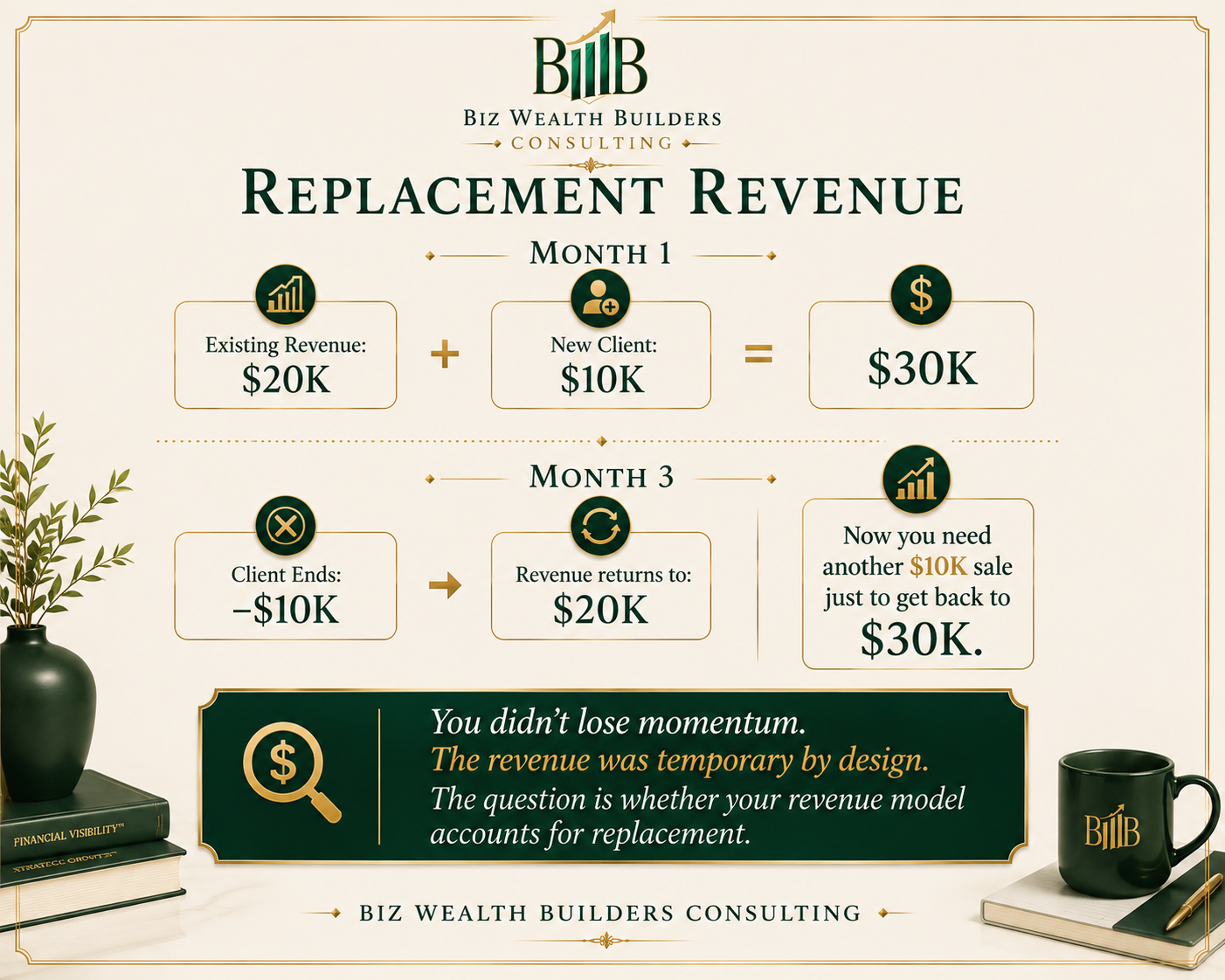
You sign a $10,000 client.
Great.
But that engagement lasts two months.
When it ends, the $10,000 doesn't remain part of your revenue base.
It disappears.
Now you need another $10,000 client just to return to where you were.
You aren't necessarily growing.
You're replacing.
And replacement revenue can create the illusion of growth because you're constantly signing new clients.
You're busy.
Sales are happening.
Contracts are being signed.
But the underlying revenue base isn't becoming stronger.
That's why the CEO feels like she's constantly hunting for the next client.
2. Your Sales Cycle Doesn't Match Your Cash Needs
You may have a healthy pipeline.
But pipeline doesn't pay payroll.
Suppose prospects typically take:
45 days
from initial conversation to signed agreement.
Then another:
15 days
before their first payment.
That's roughly 60 days between opportunity and cash.
If you realize on August 1 that September revenue is short, you may already be late.
That's why Revenue Visibility™ has to extend beyond:
“Who am I talking to?”
Leadership needs to understand:
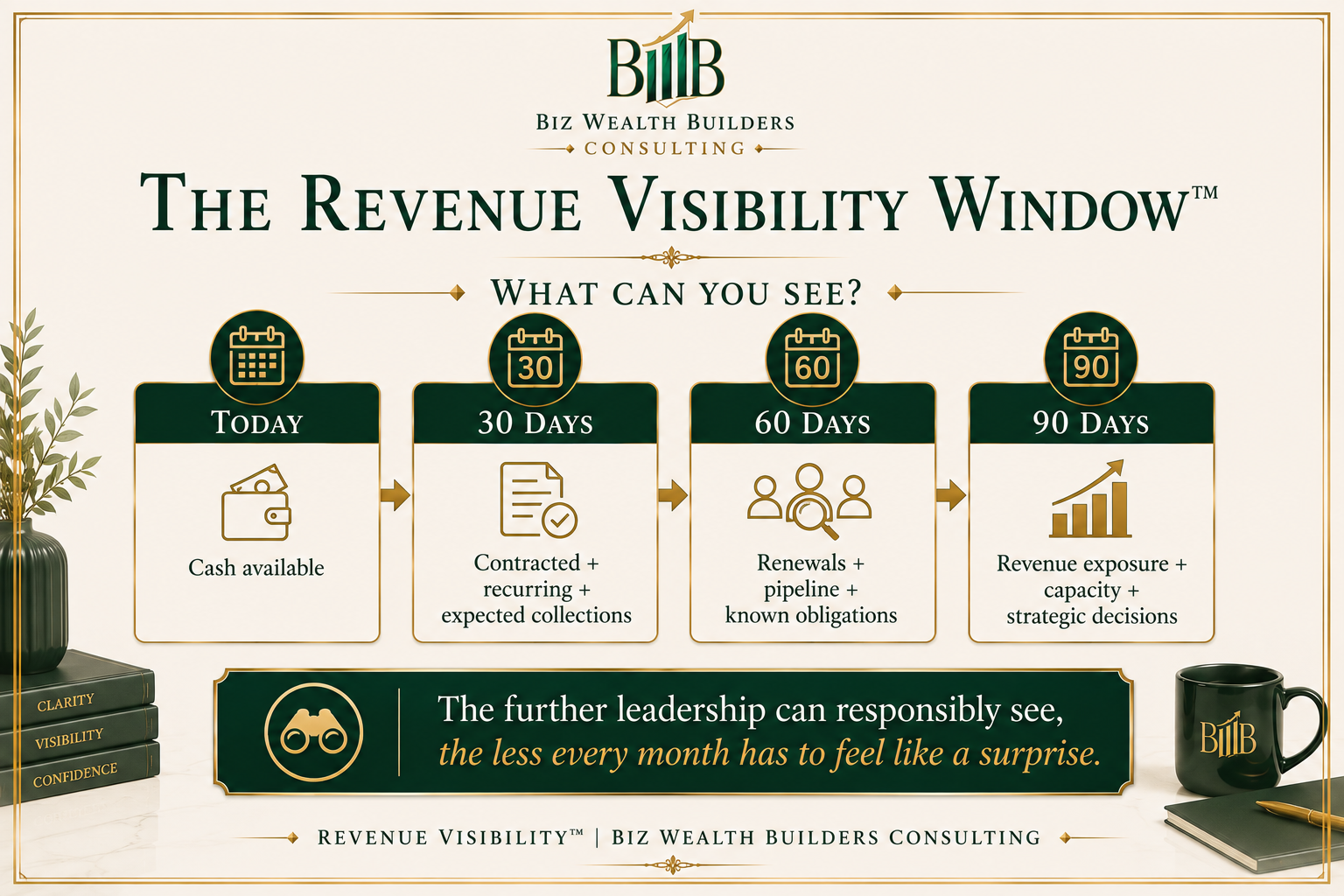
What's contracted?
What's recurring?
What's likely to renew?
What's ending?
What's outstanding?
What's in the pipeline?
What's likely to convert?
And when will the cash actually arrive?
Otherwise, every month becomes reactive.
3. Too Much Revenue Is One-Time Revenue
One-time projects aren't bad.
They can be extremely profitable.
But they behave differently from recurring revenue.
If 80% of your revenue has to be resold every month or every quarter, you need a sales engine capable of continually replacing that revenue.
Suppose your monthly target is:
$40,000
But only:
$10,000
is recurring.
That means before the month even starts, you need to generate or renew another:
$30,000
just to hit your target.
That's important information.
Because your problem may not be:
“I'm not good enough at sales.”
It may be:
“My revenue model requires me to resell too much of my income every month.”
That's a business-model conversation.
4. You're Looking at Contracts Instead of Cash
You signed:
$50,000 in new business.
That sounds excellent.
But how is the $50,000 paid?
$10,000 today?
Then $5,000 monthly?
Net 30?
Net 60?
Milestone payments?
Half now, half at completion?
Because contract value isn't the same as available cash.
A founder can have $100,000 in contracted revenue and still struggle with this month's obligations.
That's why Revenue Visibility™ and Cash Flow Visibility™ have to work together.
You need to see:
What you've sold.
AND
When that sale becomes usable cash.
5. Your Clients Are Paying Late
This one is particularly frustrating because you've already done the work.
The sale happened.
The invoice went out.
Revenue has technically been earned.
But the cash hasn't arrived.
Imagine you have:
$32,000 in outstanding receivables.
Meanwhile, you need:
$12,000 for payroll.
$4,000 for contractors.
$3,500 for operating expenses.
$5,000 for taxes.
You technically have enough money coming.
You simply don't have enough money available.
That's a collections and cash-conversion problem.
And another new client doesn't necessarily solve it.
Better visibility into receivables, payment terms, collection timing, and cash requirements might.
6. Your Pricing Doesn't Create Enough Margin
Sometimes income feels inconsistent because the company needs too much revenue just to feel comfortable.
You bring in:
$40,000.
But after:
Contractors.
Payroll.
Technology.
Marketing.
Insurance.
Professional fees.
Taxes.
Delivery expenses.
And other operating costs...
there isn't much left.
So the business needs another strong month.
And another.
And another.
Revenue can never relax because margins aren't creating enough breathing room.
Now every sales dip feels dangerous.
Not because the business generates no money.
Because the company retains too little of what it generates.
7. You Don't Know What's Already Coming Next Month
This may be the most important one.
It's August 22.
Can you reasonably estimate September revenue?
Not perfectly.
Business will always contain uncertainty.
But can you identify:
Revenue already contracted?
Recurring revenue?
Renewals expected?
Projects ending?
Outstanding invoices?
Pipeline likely to close?
Known expenses?
Owner compensation?
Cash commitments?
If the answer is mostly:
“We'll see what happens.”
Then you're not simply experiencing inconsistent income.
You're experiencing low forward visibility.
And that uncertainty changes how you lead.
The Cost Isn't Just Financial
This is where inconsistent income starts affecting the CEO differently.
Because uncertainty changes your behavior.
You delay hiring.
Even though you need help.
You don't pay yourself.
Because you're worried about next month.
You accept a client you know isn't a good fit.
Because cash feels uncertain.
You discount.
Because getting the sale feels more important than protecting margin.
You keep too much cash sitting idle.
Because you don't know what's safe to invest.
Or you spend too aggressively after a strong month because it feels like you've finally turned the corner.
Then the next month drops.
And you're back in survival mode.
Inconsistent visibility creates inconsistent decision-making.
That's the hidden cost.
The problem isn't simply:
“Some months I make more than others.”
The problem is that financial uncertainty begins influencing decisions that shape the future of the company.
The Distance Between Signing Clients and Building Financial Stability
This is where I want you to think about what you're actually trying to create.
You don't want to sign clients forever just to replace the clients who leave.
You don't want to hit $50,000 one month and wonder whether you'll hit $20,000 the next.
You don't want to celebrate every contract while privately calculating whether you'll be able to pay yourself.
You don't want to continually rebuild the same revenue.
You want to reach a point where the business has enough visibility that you can reasonably see:
What's staying.
What's ending.
What's contracted.
What's collectible.
What's at risk.
What's likely.
And what's missing.
That's when revenue becomes something leadership can plan around.
Not perfectly.
But intelligently.
You May Not Need More Clients
This is the reframe.
If you're signing clients but income still feels inconsistent, the first question shouldn't automatically be:
“How do I get more clients?”
Ask:
What percentage of my revenue has to be replaced every month?
How much revenue is recurring?
How long do clients typically stay?
How long is my sales cycle?
How quickly do customers pay?
How much contracted revenue is already secured for the next 30, 60, and 90 days?
Which services generate the strongest margins?
Which months naturally experience revenue gaps?
How much owner compensation does the company need to support?
Now we can diagnose the actual problem.
Maybe you genuinely need more clients.
But maybe you need:
Longer engagements.
Better retention.
Different payment terms.
Faster collections.
Higher margins.
More recurring revenue.
Better renewal processes.
Stronger forecasting.
Or a different revenue mix.
More clients are one possible solution.
They're not the diagnosis.
Revenue Visibility™ Changes the Conversation
Without visibility:
“I need to make $40,000 next month.”
With visibility:
“$26,000 is already contracted, $8,000 is expected from renewals, and we have a $6,000 gap to close.”
Those statements create completely different behavior.
Without visibility:
“Sales feel slow.”
With visibility:
“Three contracts totaling $18,000 end next month, and our current pipeline won't replace all of them.”
Without visibility:
“I can't afford to hire.”
With visibility:
“At our current recurring revenue and margin, we need another $8,000 in predictable monthly revenue before adding this position.”
Without visibility:
“I hope September is good.”
With visibility:
“Here's what September currently looks like, here's the gap, and here's what we're doing about it.”
That's the difference.
The Revenue Visibility™ Model
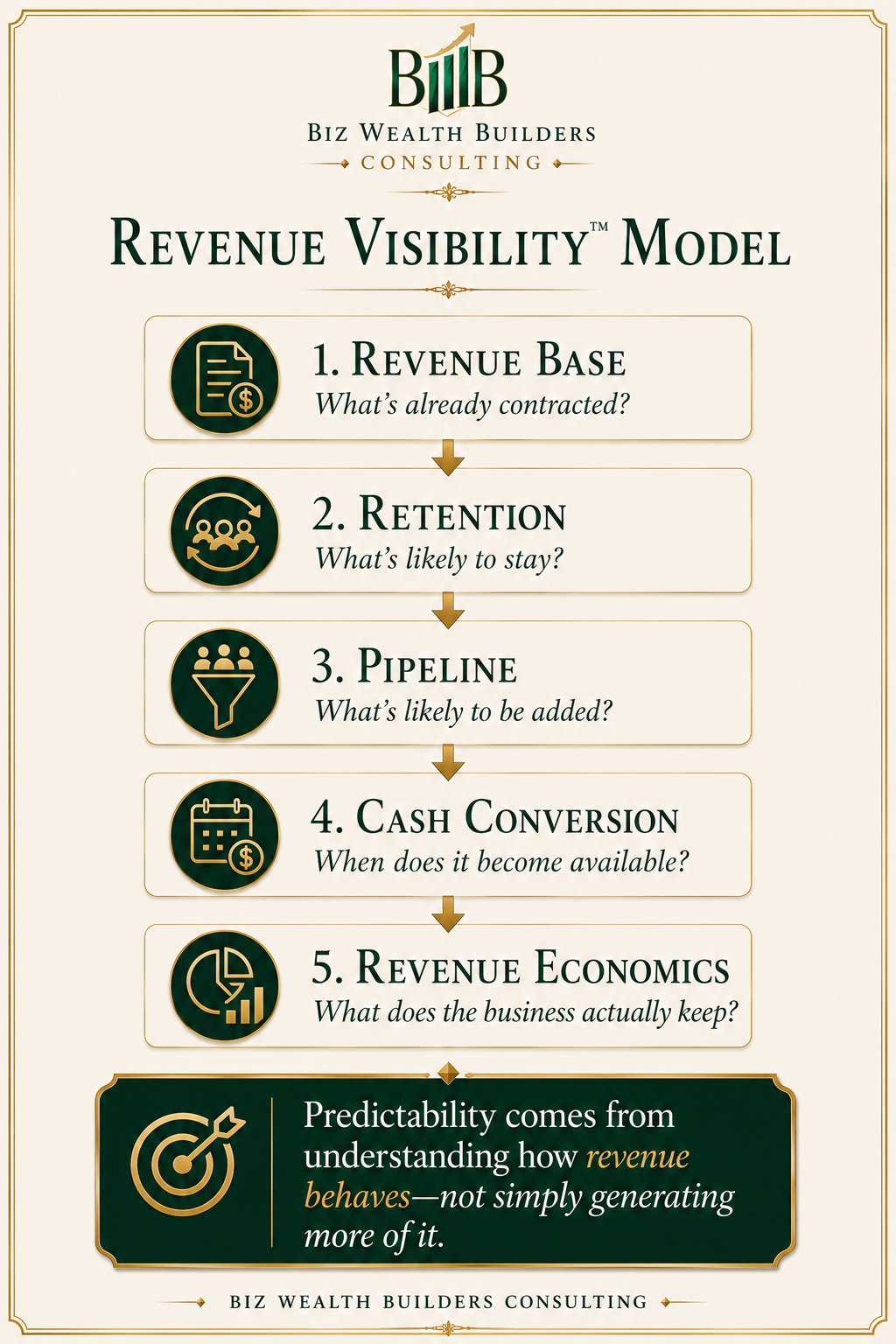
I would evaluate income consistency through five areas.
1. Revenue Base
What revenue already exists?
Recurring contracts.
Retainers.
Subscriptions.
Committed projects.
2. Revenue Retention
What revenue is likely to remain?
Renewals.
Client retention.
Contract expirations.
Churn.
3. Revenue Pipeline
What revenue may be added?
Qualified opportunities.
Proposals.
Sales cycle.
Expected close dates.
4. Cash Conversion
When does revenue become cash?
Invoice timing.
Payment terms.
Receivables.
Collections.
5. Revenue Economics
What does the company actually keep?
Margins.
Delivery costs.
Capacity.
Owner compensation.
Profitability.
Together, those create something far more useful than simply tracking monthly sales.
They create a forward view of the financial engine.
Run This Revenue Consistency Audit
Answer these questions:
1. What percentage of next month's revenue is already contracted?
2. What percentage of revenue is recurring?
3. How much revenue ends within the next 90 days?
4. What's your average client lifetime?
5. What's your average sales cycle?
6. How quickly do clients typically pay?
7. How much money is currently sitting in accounts receivable?
8. What percentage of revenue comes from your largest client?
9. Which service creates your strongest margin?
10. How much revenue do you need monthly to cover operations and consistently compensate yourself?
11. How much revenue must you replace during the next 90 days?
12. What does your current pipeline realistically cover?
If you can't answer several of those questions, don't immediately conclude that your business isn't generating enough.
You may not have enough visibility into the revenue you're already generating.
Consistency Doesn't Mean Every Month Looks the Same
This is important.
We're not trying to create a business where:
January = $40,000
February = $40,000
March = $40,000
exactly.
Real businesses fluctuate.
Clients leave.
Contracts move.
Markets change.
Projects end.
Opportunities arrive unexpectedly.
Predictability doesn't mean perfection.
It means fewer financial surprises.
It means knowing that a $15,000 contract ends next month before the revenue disappears.
It means knowing a large receivable is late before payroll becomes stressful.
It means knowing how much revenue is already secured before deciding how aggressively you need to sell.
It means knowing what a new client actually contributes before assuming the contract made the company stronger.
That's visibility.
Your Next Step
If you're signing clients but still feel like you're recreating your income every month, don't automatically make your next move:
More marketing.
First, understand how your current revenue behaves.
Your Executive Financial Visibility Assessment™ is the right diagnostic continuation because your current Visibility Pathway™ already positions the assessment as the first step for identifying visibility gaps affecting financial and operational decisions.
TAKE THE EXECUTIVE FINANCIAL VISIBILITY ASSESSMENT™ →
Because the goal isn't simply to sign enough clients to have another good month.
The goal is to build a business where you can see the next month coming.
Continue the Conversation
And sometimes the question isn't something you want to figure out alone.
That's part of why Legacy Leaders Collective™ exists.
A relationship-centered community for women founders, CEOs, business owners, managing partners, presidents, and established consultants navigating the decisions behind building stronger businesses.
Bring the revenue question.
Bring the numbers.
Bring the decision you're trying to make.
JOIN LEGACY LEADERS COLLECTIVE™ →
Pull up a chair.
Jasmyn Camp
Founder & CEO
Biz Wealth Builders Consulting
Helping Founders & CEOs Build Better Businesses Through Financial Visibility™