

If You Don't Know Your Numbers, You Don't Know Your Business
Apr 27, 2026
Your business made $50,000 last month.
Good.
Now tell me what that number actually means.
How much of it was profitable?
How much has actually been collected?
How much belongs to taxes?
How much is already committed to payroll, contractors, software, debt, and upcoming expenses?
Which service generated the strongest margin?
Which client generated the most revenue but consumed the most resources?
How much can you safely pay yourself?
How much can you reinvest?
Could you afford another employee?
And if revenue dropped 20% next month, what would happen?
If the only number you can confidently answer is:
“We made $50,000.”
You know your revenue.
You don't necessarily know your business.
And there's an important difference.
Revenue Is Usually the Number We Know Best
Ask a business owner how the company is doing, and you'll often hear:
“We're doing about $500K.”
Or:
“We crossed $1 million last year.”
Revenue becomes shorthand for success.
And it matters.
Revenue tells us whether customers are willing to pay for what the business sells.
But revenue alone cannot tell you whether the company is financially healthy.
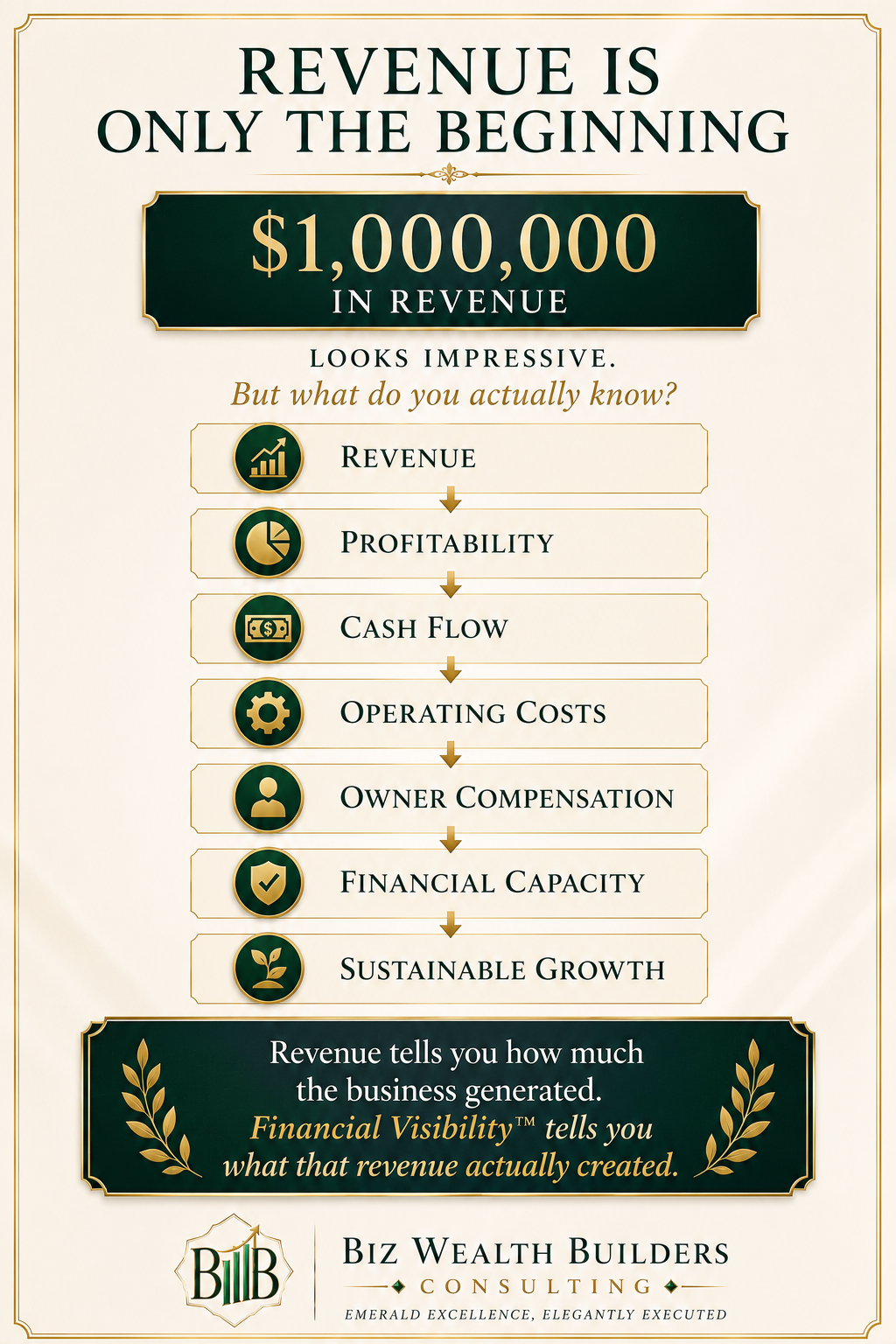
Two companies can generate exactly $1 million and have completely different businesses underneath that number.
Company A generates $1 million with:
Strong margins.
Predictable recurring revenue.
Healthy cash reserves.
Low client concentration.
Consistent owner compensation.
Operational capacity.
Company B generates the same $1 million with:
Thin margins.
Slow collections.
One client representing 40% of revenue.
High delivery costs.
No meaningful reserves.
Inconsistent owner compensation.
And a founder working 70 hours a week.
Same revenue.
Completely different business.
That's why knowing how much money comes in isn't enough.
Leadership needs to understand what happens to the money after it arrives.
Knowing Your Numbers Isn't About Memorizing Them
This distinction matters.
I don't believe every CEO needs to become an accountant.
You don't need to memorize every line on the income statement.
You don't need to spend hours inside QuickBooks.
You don't need to know your bank balance to the penny at every moment.
And you certainly don't need 47 KPIs on a dashboard.
The goal is not more numbers.
The goal is knowing which numbers should influence your decisions.
That's Financial Visibility™.
It's the difference between receiving a financial report and being able to say:
“I understand what this means for the business.”
Because numbers without context are simply information.
Numbers connected to decisions become leadership intelligence.
The Numbers Every CEO Should Understand
Different companies require different metrics.
A construction company will monitor different operating metrics than a consulting firm.
A SaaS company won't manage cash exactly like a professional-services company.
But there are several financial questions almost every CEO should be able to answer.
1. How Much Revenue Are We Actually Generating?
Start with revenue.
But go deeper than the total.
You should understand:
Where revenue comes from.
Which clients generate it.
Which services or products generate it.
How much is recurring.
How much is project-based.
How predictable it is.
Whether it's increasing or declining.
And how concentrated it is.
Suppose your company generates:
$600,000 annually.
Sounds strong.
But then you discover:
$240,000 comes from one client.
Now you know something very different.
You don't simply have $600,000 in revenue.
You have a $600,000 company with 40% client concentration.
That changes how leadership should think about risk, sales, cash reserves, and growth.
That's Revenue Visibility™.
2. How Much Are We Actually Keeping?
Revenue gets attention.
Profitability creates sustainability.
If you generate $50,000 this month but spend $47,000 delivering and operating the business, the $50,000 isn't the number leadership should be celebrating.
The more important question is:
What did it cost us to generate it?
This is where founders need visibility into margins.
Which offers are most profitable?
Which clients require excessive labor?
Which services look successful because they produce high revenue but contribute very little profit?
Where are expenses increasing?
What happens to margins as volume grows?
Because not all revenue is equally valuable.
Sometimes the fastest-growing offer in a company is quietly becoming the least attractive one financially.
You cannot see that from revenue alone.
3. How Much Cash Is Actually Available?
This is where many profitable businesses get surprised.
Your income statement says you made money.
Your bank account doesn't seem to agree.
Why?
Because profit and cash are not the same thing.
You may have:
Outstanding receivables.
Upcoming payroll.
Taxes due.
Debt payments.
Vendor obligations.
Projects you've been paid for but haven't delivered yet.
Annual expenses approaching.
Money may technically exist in the account while already belonging somewhere else.
So instead of asking:
“How much money is in the bank?”
Leadership needs to ask:
“How much cash is actually available after considering our commitments?”
That's Cash Flow Visibility™.
And it's one of the most important distinctions a growing CEO can understand.

4. What Does It Cost to Run the Business?
Do you know your monthly operating requirement?
Not approximately.
Not:
“Usually around $20K.”
What does the company need to operate?
Payroll.
Contractors.
Technology.
Insurance.
Rent.
Professional services.
Marketing.
Debt.
Taxes.
Administrative expenses.
And other recurring obligations.
Suppose your average monthly operating requirement is:
$35,000.
Now that number becomes useful.
If you have $105,000 in truly available operating cash, you can begin thinking about that as roughly three months of operating coverage.
If you have $40,000, you have a very different financial position.
The dollar amount hasn't changed.
Your understanding of what it means has.
That's why financial visibility creates context.
5. Are You Paying Yourself Consistently?
The founder's compensation should not disappear from the conversation.
Because this happens far too often:
Everyone gets paid.
Employees.
Contractors.
Vendors.
Software companies.
The government.
Then the owner looks at what's left.
And decides whether she gets paid.
Some months, yes.
Some months, no.
And because the business is technically profitable, she tells herself everything is fine.
But here's the question:
If the business only works financially when the owner doesn't receive appropriate compensation, how profitable is the business really?
Owner compensation provides information.
It can reveal:
Pricing problems.
Margin problems.
Cash-flow problems.
Cost-structure problems.
Revenue problems.
Or business-model problems.
Your pay isn't something to consider after understanding the business.
It's part of understanding the business.
6. Which Clients and Services Are Actually Profitable?
Imagine you have two services.
Service A
Revenue: $200,000
It sounds like your star offer.
But it requires:
Extensive founder involvement.
Multiple contractors.
High client support.
Frequent revisions.
And substantial administrative work.
Service B
Revenue: $130,000
Smaller.
But delivery is standardized.
Founder involvement is minimal.
Clients stay longer.
Margins are substantially stronger.
Which service should you grow?
Revenue alone might tell you:
Service A.
Profitability and operational visibility may tell you:
Service B.
That's why the numbers don't simply tell you what happened.
They help you decide what deserves more of the company's resources.
7. How Much Does Growth Actually Cost?
This is one of the numbers founders often don't calculate.
You want to grow from:
$500,000 → $1 million.
So the target appears to be:
+$500,000.
But what does another $500,000 require?
Two employees?
Three contractors?
More software?
More marketing?
Additional sales capacity?
More insurance?
Additional working capital?
A larger facility?
More management?
More of your time?
Now the growth goal isn't simply:
“How do we generate another $500,000?”
It becomes:
“What does the business need to invest to responsibly support another $500,000?”
That is a completely different conversation.
And it's one of the places Financial Visibility™ becomes essential to sustainable growth.
8. How Much Financial Risk Are We Carrying?
Not every important number appears as revenue or expense.
Some numbers tell you about exposure.
What percentage of revenue comes from your largest client?
How much debt does the company carry?
How much cash reserve exists?
How old are your receivables?
How much recurring revenue do you have?
How much payroll is fixed?
How much capacity remains?
What happens if sales decline?
These numbers answer a different question:
How much disruption can the business absorb?
That's financial resilience.
And a company can be highly profitable while still being financially fragile.
The Problem Isn't That You Don't Have the Numbers
Most businesses today have more data than they know what to do with.
QuickBooks has numbers.
Your bank has numbers.
Your CRM has numbers.
Payroll has numbers.
Your marketing platform has numbers.
Your project-management software has numbers.
Your spreadsheets definitely have numbers.
The problem is usually not access.
It's interpretation.
You have financial statements.
But what should change because of them?
You have a dashboard.
But which number deserves your attention?
You know revenue increased.
But did the business actually become stronger?
You know cash declined.
But why?
You know expenses increased.
But was the increase strategic or inefficient?
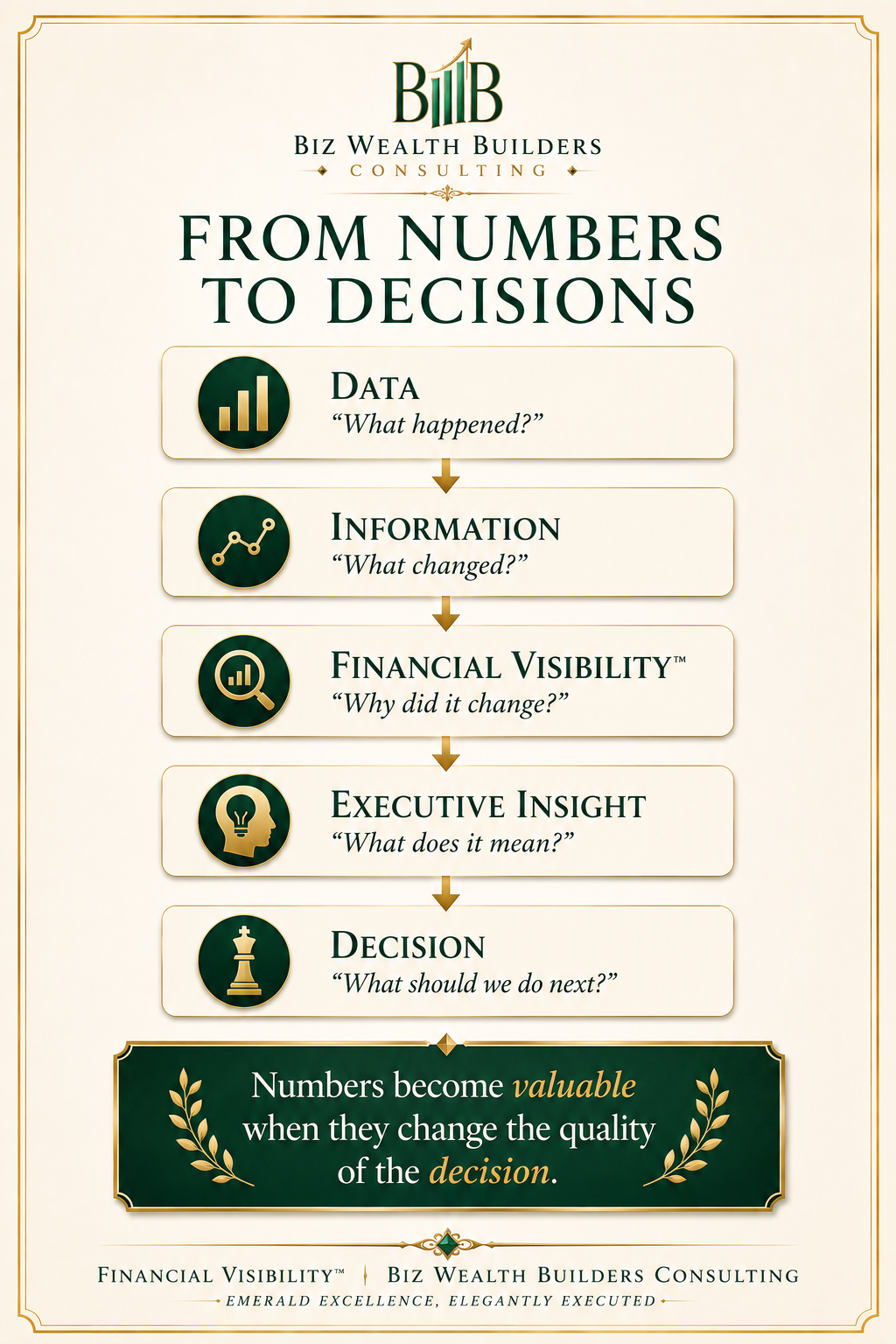
This is the distinction between financial reporting and Financial Visibility™.
Reporting tells you what happened.
Visibility helps you understand what it means.
Leadership determines what happens next.
The Cost of Not Knowing Your Numbers
This is where the problem becomes bigger than accounting.
Because financial uncertainty changes behavior.
You hesitate to hire.
Not necessarily because you can't afford it.
Because you don't know whether you can.
You delay an investment.
Not because it's wrong.
Because you don't understand the financial impact.
You continue serving an unprofitable client because their revenue looks impressive.
You keep prices too low because you haven't calculated what delivery actually costs.
You postpone paying yourself because you're worried about next month.
You hold too much cash because you don't know what's safe to invest.
Or you spend too much because the bank balance looks healthy.
These aren't accounting problems.
They're leadership decisions being made without enough financial context.
And the cost isn't simply inaccurate numbers.
It's everything you don't do because you can't confidently interpret them.
The Distance Between Knowing Revenue and Knowing Your Business
Suppose your goal is to build a $1 million company.
You reach it.
Congratulations.
Now I ask:
How much did you keep?
How much cash did the growth consume?
How much did you pay yourself?
What was your strongest margin?
What was your weakest?
How much revenue was recurring?
How much depended on your largest client?
How many additional people did growth require?
How much founder involvement did the company require?
What return did you receive on the investments you made?
Could the company withstand losing 20% of revenue?
What should you invest in next?
If you can't answer those questions, reaching $1 million gave you a bigger business.
It didn't necessarily give you greater control over it.
And that's the distance Financial Visibility™ closes.
The Financial Visibility™ Model
At Biz Wealth Builders Consulting, Financial Visibility™ isn't simply about tracking money.
It connects five areas of the business.
REVENUE VISIBILITY™
What are we generating?
Where is revenue coming from, and how predictable is it?
↓
PROFITABILITY VISIBILITY™
What are we keeping?
Which clients, services, and activities create economic value?
↓
CASH FLOW VISIBILITY™
What is actually available?
When does money arrive, where does it go, and what is already committed?
↓
OPERATIONAL VISIBILITY™
What does the business require?
What people, systems, capacity, and resources are required to generate and deliver the revenue?
↓
DECISION-MAKING VISIBILITY™
What can we confidently do next?
Hire?
Invest?
Expand?
Increase owner compensation?
Build reserves?
Change pricing?
Grow?
That's why Financial Visibility™ is bigger than accounting.
It connects the numbers to the decisions leadership is responsible for making.
What Knowing Your Numbers Actually Feels Like
Knowing your numbers doesn't mean you never experience uncertainty.
Leadership will always involve judgment.
Markets change.
Clients leave.
Unexpected expenses happen.
Opportunities appear.
But the experience changes.
Instead of:
“I think we can afford it.”
You can say:
“Here are the conditions under which we can afford it.”
Instead of:
“Revenue seems good.”
You can say:
“Revenue increased 18%, margins improved four points, and cash conversion remained stable.”
Instead of:
“We probably need another employee.”
You can say:
“We're operating at this level of capacity, and here's the revenue threshold that financially supports the next hire.”
Instead of:
“I hope next month is better.”
You understand what's already scheduled to happen.
That's the difference.
You're no longer reacting to numbers.
You're using them.
Your 10-Minute CEO Numbers Audit
Before you leave this article, answer these questions without opening your accounting software:
- What is your average monthly revenue?
- What is your average monthly operating cost?
- What is your current profit margin?
- Which service or product generates your strongest margin?
- What percentage of revenue comes from your largest client?
- How much cash does the business need to operate each month?
- How much truly available cash does the company currently have?
- How much are you consistently paying yourself?
- What happens financially if revenue drops 20% next month?
- What happens financially if revenue increases 25% next month?
Now look at your answers.
The goal isn't perfection.
Pay attention to the questions where your answer was:
“I'm not sure.”
Those aren't reasons to feel embarrassed.
They're visibility gaps.
And now you know where to look.
You Don't Need to Become Your Accountant
That's not your job.
Your accountant should help ensure the financial information is accurate.
Your bookkeeper should help ensure transactions are properly recorded.
Your financial team may prepare reports, forecasts, analyses, and recommendations.
But there is one responsibility leadership cannot completely outsource:
Understanding what the financial information means for the business you're leading.
You don't need to prepare the numbers.
You need enough visibility to lead from them.
That's the executive responsibility.
Because your team can give you the information.
Your advisors can interpret it with you.
But ultimately, you're the person deciding:
Where the company invests.
What it stops doing.
What it grows.
What risk it takes.
Who it hires.
How fast it expands.
And what happens next.
Those decisions deserve more than a glance at the bank balance.
Your Next Step
If you're generating revenue but still can't confidently explain what your numbers are telling you about the business, don't start by chasing another revenue goal.
Start by identifying what you cannot currently see.
The Executive Financial Visibility Assessment™ helps founders and CEOs evaluate visibility across their finances, operations, decision-making, and growth.
TAKE THE EXECUTIVE FINANCIAL VISIBILITY ASSESSMENT™ →
Because knowing how much money your company makes is useful.
Knowing what the numbers are telling you to do next is leadership.
Continue the Conversation
Financial decisions can become surprisingly isolating when you're the person expected to have the answers.
That's part of why Legacy Leaders Collective™ exists.
A relationship-centered community for women founders, CEOs, business owners, managing partners, presidents, and established consultants navigating the real decisions behind leadership and growth.
Not another place to perform success.
A place to bring the questions behind it.
JOIN LEGACY LEADERS COLLECTIVE™ →
Pull up a chair.
Jasmyn Camp
Founder & CEO
Biz Wealth Builders Consulting
Helping Founders & CEOs Build Better Businesses Through Financial Visibility™