Discover What's Creating Pressure

The Emerald Ledger


The Emerald Ledger is the official blog of Biz Wealth Builders Consulting, LLC — a space where entrepreneurs and CEOs gain strategic insight into the financial and structural decisions that drive sustainable business growth.

Here, we explore the principles behind financial clarity, premium positioning, capital readiness, and the systems required to transform profitable businesses into wealth-building enterprises.

Each article offers grounded, strategic guidance on how money truly moves inside a business — from strengthening margins and preparing for funding to building structures that support long-term scalability.

This is where leadership meets financial strategy — helping founders move beyond operating a business and begin building an asset designed for lasting wealth and legacy.

Why Productivity Isn't Solving Your Biggest Business Problem

Jul 13, 2026

Why the businesses that scale most sustainably aren't always the businesses working the hardest.

Executive Summary

There comes a point in nearly every founder's journey when working harder no longer produces better results.

The to-do list grows.

The decisions become heavier.

The business becomes more complex.

And despite becoming more productive than ever before, many leaders find themselves feeling further behind.

For years, I believed my biggest challenge was time.

I needed a better planner, a better routine, or another productivity system.

Instead, I discovered something that completely changed how I lead my business.

I didn't have a productivity problem.

I had a visibility problem.

This article explores why productivity eventually reaches its limits, why founders often mistake busyness for progress, and why sustainable growth begins not with doing more—but with seeing more clearly.

Productivity Isn't the Problem

There was a season when I believed the answer to everything was becoming more productive.

If I could wake up earlier...

Plan better...

Focus longer...

Maybe I'd finally stop feeling like I was falling behind.

I was working a full-time job.

Building Biz Wealth Builders Consulting in the early mornings, late nights, and weekends.

Raising my two boys.

Trying to build a business that would one day give us more freedom.

So I did what ambitious founders often do.

I tried to optimize everything.

I bought the planners.

Color-coded my calendar.

Blocked every hour.

Downloaded the apps.

Read the productivity books.

Every new system promised the same thing:

"This will finally help you get ahead."

For a while, it worked.

I crossed more things off my list.

Accomplished more than I ever had before.

Felt more organized.

More disciplined.

More efficient.

But something didn't make sense.

The more productive I became...

The more pressure I felt.

The to-do list never became shorter.

Every opportunity felt important.

Every decision felt urgent.

Every unfinished task quietly whispered that I wasn't doing enough.

The hardest part wasn't being busy.

It was constantly questioning whether I was spending my time on the right things.

Even when I was with my boys, part of my mind was still inside the business.

And when I was working...

Another part of me wondered whether I was missing too much at home.

I wasn't simply overwhelmed.

I felt divided.

That was the realization that hurt the most.

I had started this business to create more freedom.

More presence.

More choice.

Yet somewhere along the way, I had unintentionally built a business that demanded more of me instead of supporting the life I was trying to create.

For a long time, I assumed I needed another productivity system.

Looking back...

I wasn't solving the wrong way.

I was solving the wrong problem.


"Productivity helped me do more. Visibility helped me understand what mattered."

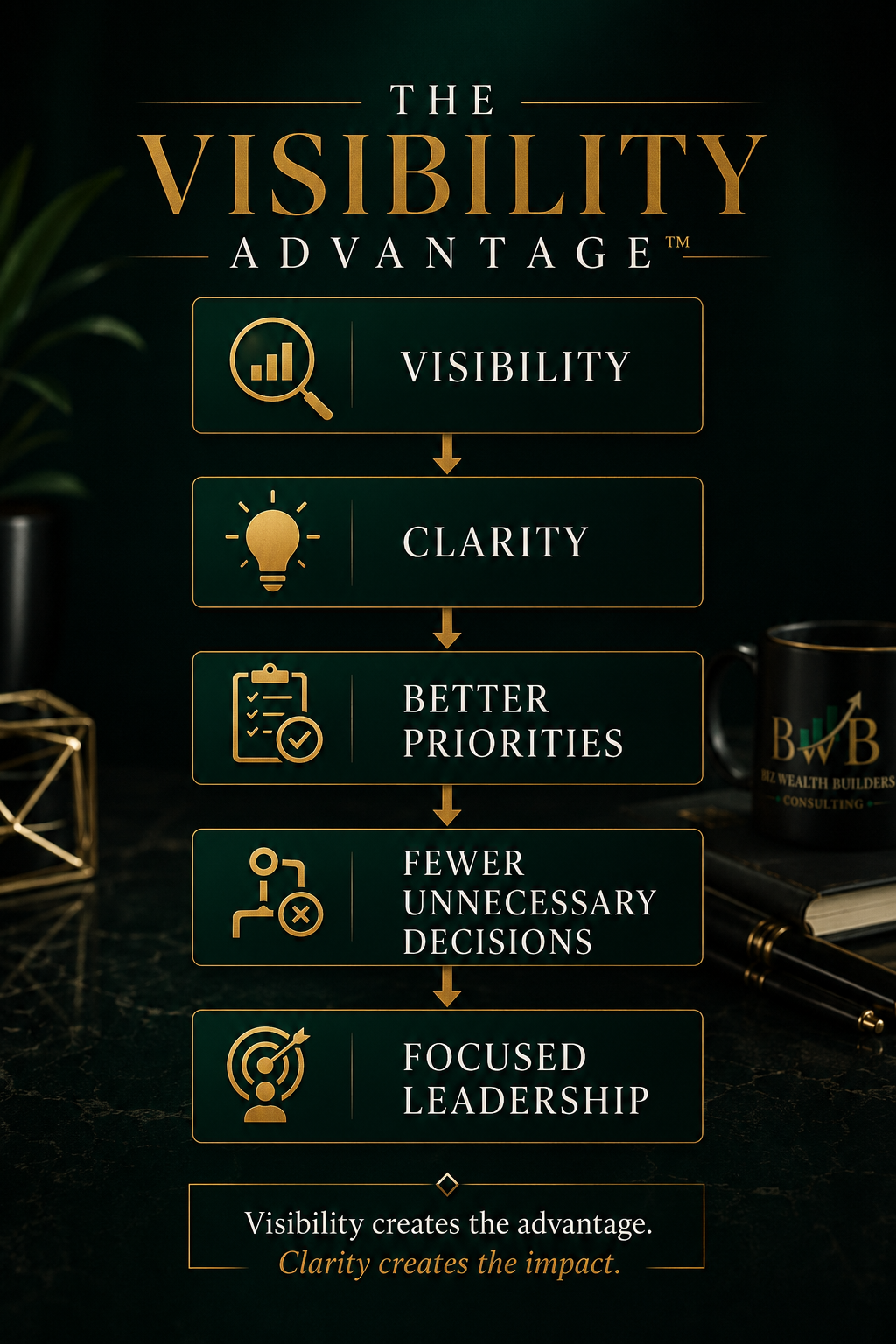
I eventually realized something that has completely changed the way I think about leadership. Productivity can make you incredibly efficient. But it can also make you incredibly efficient at solving the wrong problems. The businesses that scale most sustainably aren't necessarily led by founders who accomplish the most. They're led by founders who can clearly see:


  • what deserves their attention,
  • what's creating unnecessary pressure,
  • and what can safely wait.

That distinction changed how I lead. It changed how I make decisions. And ultimately, it changed how I help other founders grow. Because I've come to believe that productivity isn't the problem. It's often the symptom. The real challenge is that, as businesses grow, complexity often grows faster than clarity. And when clarity begins falling behind...Productivity alone can no longer carry the weight.

The Productivity Trap

At first, productivity feels like the answer.

You create a better routine.

Organize your calendar.

Become more disciplined.

You start checking more things off your list.

For a while, it feels like progress.

Until one day, it doesn't.

Because something subtle begins happening as your business grows.

Complexity increases.

More clients.

More decisions.

More meetings.

More opportunities.

More responsibilities.

Yet many founders continue responding the same way they always have.

They simply try to work harder.

It's understandable.

For most of our lives, productivity has been rewarded.

If you wanted better grades, you studied longer.

If you wanted a promotion, you worked harder.

If you wanted to accomplish more, you became more efficient.

So naturally, many founders assume the same formula will continue working inside their business.

But businesses don't scale the same way careers do.

There comes a point where success is no longer determined by how much you can personally accomplish.

It's determined by how well you can understand what is happening inside your business.

That's a completely different skill.

One requires effort.

The other requires visibility.

Unfortunately, many successful founders don't realize they've crossed that line.

They continue measuring progress by how busy they are.

How many hours they worked.

How many emails they answered.

How many meetings they attended.

How many problems they solved.

The irony is that many of those problems only exist because they haven't been able to see the deeper issue creating them.

That's the productivity trap.

Productivity convinces us we're making progress because we're constantly moving.

Visibility forces us to stop long enough to ask whether we're moving in the right direction.

The difference matters.

Because activity and progress are not the same thing.

I've worked with founders who looked incredibly productive from the outside.

Their calendars were full.

Their teams were busy.

Revenue was growing.

Yet they ended every week asking themselves the same question:

"Why does this still feel so hard?"

The answer usually wasn't a lack of discipline.

It wasn't laziness.

And it certainly wasn't ambition.

It was that productivity had reached its limit.

The business had become too complex to manage through effort alone.

At that stage, growth begins demanding something different.

Not more hours.

Not another planner.

Not another productivity system.

A clearer understanding of what is actually driving results.

One of the biggest mindset shifts I had to make as a founder was realizing that every stage of growth asks a different question.

In the beginning, the question is:

"Can I do enough?"

As your business grows, the question changes.

It becomes:

"Can I clearly see what matters most?"

Those are two very different businesses.

And they require two very different ways of leading.

Because eventually...

The founder who can do the most doesn't win.

The founder who can see the clearest does.

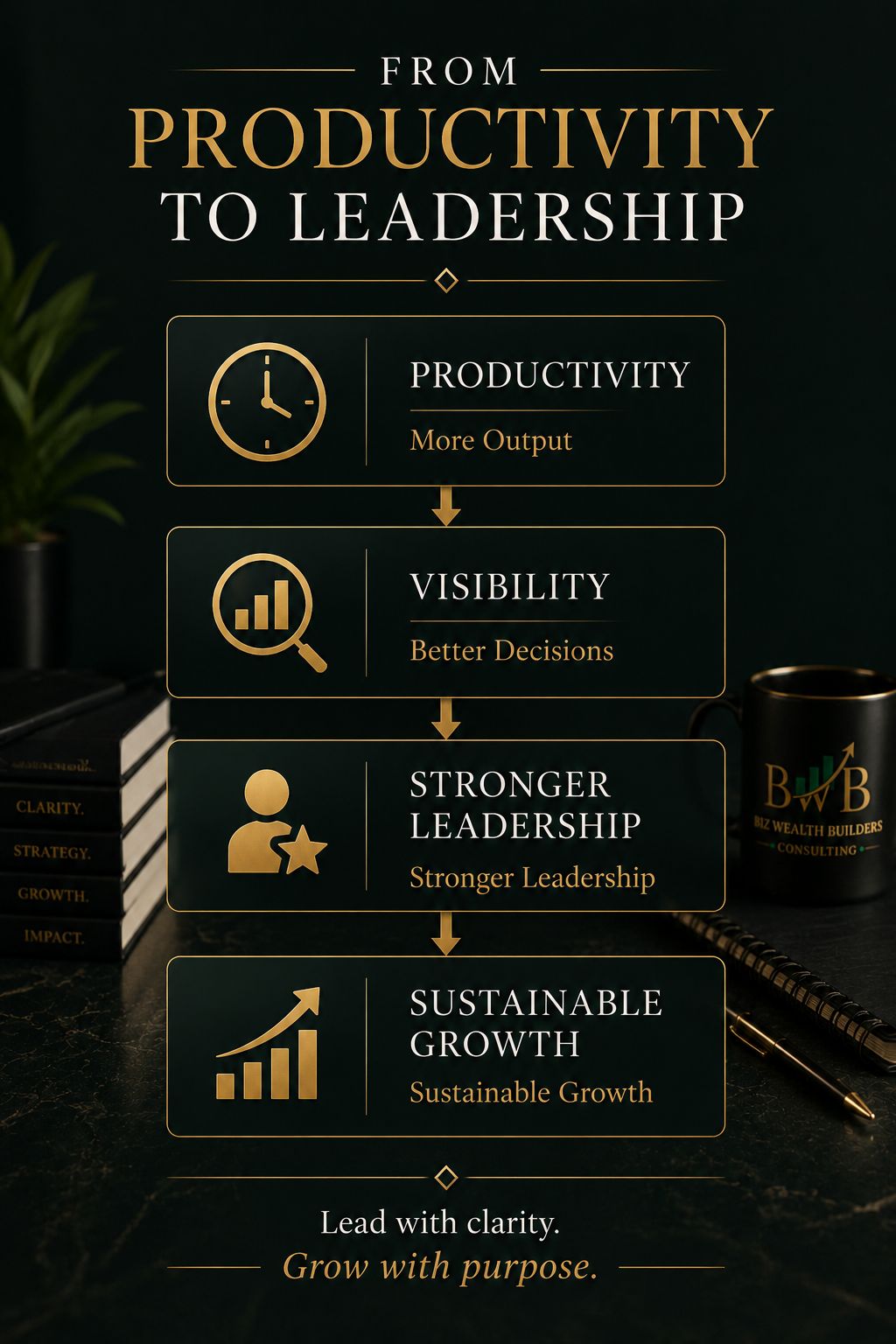
"Productivity helps you manage today's workload. Visibility helps you build tomorrow's business."

The founder who can see the clearest does.

By this point, you might be wondering,

"If productivity isn't the problem, why does growing a business feel so overwhelming?"

For a long time, I believed the answer was simple.

I thought I just had too much to do.

But over time, I realized something that completely changed the way I think about leadership.

Most founders don't feel overwhelmed because they have too much work.

They feel overwhelmed because they're carrying too many decisions.

Those aren't the same thing.

As a business grows, complexity rarely arrives all at once.

It builds quietly.

A new client.

A new hire.

Another offer.

A larger payroll.

More software.

More communication.

More expectations.

Individually, none of those changes feel overwhelming.

Collectively, they create something much heavier.

The invisible weight of leadership.

Most people only see the visible work.

The meetings.

The emails.

The deadlines.

The client conversations.

What they don't see is everything happening in a founder's mind before a single decision is made.

You're thinking about cash flow while reviewing a proposal.

Wondering whether it's finally time to hire.

Questioning if pricing needs to change.

Trying to determine whether revenue is actually translating into profit.

Considering how today's decision will affect your business six months from now.

You're constantly evaluating risk, opportunity, timing, people, and priorities—often all at once.

That mental load doesn't appear on your calendar.

But it consumes an extraordinary amount of energy.

I've started believing that one of the greatest misconceptions about entrepreneurship is that founders become overwhelmed because they have too much to do.

In reality, many become overwhelmed because everything begins competing for the same level of attention.

Every email feels important.

Every opportunity feels urgent.

Every problem feels like it needs an immediate answer.

When everything feels equally important, your brain loses its ability to prioritize effectively.

You stop leading strategically.

You start reacting continuously.

That's exhausting.

Not because you're incapable.

Because your decision-making system is overloaded.

"Founders don't burn out because they have too much work. They burn out because too many decisions compete for the same level of attention."

The Visibility Gap

For a long time, I thought the pressure I was experiencing was simply the price of growth.

The business was becoming more complex.

There were more decisions to make.

More people to support.

More opportunities to evaluate.

I assumed feeling overwhelmed was just part of becoming a successful founder.

Many women I've spoken with have told me the same thing.

"I guess this is just what scaling feels like."

"Maybe I'm just not organized enough."

"I probably need to hire another person."

"Once revenue increases, things will settle down."

But what if the pressure isn't coming from growth itself?

What if growth is simply exposing something that was already there?

That question changed the way I think about business.

Growth doesn't create weak systems.

It reveals them.

Growth doesn't create founder dependency.

It exposes where the business has quietly become dependent on one person's decisions.

Growth doesn't create communication problems.

It makes existing communication gaps impossible to ignore.

Growth doesn't create financial uncertainty.

It magnifies financial decisions that were manageable when the business was smaller but become far more expensive as complexity increases.

That's what I now call the Visibility Gap.

The Visibility Gap is the distance between what's actually happening inside your business and what you're able to see clearly enough to lead confidently.

The larger that gap becomes, the heavier leadership feels.

Not because you're doing anything wrong.

Because you're being asked to make increasingly important decisions with increasingly incomplete information.

When visibility is limited, every decision carries more emotional weight.

Should you hire now—or wait another quarter?

Can the business truly support another salary?

Is cash flow tightening because of a temporary season, or is something more significant beginning to emerge?

Is revenue growing because demand is increasing, or because you're working harder than ever to sustain it?

Without visibility, those questions don't just stay unanswered.

They stay with you.

They follow you into dinner with your family.

They sit beside you while you're trying to fall asleep.

They quietly occupy your mind when you're supposed to be present.

That's why so many founders describe themselves as exhausted even when they're no longer working the longest hours.

They're carrying uncertainty.

And uncertainty is one of the heaviest responsibilities a leader can carry.

The businesses that appear calm from the outside aren't necessarily experiencing fewer challenges.

More often, they've built systems that allow them to understand those challenges before they become crises.

That's the difference.

They don't eliminate complexity.

They make complexity visible.

That realization completely transformed the way I approach every business conversation.

Today, when a founder tells me she's overwhelmed, I don't immediately ask about her workload.

I ask about her visibility.

Because workload is often the symptom.

Visibility is often the diagnosis.

The businesses that scale most sustainably aren't the ones with the smartest founders.

Or the longest hours.

Or the most sophisticated software.

They're the businesses where leaders can clearly see what's driving results, what's creating pressure, and what deserves their attention next.

That's where confidence comes from.

Not certainty that nothing will go wrong.

But confidence that you'll see the problem early enough to respond intentionally instead of reactively.

And that's the shift every founder eventually has to make.

From managing more...

To seeing more.

"Growth doesn't become overwhelming because there is more to do. It becomes overwhelming when leaders lose sight of what matters most."


The Four Dimensions of Executive Visibility™

By now, you may be wondering,

"If visibility is the answer, what exactly am I supposed to see?"

It's a fair question.

When most people hear the word visibility, they immediately think about financial reports.

Profit and loss statements.

Balance sheets.

Cash flow reports.

Those are certainly important.

But they're only one piece of the picture.

Over time, I've come to believe that visibility isn't a report.

It's a leadership capability.

It's the ability to clearly understand what's happening inside your business before problems become expensive and before opportunities are missed.

The founders who lead with confidence don't necessarily have more experience than everyone else.

They've simply developed visibility across the areas that influence every major decision they make.

I've found that sustainable businesses are built on four distinct dimensions of visibility.

When one of these areas is missing, leadership becomes reactive.

When all four work together, leaders stop guessing and start leading with confidence.


1. Financial Visibility™

Financial visibility goes far beyond knowing how much revenue came in this month.

It answers questions like:

  • Where is the business actually making money?
  • Which services are generating the strongest margins?
  • Is revenue translating into profitability?
  • Is cash flow supporting growth—or quietly restricting it?

Many businesses appear healthy because revenue is increasing.

But revenue alone rarely tells the full story.

Without financial visibility, leaders often celebrate growth while unknowingly creating greater financial pressure.

The goal isn't simply to know your numbers.

The goal is to understand what your numbers are trying to tell you.


2. Operational Visibility™

Every business develops friction.

The question isn't whether it exists.

The question is whether you can see it before it slows the business down.

Operational visibility helps leaders recognize:

  • Bottlenecks.
  • Inefficient processes.
  • Communication breakdowns.
  • Recurring problems.
  • Workflow delays.

Many founders become excellent problem-solvers.

But sustainable businesses aren't built by solving the same problems over and over.

They're built by identifying why those problems continue appearing in the first place.

When operational visibility improves, recurring issues become opportunities for improvement instead of permanent frustrations.

3. Capacity Visibility™

One of the most common things I hear founders say is,

"I think I need to hire someone."

Sometimes that's true.

Many times, it isn't.

Capacity visibility helps leaders distinguish between a true resource problem and a prioritization problem.

It asks questions like:

  • Is the team actually at capacity?
  • Where is founder dependency slowing progress?
  • What work should be delegated?
  • What work shouldn't exist anymore?

I've seen founders add employees when what they really needed was greater clarity.

Hiring without visibility doesn't remove pressure.

It often multiplies complexity.

Capacity visibility ensures growth happens intentionally—not reactively.


4. Decision Visibility™

Every other dimension ultimately leads here.

Because leadership is a series of decisions.

Should we hire?

Should we invest?

Should we expand?

Should we increase prices?

Should we change our offer?

The quality of those decisions depends on the quality of what the leader can see.

When decision visibility is low, uncertainty fills the gaps.

Founders begin relying on instinct because they don't have enough context to lead confidently.

Intuition will always have a place in leadership.

But intuition becomes far more powerful when it's supported by visibility.

The strongest leaders aren't the ones who never face uncertainty.

They're the ones who reduce uncertainty before making important decisions.

"Visibility doesn't eliminate uncertainty. It gives leaders enough clarity to move forward with confidence."

These four dimensions don't exist independently.

They're deeply connected.

When financial visibility improves, operational decisions become clearer.

When operational visibility improves, capacity becomes easier to manage.

When capacity becomes clearer, decision-making becomes more intentional.

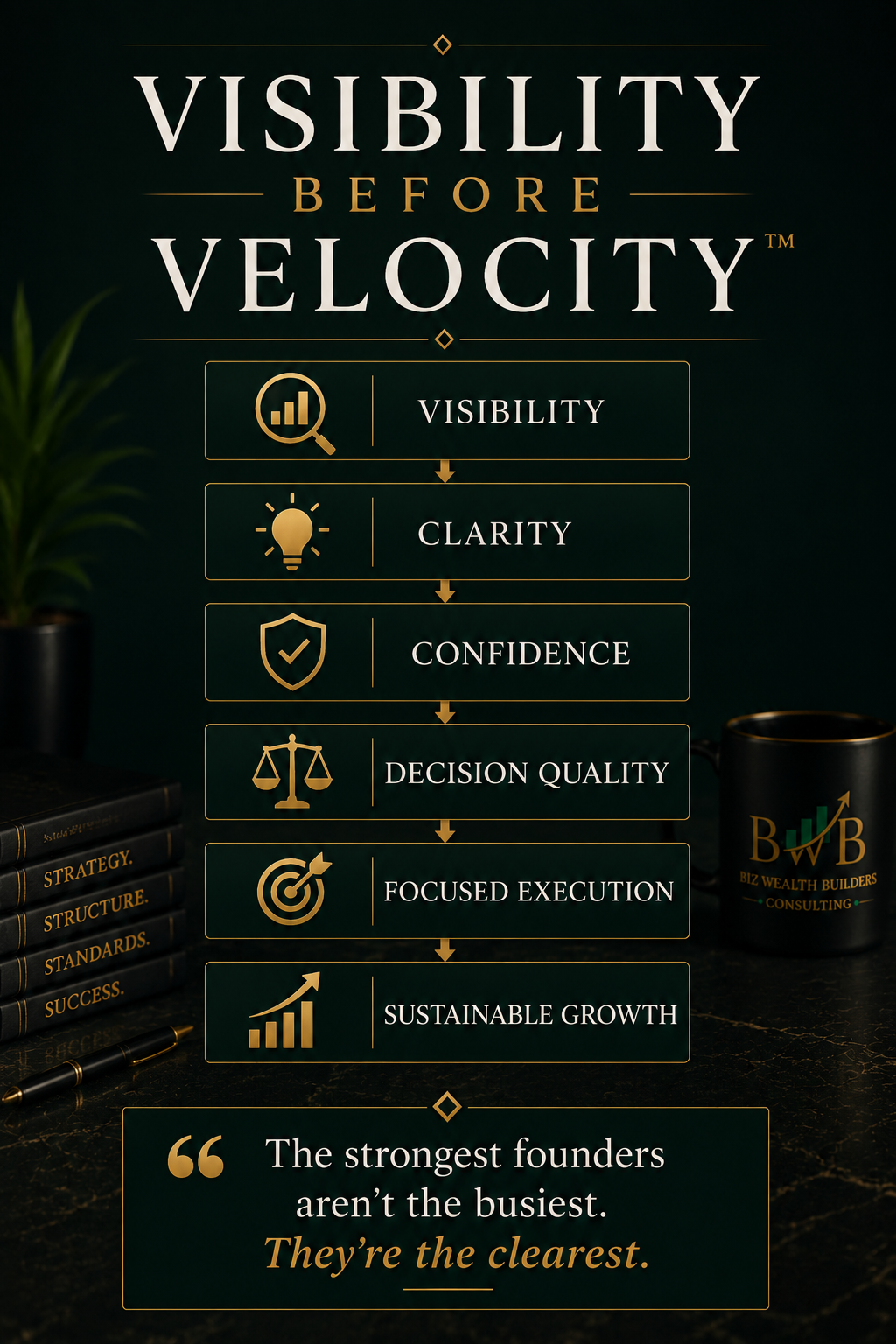
And when decision-making improves, the business becomes easier to lead.

That's why I no longer think about visibility as something you have.

I think about it as something you build.

One decision.

One system.

One layer of clarity at a time.

Because sustainable growth isn't created by seeing everything.

It's created by seeing the right things at the right time.

What Changes When Leaders Can Finally See Clearly

One of the biggest misconceptions about visibility is that it's about having better reports.

It isn't.

Reports don't transform businesses.

Leaders do.

Visibility simply gives leaders the confidence to lead differently.

That's the transformation.

When founders first begin building greater visibility, the business doesn't suddenly become simpler overnight.

The challenges don't disappear.

There are still decisions to make.

Problems to solve.

Goals to achieve.

But something much more important begins to change.

The emotional weight of leading starts to lift.

Instead of wondering whether you're making the right decision...

You begin making decisions with context.

Instead of reacting to whatever feels most urgent...

You begin recognizing what actually deserves your attention.

Instead of carrying every question yourself...

Your team begins making more decisions because expectations become clearer.

That's what visibility creates.

Not perfection.

Confidence.

I've watched founders experience this shift in ways that have nothing to do with spreadsheets.

Leadership meetings become shorter because priorities are no longer competing for attention.

Conversations become more strategic because people are discussing solutions instead of trying to identify the problem.

Hiring decisions become more intentional because leaders understand where capacity is genuinely constrained instead of assuming more people will solve the issue.

Growth begins feeling less chaotic because the business is no longer relying on instinct alone.

The business hasn't necessarily become easier.

The founder has simply stopped leading in the dark.

Perhaps the greatest transformation isn't found inside the business at all.

It's found inside the founder.

When uncertainty begins to decrease, something remarkable happens.

You stop questioning every decision after you've made it.

You stop feeling guilty for stepping away from your laptop.

You stop believing that every problem requires your immediate attention.

You begin trusting your judgment again.

That confidence influences everything.

The way you communicate with your team.

The way you lead meetings.

The way you evaluate opportunities.

The way you plan for the future.

Even the way you show up for your family.

Because leadership doesn't exist in isolation.

The pressure we carry in our businesses often follows us into every other part of our lives.

When visibility increases, many founders discover they're not just building a healthier business.

They're becoming a calmer leader.

A more intentional decision-maker.

A more present spouse.

A more engaged parent.

A more confident version of themselves.

That doesn't happen because the business suddenly becomes perfect.

It happens because they finally understand what's actually happening inside it.

"Visibility doesn't eliminate uncertainty. It replaces unnecessary uncertainty with informed confidence."

I've come to believe that sustainable growth isn't measured by how much a founder can carry.

It's measured by how much clarity they've built into the way their business operates.

Because when leaders can clearly see what's driving results...

What's creating pressure...

And what deserves their attention...

They stop leading reactively.

They start leading intentionally.

And that's where sustainable growth begins.

Start by Seeing What You Can't Yet See

One of the greatest lessons entrepreneurship has taught me is that growth has a way of exposing what success once allowed us to ignore.

When our businesses are smaller, we can often compensate for weak systems with our own effort.

We remember every detail.

We answer every question.

We solve every problem.

We make every important decision.

And for a while, it works.

Until it doesn't.

As complexity increases, effort becomes a less reliable strategy.

Not because we've become less capable.

But because the business has begun asking something different of us.

It no longer needs us to do more.

It needs us to see more.

I've come to believe that's one of the most significant transitions every founder eventually makes.

The shift from being the person who keeps everything moving...

To becoming the leader who builds a business that can move with clarity.

That shift doesn't happen because we suddenly become more experienced.

It happens because we begin asking better questions.

Instead of asking:

"How can I work harder?"

We ask:

"What is my business trying to show me?"

Instead of asking:

"Who should I hire next?"

We ask:

"Where is the real constraint?"

Instead of asking:

"Why does growth feel so heavy?"

We ask:

"What can I not see yet?"

Those questions changed the way I lead my own business.

They've changed the conversations I have with founders.

And they've become the foundation of the work I do every day.

Because I've learned that the businesses that grow most sustainably aren't necessarily the ones with the smartest leaders.

They're the ones led by founders who are willing to pause long enough to understand what their business is trying to tell them before rushing to solve the next problem.

The Executive Financial Visibility Assessment™ was created with that philosophy in mind.

Not to judge your business.

Not to tell you whether you're succeeding or failing.

And certainly not to overwhelm you with more information.

It was designed to help you see what may have been difficult to recognize while you were busy leading.

Because once you can clearly identify where your visibility gaps exist, you stop reacting to symptoms.

You begin addressing the causes.

And that's where meaningful change begins.

Whether your business is preparing for its next stage of growth or simply feels heavier than you expected, I hope that this article has encouraged you to look beyond productivity and ask a different question.

Not,

"How can I do more?"

But,

"How can I lead with greater clarity?"

Because productivity can help you accomplish more tasks.

Visibility helps you build a business that no longer depends on carrying them all yourself.


Take the Next Step

If this article resonated with you, I invite you to take the Executive Financial Visibility Assessment™.

In less than 15 minutes, you'll evaluate your business across the Four Dimensions of Executive Visibility™:

  • Financial Visibility™ – Understand the financial health behind your growth.
  • Operational Visibility™ – Identify where systems and processes are creating friction.
  • Capacity Visibility™ – Recognize the constraints limiting your ability to scale.
  • Decision Visibility™ – Evaluate whether you have the clarity to make confident strategic decisions.

You'll receive an Executive Visibility Score™ that highlights both your strengths and the areas that deserve your attention next.

Because the goal isn't to work harder.

The goal is to see more clearly.

And once you can clearly see your business…

You'll be able to lead it with greater confidence.

"Growth doesn't become sustainable because founders work harder. It becomes sustainable because they gain the visibility and confidence to make better decisions before pressure becomes costly."

About the Author

Jasmyn Camp is the Founder & Business & Financial Strategy Consultant at Biz Wealth Builders Consulting. She helps established female founders build greater financial clarity, scalable operational systems, and executive confidence through her Financial Visibility Operating System™. Her work centers on helping leaders replace uncertainty with clarity so they can grow sustainable businesses without sacrificing themselves in the process.


Want to Stay Inspired?

Join our community and get actionable tips, expert insights, and inspiration delivered straight to your inbox! Subscribe to our newsletter and stay ahead with the latest strategies to grow your coaching business and attract aligned clients. Click the link below to subscribe and elevate your journey today!

Subscribe Now