

Why Successful CEOs Feel More Pressure as Their Business Grows
Jun 08, 2026
Your business became more successful. So why did your life become harder?
There was a time when you wanted exactly what you have now.
More clients.
More revenue.
A growing reputation.
A team to help you deliver the work.
Opportunities you once had to chase now arrive in your inbox.
People look at your business and see success.
And they're not wrong.
You built something that works.
But there's another side of that success that people don't always see.
Your phone starts buzzing before you've finished your coffee.
A team member needs an answer.
A client needs something approved.
There's a proposal waiting for your review.
A payment hasn't arrived.
Someone needs access to something only you have.
You remember the conversation you were supposed to follow up on yesterday.
And somewhere between all of that, you're supposed to be thinking about the future of the company.
By the end of the day, you've made dozens of decisions.
But somehow the decisions that actually require you as CEO are still sitting on your desk.
So later that evening, after you've handled everything else that needed you, you open the laptop again.
And eventually you think something you don't say very often:
“I thought success was supposed to make this easier.”
That's the part of growth we don't talk about enough.
Sometimes the business becomes more successful...
while being the person responsible for it becomes significantly harder.
Growth Was Supposed to Create Freedom
Think about what you originally believed growth would give you.
Maybe it was more money.
But probably not only money.
You wanted choices.
Time.
Stability.
A team.
Financial security.
The ability to step away without everything stopping.
The freedom to be present with your family without mentally running the business from another room.
The ability to think strategically instead of constantly reacting.
Maybe you wanted to build something that eventually became bigger than you.
So you grew.
You brought in more clients.
Revenue increased.
You hired people.
You built systems.
You delegated.
And yet...
more decisions started coming back to you.
The business got bigger.
But your freedom didn't grow with it.
That's the contradiction many successful CEOs eventually encounter.
And it creates a dangerous assumption:
“Maybe this is simply what leadership feels like at this level.”
Sometimes it is.
Leadership carries responsibility.
But constant pressure is not automatically proof that you're leading a successful company.
Sometimes pressure is information.
Success Changes the Nature of the Problem
In the early stages of business, the problem is usually straightforward:
How do we create enough opportunity?
You need customers.
Revenue.
Visibility.
Proof that the business model works.
But once the business begins working, the problem changes.
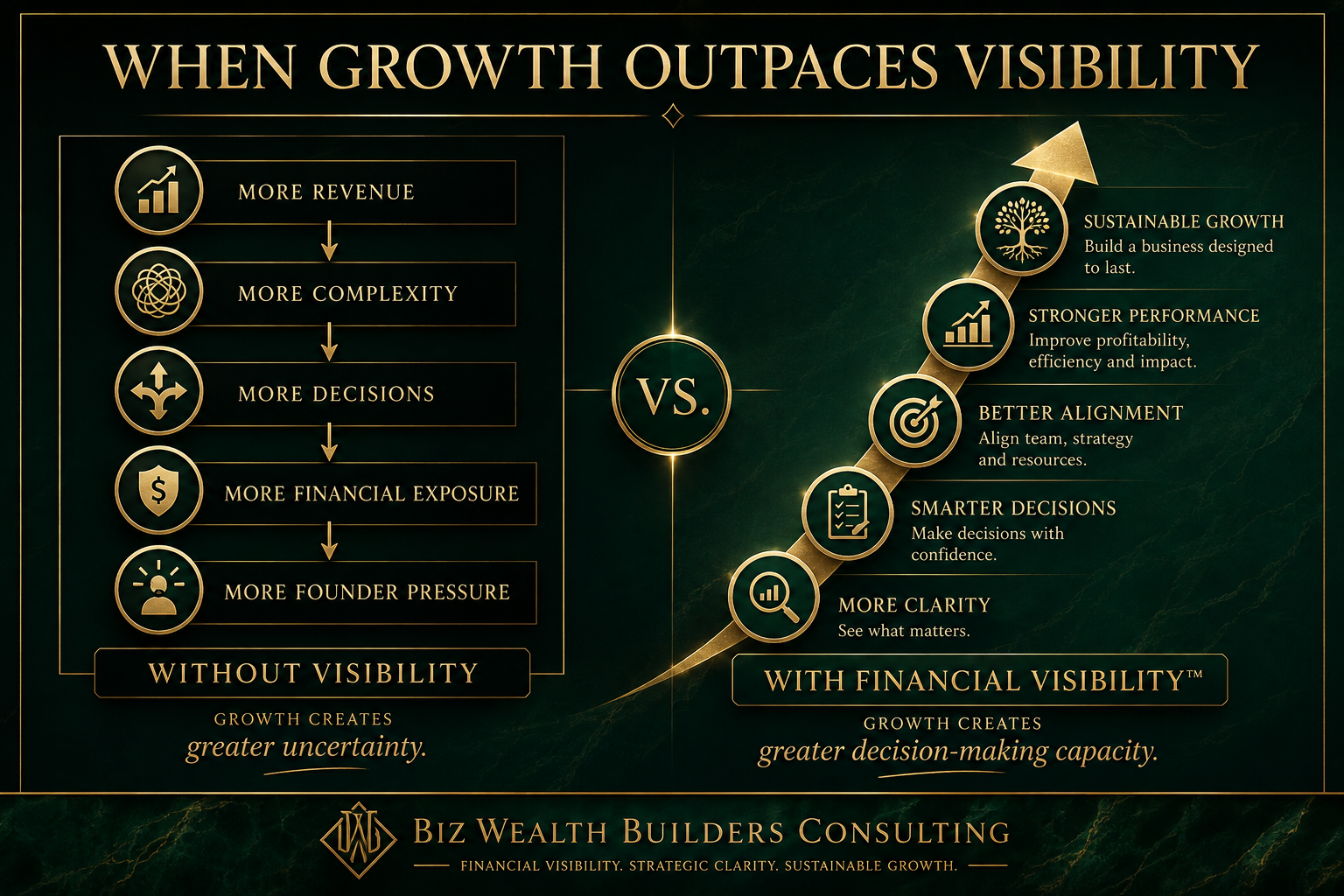
Now you're managing:
More people.
More money.
More clients.
More commitments.
More systems.
More financial exposure.
More decisions.
More consequences when those decisions are wrong.
That's why growth doesn't simply create a larger version of your existing company.
Growth creates a more complex company.
And complexity requires a different way of leading.
The leadership approach that helped you build the first version of the business may become the very thing preventing the next version from functioning without you.
The CEO Becomes the Business's Default Answer
This usually happens gradually.
A team member asks:
“What do you think?”
You answer.
A client situation arises.
You step in.
Something needs approval.
You approve it.
There's an exception to the process.
You decide what happens.
A financial decision comes up.
Everyone waits for you.
None of those moments feels particularly dangerous.
In fact, they can feel responsible.
You're the founder.
You know the business.
You have the context.
You can usually make the decision faster than anyone else.
So you do.
Again.
And again.
And again.
Until something subtle happens:
Your competence becomes infrastructure.
Instead of the business developing the ability to make good decisions, the business develops the ability to ask you to make good decisions.
That's founder dependency.
And successful founders are particularly vulnerable to it because they're usually very good at solving problems.
The better you are at rescuing the business, the easier it becomes for the business to depend on being rescued.
This Is Why Delegation Doesn't Always Solve the Problem
You may have already tried delegating.
You hired help.
Assigned responsibilities.
Created processes.
Maybe you've even told your team:
“You don't have to ask me about everything.”
And yet...
they still ask.
Why?
Because delegation without visibility often transfers tasks without transferring decision-making capacity.
Your team knows what to do when everything goes according to plan.
But what happens when:
A client asks for something outside scope?
An expense exceeds expectations?
A deadline conflicts with another priority?
Capacity becomes constrained?
A customer needs an exception?
An opportunity appears that wasn't anticipated?
Now someone has to interpret the situation.
And if the information, priorities, financial boundaries, and decision criteria aren't visible...
the safest answer is you.
That's why some founders technically delegate 70% of the work and still feel responsible for 100% of the business.
They delegated execution.
They didn't decentralize judgment.
The Hidden Cost of Decision Concentration
Founder dependency doesn't only cost you time.
It slows the entire organization.
Imagine ten decisions are waiting for you.
Individually, each may take only five minutes.
So technically, the workload is less than an hour.
But that's not the real cost.
Until you answer:
Someone can't proceed.
A client is waiting.
A project is delayed.
Another team member can't complete her work.
A purchase isn't approved.
An opportunity isn't pursued.
Now one hour of your decision-making capacity has influenced dozens of hours throughout the organization.
That's what happens when decision authority becomes concentrated at the top.
The CEO doesn't have to perform every task to become the bottleneck.
She only has to be required for enough decisions.
The Pressure Gets Worse Because the Decisions Get More Expensive
At $100,000 in revenue, a mistake may be inconvenient.
At $500,000, it may affect payroll, profitability, capacity, or a major client relationship.
At $1 million and beyond, the consequences can become substantially larger.
The decisions change.
Should we hire another employee?
Can we afford the additional $80,000 in payroll?
Should we expand into another market?
Should we invest $30,000 into this opportunity?
Should we discontinue an offer?
Should we restructure the team?
Can we afford to lose this client?
Should we raise prices?
Do we have enough cash to support the next stage of growth?
These aren't simply operational questions.
They're financial questions.
Leadership questions.
Capacity questions.
Risk questions.
And when you can't clearly see the information underneath them, every decision feels heavier.
That's where CEO pressure and Financial Visibility™ begin intersecting.
You Don't Need More Information. You Need Better Visibility.
Most growing companies don't lack data.
There's plenty of it.
QuickBooks has data.
Your CRM has data.
Payroll has data.
Your bank has data.
Your project-management system has data.
Your marketing platform has data.
Your team has information.
The problem is that the CEO is often responsible for mentally connecting all of it.
You become the person who knows:
What the numbers mean.
What the client needs.
What the team can handle.
What's coming next.
What happened last time.
What you can afford.
What's most important.
And what should happen next.
That's not visibility.
That's institutional knowledge living inside the founder's head.
And as the company grows, maintaining that model becomes increasingly expensive.
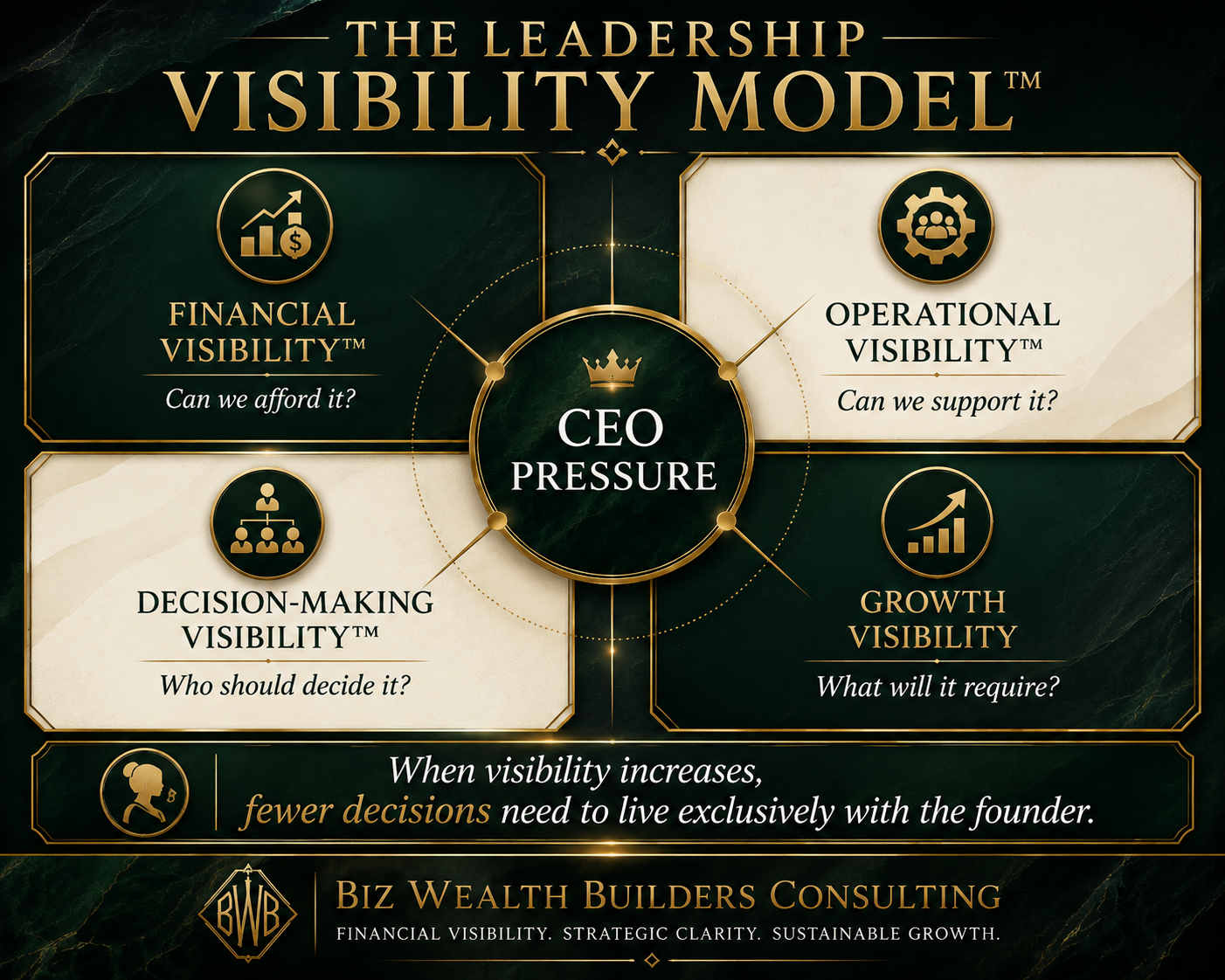
Four Visibility Gaps That Increase CEO Pressure
The pressure you're experiencing may not be one problem.
It may be several visibility gaps showing up at the same time.
1. Financial Visibility™
Can you clearly see:
What you're making?
What you're keeping?
Where cash is going?
What the business can afford?
What growth will require financially?
Without Financial Visibility™, decisions require more caution because leadership cannot clearly evaluate the financial consequences.
2. Operational Visibility™
Can you see:
Where work is getting stuck?
Who owns what?
Where capacity is constrained?
Which processes depend on you?
Where delivery costs are increasing?
What breaks when volume increases?
Without Operational Visibility™, problems tend to reach leadership after they've already become urgent.
3. Decision-Making Visibility™
Does your team know:
Which decisions they own?
Which require approval?
What financial boundaries exist?
What outcomes matter most?
When something should be escalated?
What principles should guide exceptions?
Without Decision-Making Visibility™, delegation stops at the moment judgment becomes necessary.
And the decision returns to you.
4. Growth Visibility™
Can you see what the next stage of growth actually requires?
Not simply the revenue target.
The infrastructure.
People.
Cash.
Systems.
Capacity.
Leadership.
Because the distance between a $500,000 company and a $1 million company isn't simply:
$500,000.
It's everything the business has to become to support that additional revenue.
The Distance Between the Business You Built and the Business You Wanted
This is where the pressure becomes personal.
Because you didn't build this business just to become the busiest employee in it.
You wanted something different.
Maybe you imagined Friday afternoon arriving and being able to close the laptop.
Instead, Friday arrives, and you're thinking about Monday.
You wanted to take your children somewhere without answering Slack messages from the parking lot.
You wanted a team so everything wouldn't depend on you.
You wanted more money so financial decisions wouldn't constantly feel heavy.
You wanted success to create more choices.
But the business grew faster than its ability to operate independently of you.
So now you're standing in the middle of something you worked incredibly hard to build...
and wondering why it still requires so much of you.
That's the distance.
Not between your current revenue and your next revenue target.
Between the life growth was supposed to create and the life the current business model actually requires.
And another $100,000 in revenue doesn't automatically close that gap.
Sometimes it widens it.
More Revenue Can Actually Increase the Pressure
Suppose your business currently generates $40,000 per month.
You're overwhelmed.
So the answer seems obvious:
Get to $60,000.
Then you'll have more money to hire.
More resources.
More breathing room.
But what does another $20,000 require?
More clients?
More delivery?
More contractors?
More customer support?
More sales conversations?
More administrative work?
More financial complexity?
More decisions?
If the underlying structure doesn't change, you may reach $60,000 and discover that you've simply purchased another $20,000 worth of complexity.
That's why growth itself cannot be the solution to a growth problem.
The business has to develop the capacity to support the growth.
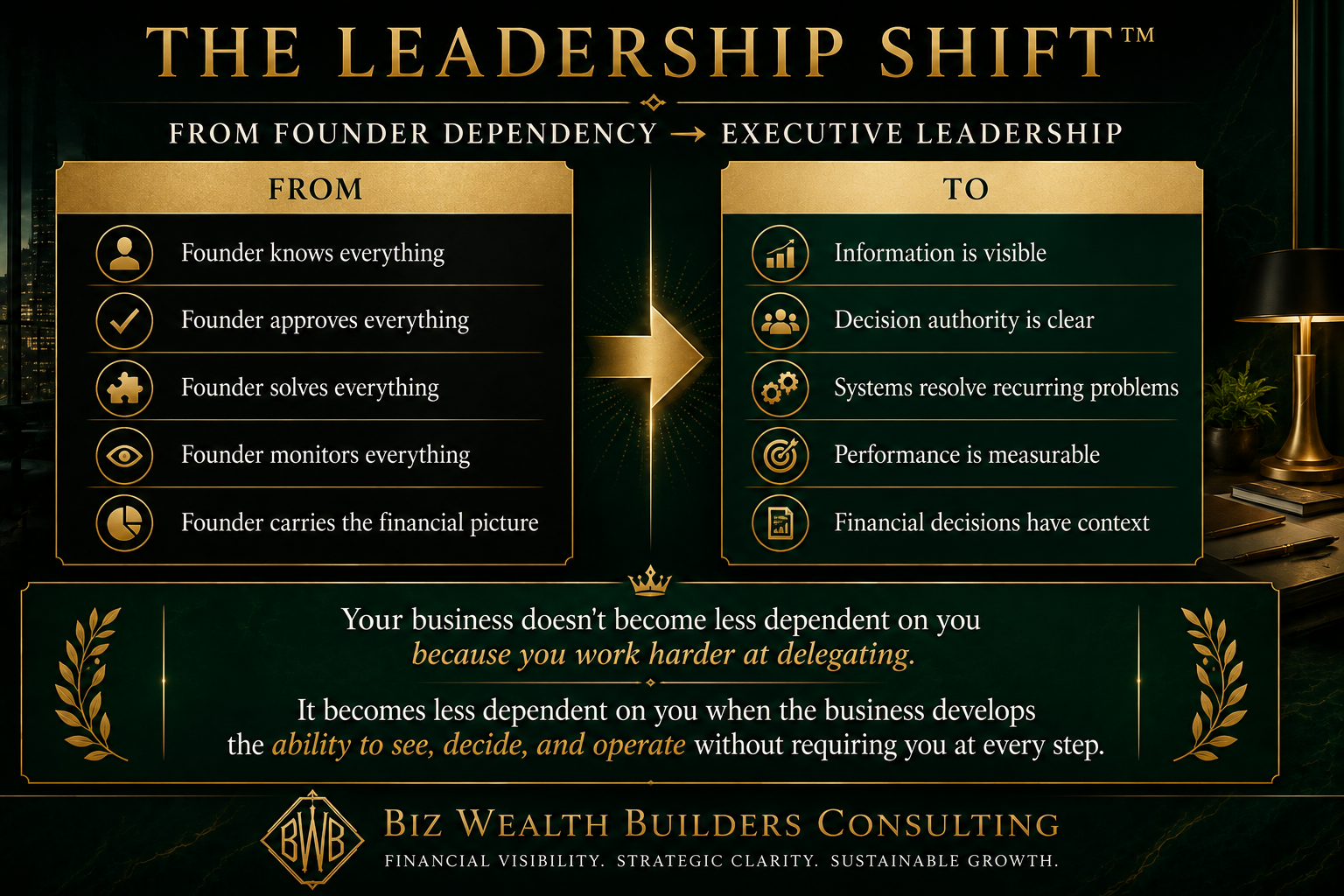
The Leadership Shift™
At some point, successful founders have to make a fundamental transition.
From being the person who knows everything...
to building a business where the right information is visible to the right people.
From making every important decision...
to establishing how good decisions are made.
From personally protecting quality...
to building standards that protect quality.
From carrying the financial picture in your head...
to creating Financial Visibility™.
From being the business's operating system...
to designing the operating system.
That's The Leadership Shift™.
And it's one of the most important transitions between entrepreneurship and executive leadership.
What This Looks Like in Practice
Imagine the same Monday morning.
The business hasn't become smaller.
You still have clients.
Employees.
Revenue.
Responsibilities.
But now something is different.
A team member encounters an issue.
She doesn't immediately message you.
She knows the decision criteria.
She can see the relevant information.
She understands the financial boundary.
She knows what outcome matters.
And she makes the decision.
Another employee sees capacity tightening.
Instead of waiting until something breaks, it's visible in the operating metrics.
The team adjusts.
You consider hiring.
Instead of checking the bank balance and hoping you're making the right decision, you understand:
Expected revenue.
Cash requirements.
Payroll obligations.
Capacity.
Margins.
And the financial threshold required to support the position.
You make the decision.
Then you move on.
Not because leadership became easy.
Because the business stopped requiring you to manufacture clarity every time something happened.
That's the possibility.
Your Executive Pressure Audit
This week, I want you to pay attention every time someone asks you a question.
Don't immediately focus on the person asking it.
Focus on why the question needed you.
Ask:
Did this require my expertise?
Did this require my authority?
Or did this require information the business hasn't made visible?
Then look at the decisions you're personally carrying.
Which ones genuinely belong with the CEO?
Which ones could happen elsewhere if the team had clearer information?
Which ones repeat?
Which ones exist because financial boundaries aren't clear?
Which ones exist because accountability isn't clear?
Which ones exist because nobody knows what "good" looks like without asking you?
You may discover that your problem isn't simply:
“Everyone needs me.”
The deeper problem may be:
The business still needs something only you can currently see.
That's a solvable problem.
Success Should Change Your Role
Growth should eventually change what the business needs from you.
Less execution.
More direction.
Less reaction.
More interpretation.
Less approving.
More designing.
Less solving recurring problems.
More deciding which problems deserve the organization's attention.
That's executive leadership.
And it requires something very different from the hustle that built the early business.
It requires visibility.
Because you cannot lead what you cannot see.
And you cannot sustainably delegate what only you understand.
EXECUTIVE REFLECTION VISUAL
If every important decision still requires you, you haven't built leverage yet.
You've built a larger business around your own decision-making capacity.
The Leadership Shift™
— Jasmyn Camp
Founder & CEO, Biz Wealth Builders Consulting
The Question to Ask Before Your Next Growth Goal
Before deciding that your business needs another $100,000, $500,000, or $1 million in revenue, ask:
If the business grew 25% tomorrow without changing anything else, would my leadership pressure increase or decrease?
Would more decisions reach you?
Would the team require more oversight?
Would cash become harder to predict?
Would fulfillment require more of your involvement?
Would your calendar become fuller?
Would you have more time to think—or less?
If the answer is:
“I'd probably become even busier.”
Pay attention.
Because the next stage of your business may not require more growth first.
It may require building the visibility, structure, and decision-making capacity necessary to support the growth you're already creating.
Growth Should Create Freedom, Not Just Responsibility
There will always be pressure in leadership.
There will always be decisions only you can make.
There will always be moments when the company needs its CEO.
The goal isn't to build a business that never needs you.
The goal is to build one that doesn't need you for things that shouldn't require you.
Because success shouldn't mean carrying an increasingly larger company on your shoulders.
It should mean developing an increasingly stronger company beneath them.
That's the shift.
From founder dependency.
To executive leadership.
From carrying the business.
To leading it.
And sometimes the first step isn't doing anything differently.
It's finally seeing what has been depending on you all along.
Your Next Step
If your business is growing but leadership is becoming heavier, don't immediately assume you need to become more productive.
Find out what the business still requires you to personally see, know, decide, or control.
The Executive Financial Visibility Assessment™ is designed to help founders and CEOs identify the financial, operational, decision-making, and growth visibility gaps creating unnecessary pressure inside their businesses.
TAKE THE EXECUTIVE FINANCIAL VISIBILITY ASSESSMENT™ →
Because the question isn't simply:
Can your business grow?
It's:
Can your business grow without requiring increasingly more of you to hold it together?
Continue the Conversation
Some leadership questions are difficult to solve inside your own head.
That's why I created Legacy Leaders Collective™.
A relationship-centered community for women founders, CEOs, business owners, managing partners, presidents, and established consultants navigating growth, leadership, decisions, and what comes next.
Not another networking room.
Not another place to perform success.
A table where women who carry significant responsibility can think together.
JOIN LEGACY LEADERS COLLECTIVE™ →
Pull up a chair.
Jasmyn Camp
Founder & CEO
Biz Wealth Builders Consulting
Helping Founders & CEOs Build Better Businesses Through Financial Visibility™