
Why Business Structure Matters More Than Strategy for Sustainable Growth
Apr 20, 2026
You probably don't need another strategy. You may need a business capable of executing the one you already have.
You've made the plan.
Increase revenue.
Hire the right people.
Improve marketing.
Raise your prices.
Launch the new offer.
Delegate more.
Create partnerships.
Expand into another market.
You know where you want the business to go.
In fact, you may have spent months thinking about it.
But Monday morning arrives...
and strategy disappears underneath operations.
A client needs something.
Someone on the team needs an answer.
A payment hasn't arrived.
There's something you forgot to follow up on.
A process isn't working the way you thought it was.
Your calendar fills with things that weren't supposed to take this much of your attention.
And by Friday, you've spent another week running the business you have instead of building the business you're trying to create.
So you revisit the strategy.
Maybe the plan needs to change.
Maybe you need a different marketing approach.
Maybe you need another offer.
Maybe you need another hire.
Maybe you need another system.
But sometimes the strategy isn't the problem.
The business doesn't have the structure required to execute it.
And no amount of strategic planning can compensate for that indefinitely.
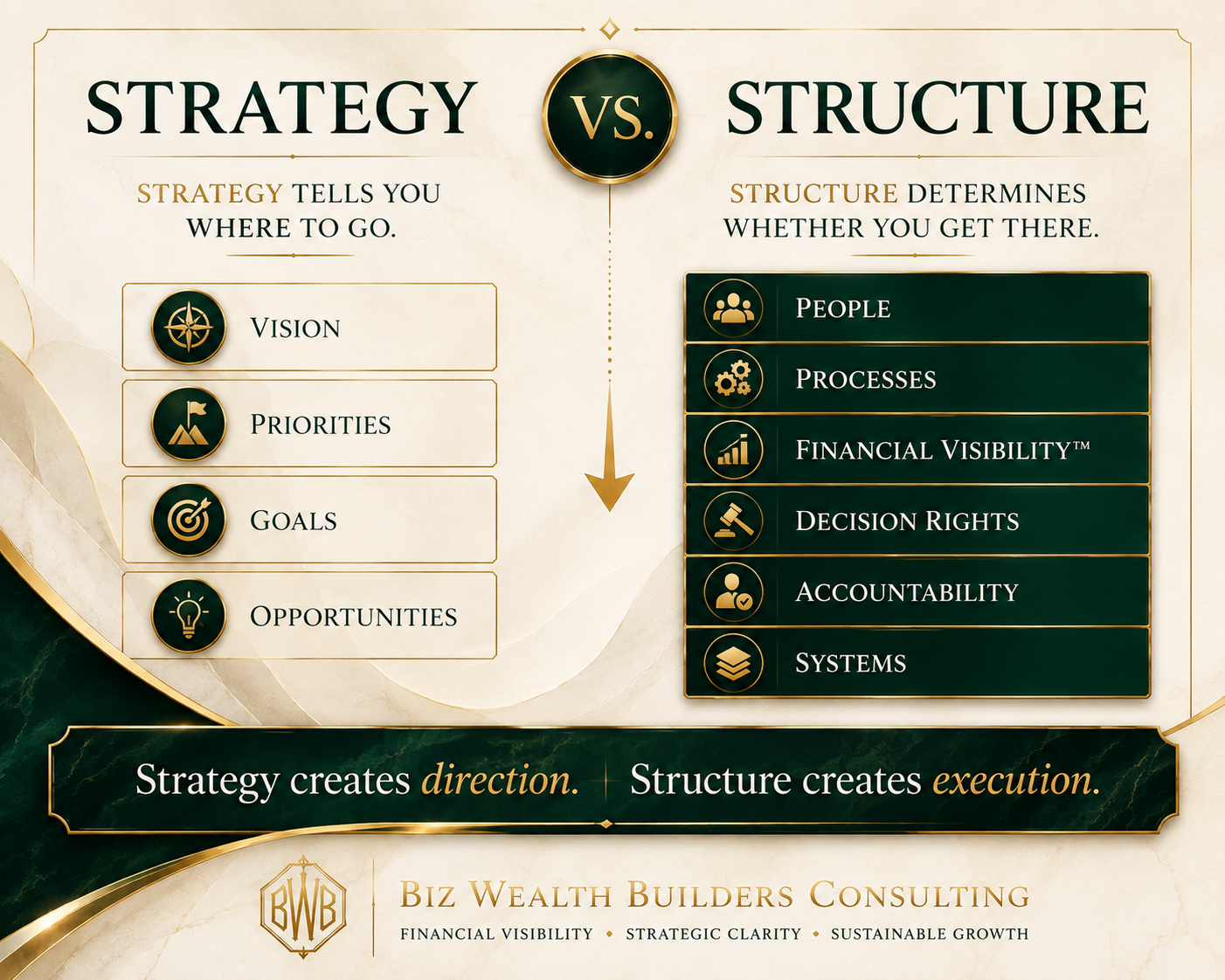
Strategy Tells You Where You're Going. Structure Determines Whether You Can Get There.
Strategy matters.
You need direction.
You need priorities.
You need to understand where the company is going and what you're trying to accomplish.
But strategy answers questions like:
What are we trying to achieve?
Where are we going?
What opportunities should we pursue?
What should we prioritize?
Structure answers a different set of questions:
Who owns it?
How does it happen?
What resources does it require?
How will we measure it?
What happens when something goes wrong?
Who can make the decision?
Can the business financially support it?
That's why a brilliant strategy inside a poorly structured business often produces disappointing results.
The problem isn't necessarily the idea.
The organization doesn't have the infrastructure required to turn the idea into consistent execution.
The Problem Usually Doesn't Look Like a Structure Problem
That's what makes this difficult to recognize.
Poor structure rarely announces itself as:
"Your company needs better operational infrastructure."
Instead, it looks like:
You're constantly busy.
Your team keeps asking questions.
Revenue is inconsistent.
Things get missed.
You're repeating instructions.
You can't step away.
Decisions take too long.
Clients experience inconsistencies.
You have systems, but people don't always use them.
You've delegated, but you're still involved.
You're making money, but cash doesn't feel predictable.
You keep solving problems you thought you already solved.
Eventually you think:
"I need to get more organized."
Maybe.
But if these patterns continue as the business grows, organization probably isn't the full problem.
You're experiencing the symptoms of a business whose complexity has outgrown its structure.
Growth Exposes What Hustle Used to Hide
In the beginning, founders can compensate for almost anything.
No process?
You'll remember.
No system?
You'll handle it manually.
No reporting structure?
You'll check the bank account.
Unclear responsibility?
You'll do it.
Client unhappy?
You'll fix it.
Something falls through the cracks?
You'll stay up late.
That's one of the reasons early-stage businesses can survive with very little formal structure.
The founder becomes the structure.
Your memory is the CRM.
Your judgment is the policy manual.
Your inbox is project management.
Your bank balance is financial reporting.
Your availability is quality control.
And your personal effort fills every gap.
At a small scale, it can work surprisingly well.
Until the business grows.
Now there are more clients.
More transactions.
More employees.
More money.
More decisions.
More risk.
More moving parts.
And suddenly, the system that depended on one person's ability to remember, decide, correct, and rescue everything begins breaking.
Not because you became less capable.
Because the business became too complex to continue operating through your individual capacity.
That's When the Founder Becomes the Bottleneck
Here's the irony:
The founder often becomes the bottleneck because she is exceptionally good at running the business.
You know the clients.
You understand the numbers.
You know what good work looks like.
You remember why decisions were made.
You know which expenses matter.
You understand the nuances nobody else sees.
So when something important happens, everyone comes to you.
And because you can usually solve the problem quickly, you do.
That works.
Until your ability to solve problems becomes the company's primary problem-solving system.
Now the business can only move as quickly as you can:
Answer.
Review.
Approve.
Correct.
Decide.
Explain.
That's not scale.
That's founder dependency disguised as leadership.
More People Won't Automatically Fix It
This is where many growing CEOs make an expensive mistake.
The pressure increases, so they hire.
Now there are more people.
But the founder is still answering the questions.
Still reviewing the work.
Still approving decisions.
Still correcting problems.
Still carrying the financial context.
Except now there's something else to manage:
the people you hired to reduce your workload.
That's why headcount isn't the same as capacity.
And delegation isn't the same as structure.
You can delegate a task:
"Send the client report every Friday."
But structure goes deeper:
Who owns the outcome?
Where does the information come from?
What does a good report contain?
What happens if information is missing?
What decisions can the employee make?
What requires escalation?
What metric tells us whether the process is working?
What happens if the client requests something outside scope?
That's structure.
It turns knowledge into something the organization can use without constantly returning to the founder.
Structure Is More Than SOPs
This distinction is important.
When founders hear "business structure," they often think:
SOPs.
Document everything.
Create checklists.
Build workflows.
Those things matter.
But a company can have 100 SOPs and still be structurally weak.
Because operational structure includes more than instructions.
A scalable business needs visibility across several interconnected areas.
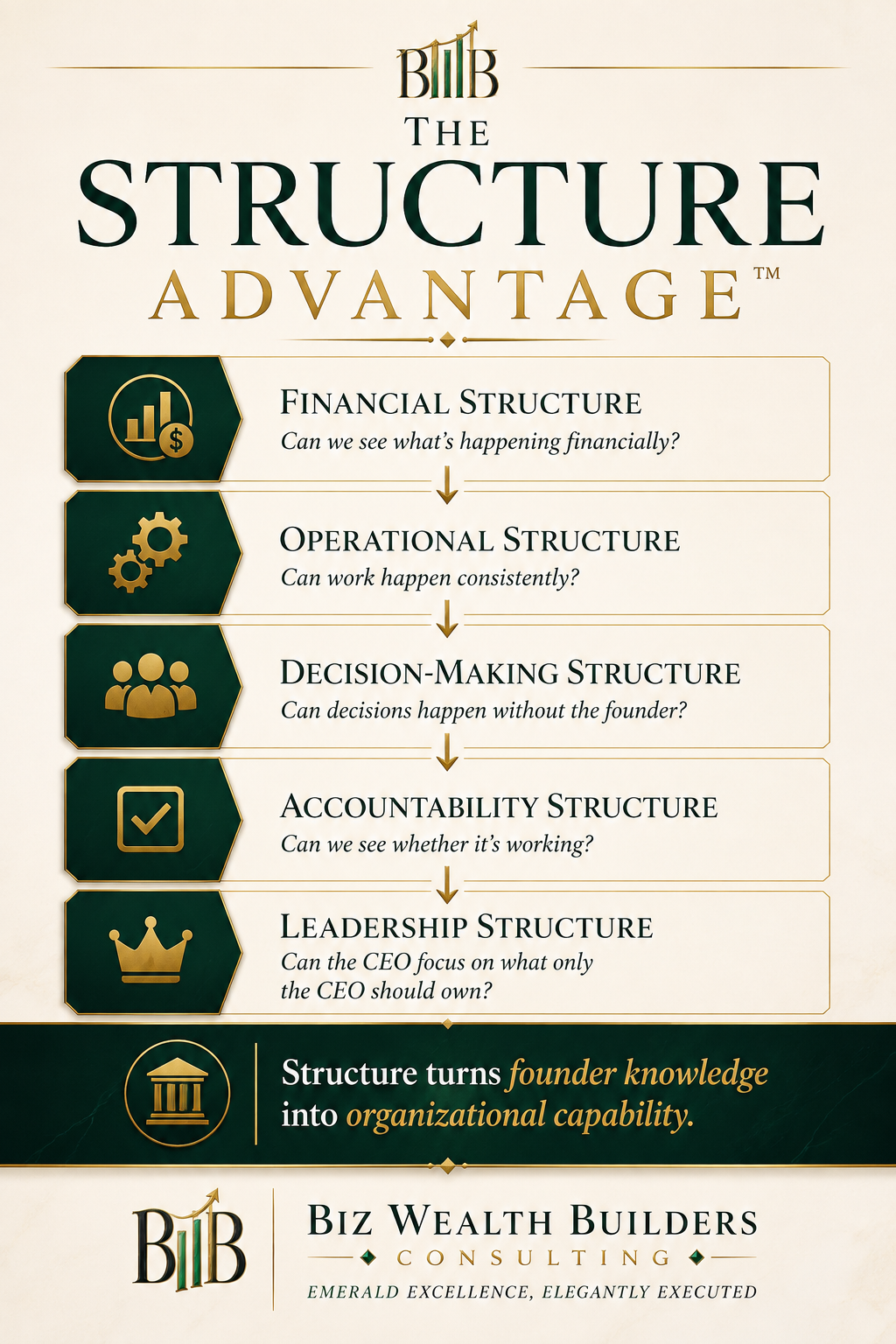
The Structure Advantage™
At Biz Wealth Builders Consulting, I think about business structure through five areas.
1. Financial Structure
The business needs a reliable way to understand:
Revenue.
Profitability.
Cash flow.
Expenses.
Financial commitments.
Owner compensation.
Financial capacity.
Without financial structure, leadership decisions become reactions to the bank account.
And that's where Financial Visibility™ becomes critical.
The goal isn't simply accurate accounting.
The goal is having financial information leadership can actually use.
2. Operational Structure
How does work move through the organization?
Who owns what?
Where are the handoffs?
What happens when something goes wrong?
Where are bottlenecks occurring?
How much capacity exists?
Operational structure turns repeated activity into repeatable execution.
3. Decision-Making Structure
This is one of the most overlooked.
Who is allowed to decide what?
What requires CEO approval?
What financial limits exist?
When should something be escalated?
What information should guide the decision?
If every unusual situation comes back to the founder, you've delegated work without delegating decision-making capacity.
4. Accountability Structure
Everyone being busy doesn't mean the business is performing.
There needs to be clarity around:
What outcomes matter.
Who owns them.
How they're measured.
When they're reviewed.
What happens when performance falls short.
Without accountability, founders often compensate by monitoring everything themselves.
5. Leadership Structure
Finally:
What actually requires the CEO?
This question changes as the business grows.
The founder who once needed to perform the work eventually needs to lead the people performing it.
Then she needs to lead the systems supporting those people.
Eventually, her highest-value work becomes:
Direction.
Capital allocation.
Strategic decisions.
Relationships.
Opportunity evaluation.
Culture.
Leadership.
And the future of the organization.
If the CEO is still consumed by decisions that should happen elsewhere, the business hasn't completed that transition.
The Cost of Weak Structure Isn't Just Inefficiency
This is where structure becomes a financial conversation.
Imagine your company generates $500,000 annually.
You want to grow to $1 million.
You could focus exclusively on acquiring another $500,000 in revenue.
But first, look underneath the existing $500,000.
How much work requires you?
How much gets redone?
How much revenue is delayed because of operational bottlenecks?
How many hours are spent answering repeat questions?
How often are decisions delayed?
How much capacity is actually available?
Which services are profitable after accounting for the resources required to deliver them?
What breaks if sales increase 30% next month?
Because if your current structure is already under pressure at $500,000...
another $500,000 may not create freedom.
It may create a $1 million version of the same problem.
More customers.
More payroll.
More expenses.
More complexity.
More decisions.
And more pressure on the founder.
Revenue growth doesn't automatically strengthen a company.
Sometimes it simply magnifies what's already weak.
This Is Why Structure Has to Come Before Scale
There's a difference between growing and scaling.
Growth means the business gets bigger.
Scaling means the business develops the capacity to become bigger without requiring resources, complexity, and founder involvement to increase at the same rate.
That's why structure matters.
You don't build structure because you want bureaucracy.
You build it because you're trying to create leverage.
One process supports multiple clients.
One dashboard supports multiple decisions.
One clearly defined role removes dozens of questions.
One financial reporting system informs multiple investments.
One decision framework prevents repeated escalation.
That's leverage.
And leverage is what allows growth to create capacity instead of simply creating more work.
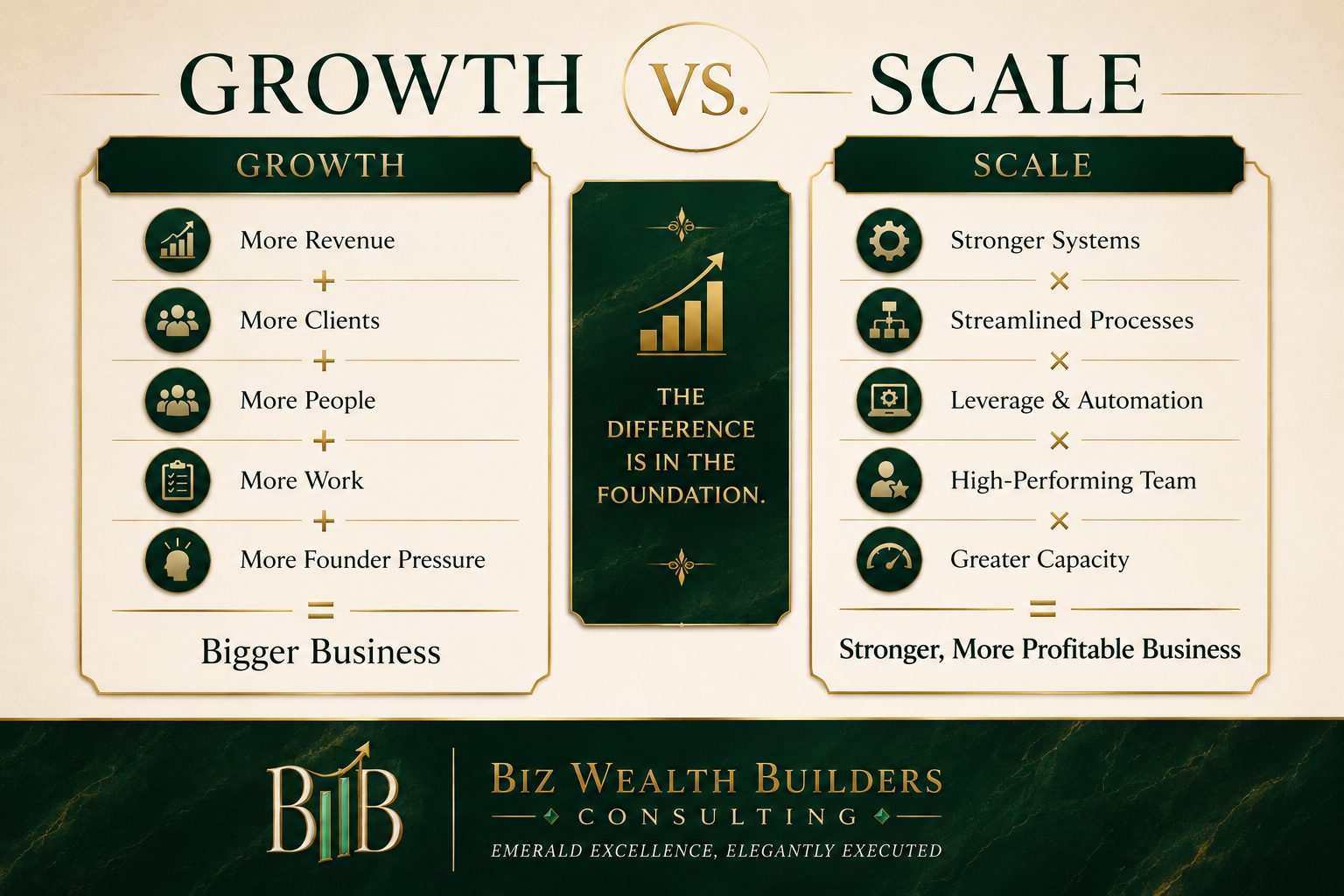
SCALE
More Revenue
+
Stronger Systems
+
Clear Ownership
+
Financial Visibility™
+
Decision Capacity
= Stronger Business
Bottom:
The goal isn't simply to build a bigger business. It's to build one capable of supporting what's next.
Strategy Without Structure Creates a Dangerous Cycle
You've probably seen some version of this.
Step 1: Create a growth strategy.
"This quarter we're increasing revenue."
↓
Step 2: Growth starts happening.
More clients arrive.
↓
Step 3: Operations become strained.
The team gets busier.
↓
Step 4: The founder steps in.
You start solving problems.
↓
Step 5: Strategic work stops.
You're back inside daily operations.
↓
Step 6: Growth slows.
Now you're worried about revenue again.
↓
Step 7: Create another strategy.
And the cycle begins again.
At first, it looks like inconsistent execution.
But the deeper issue is:
The business cannot sustain the strategy without the founder personally compensating for structural gaps.
That's why the solution isn't necessarily a better strategy.
The solution may be strengthening the organization underneath it.
Financial Visibility Is Part of Business Structure
This is also where financial visibility becomes much bigger than bookkeeping.
You can have accurate financial statements and still have a structurally weak company.
Because leadership needs more than historical reporting.
Imagine you're considering adding another service.
The strategic argument looks good.
Customers want it.
There's demand.
Revenue potential is strong.
But structure asks:
What will it cost to deliver?
What's the expected margin?
Who will own it?
Do we have capacity?
Will we need another hire?
What does that do to cash?
How long until the investment pays back?
Does it create additional founder dependency?
What happens to existing services?
Now we're not simply asking:
"Is this a good idea?"
We're asking:
"Is this a good idea for this business, with its current financial and operational capacity?"
That's a much stronger executive question.
And you need visibility to answer it.
What Strong Structure Actually Feels Like
Strong structure doesn't mean everything becomes rigid.
It doesn't mean you create layers of bureaucracy.
And it doesn't mean the CEO disappears.
It feels different.
Your team knows what they own.
Decisions happen without automatically reaching you.
Problems become visible earlier.
Financial information helps guide decisions.
Performance can be evaluated without hovering.
Processes create consistency.
Exceptions don't automatically become emergencies.
You can leave for an afternoon without wondering what will collapse.
You can spend time thinking about next quarter because you're not personally solving every problem from this morning.
And when the company grows...
the pressure doesn't automatically grow at the same rate.
That's the outcome we're trying to create.
The Distance Between Your Strategy and Your Reality
Think about your current business plan.
Maybe your goal is:
$500,000.
$1 million.
$5 million.
A new market.
A larger team.
A second location.
A new service.
A company that can operate without you every day.
Now ask a different question.
What would have to be true inside the business for that strategy to work?
Would reporting need to improve?
Would responsibilities need to change?
Would the company need more cash?
Would pricing need to change?
Would your role need to change?
Would certain decisions need to move away from you?
Would systems need to become stronger?
Would profitability need to improve before revenue increases?
Would the team need greater visibility?
That distance is where your real growth strategy lives.
Not only in the goal.
In the structure required to support it.
Before You Create Another Strategy, Run This Structure Audit
Look at your business and answer these questions:
Financial:
Can I confidently explain what's driving revenue, profitability, and cash?
Operational:
Can I see where work is getting stuck before it becomes a problem?
Ownership:
Does everyone know what they're responsible for?
Decision-making:
Can my team make appropriate decisions without constantly asking me?
Accountability:
Can I measure whether important areas of the business are performing?
Leadership:
Am I spending most of my time doing work that actually requires the CEO?
Growth:
If revenue increased 25% next month, would the business become stronger—or more chaotic?
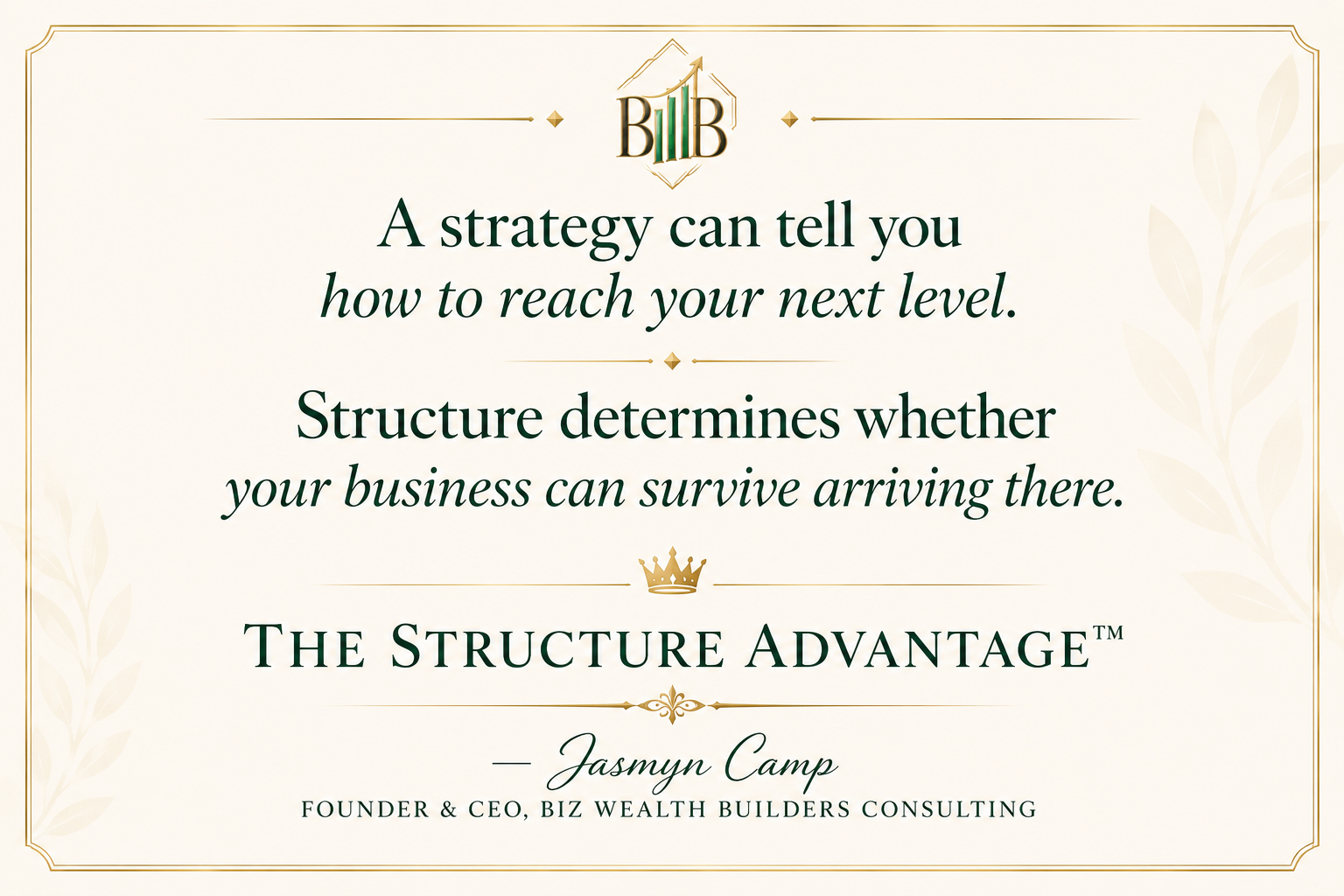
Your answers will tell you something important.
You may not have a strategy problem.
You may have a structural gap standing between your strategy and its execution.
Build the Business Before You Ask It to Carry More
There's nothing wrong with wanting more.
More revenue.
More impact.
More clients.
More freedom.
More wealth.
More opportunity.
But sustainable growth requires asking a second question:
What does the business need to become before it can responsibly carry more?
That's where structure matters.
Because you shouldn't have to personally hold together every new level of growth.
The systems should get stronger.
The information should become clearer.
Decision-making should become more distributed.
Your financial visibility should improve.
The organization should develop more capacity.
And your role should continue evolving.
That's how growth eventually creates what you originally wanted from the business.
Not simply more revenue.
More freedom.
Your Next Step
Before creating another strategy, determine whether the business has the financial and operational structure required to execute the one you already have.
The Executive Financial Visibility Assessment™ helps founders and CEOs identify the visibility gaps creating operational pressure, limiting decision-making, and making growth harder to manage than it should be.
TAKE THE EXECUTIVE FINANCIAL VISIBILITY ASSESSMENT™ →
Because the question isn't only:
Where do you want the business to go?
It's:
Is the business you're building structurally prepared to get there?
Continue the Conversation
These are also the conversations we explore inside Legacy Leaders Collective™.
A relationship-centered community for women founders, CEOs, business owners, managing partners, presidents, and established consultants navigating the decisions that come with building something bigger.
No pretending everything is figured out.
No performative networking.
Just thoughtful women bringing real businesses, real questions, and real experience to the table.
JOIN LEGACY LEADERS COLLECTIVE™ →
Pull up a chair.
Jasmyn Camp
Founder & CEO
Biz Wealth Builders Consulting
Helping Founders & CEOs Build Better Businesses Through Financial Visibility™