

Why Profitable Businesses Still Feel Financially Fragile
Mar 10, 2026
Your business made a profit last year. So why does one slow month still make you nervous?
The accountant tells you the business is profitable.
You look at the income statement.
There it is.
Revenue exceeded expenses.
Technically, the business made money.
And yet...
You don't feel financially secure.
A large client pays two weeks late and suddenly you're watching the bank balance.
Payroll is coming.
Taxes need to be set aside.
Your credit card balance is higher than you want it to be.
There's an investment you know the business needs, but you're not sure whether now is the right time.
And paying yourself consistently still feels more optional than it should.
So you're sitting there looking at a profitable business thinking:
“If we're making money, why does money still feel this tight?”
That's a question more successful business owners need to ask.
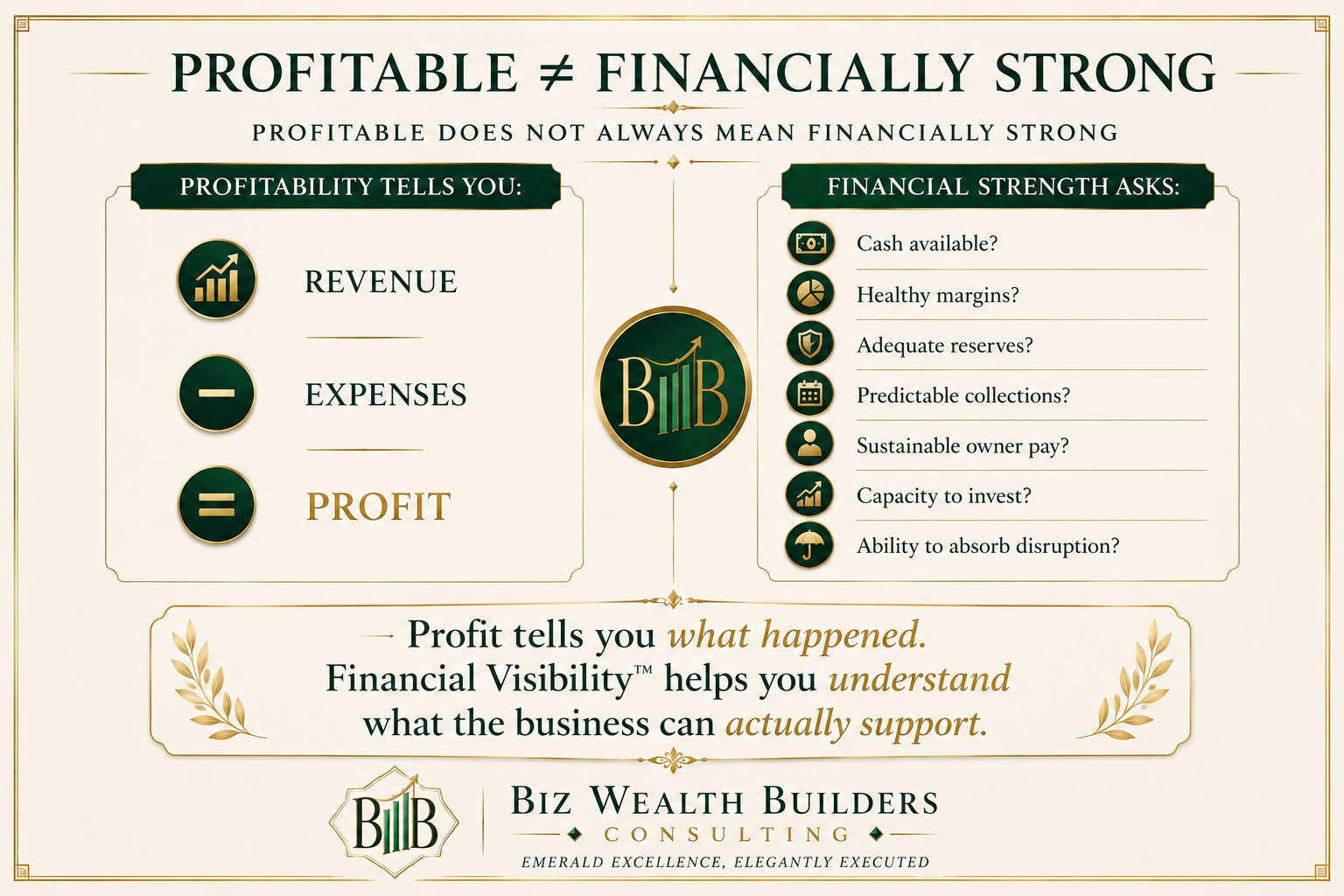
Because profitability and financial strength are not the same thing.
A business can be profitable on paper...
and financially fragile underneath.
Profitability Can Create a False Sense of Security
Profit matters.
Let's be clear about that.
A business ultimately needs to generate more economic value than it consumes.
But profit answers one specific question:
Did revenue exceed expenses during a particular period?
It does not automatically tell you:
How much cash is available today.
How much cash will be available 60 days from now.
Whether clients are paying quickly enough.
Whether you can afford another employee.
Whether you're carrying enough reserves.
Whether your pricing supports future growth.
Whether the owner can pay herself consistently.
Whether one client represents too much of your revenue.
Whether your margins are getting stronger or weaker.
Whether growth is consuming cash faster than it's creating it.
Or whether the business could withstand an unexpected disruption.
Those are different questions.
And when leadership can't answer them confidently, a profitable business can still feel surprisingly unstable.
The Friday-Night Test
Here's one way I think about financial strength.
It's Friday night.
You close the laptop.
Then something happens.
Your largest client emails you.
There's a problem with their payment.
The $15,000 you expected today won't arrive for another three weeks.
What happens inside you?
Is it:
“That's inconvenient. We'll adjust the forecast.”
Or:
“Wait...payroll is next Friday.”
That difference tells you something.
Not necessarily about profitability.
About financial resilience.
A financially strong company has enough visibility, liquidity, margin, and structure to absorb ordinary disruptions without every disruption becoming a leadership emergency.
That's the difference.
Financial strength doesn't mean nothing goes wrong.
It means everything doesn't become a crisis when something does.
Why Profitable Businesses Still Run Out of Cash
This is one of the most important distinctions for growing CEOs to understand.
Profit is not cash.
Suppose your company invoices $50,000 this month.
Your accounting records may recognize that revenue.
But if $30,000 of those invoices haven't been collected yet, you cannot use those receivables to run payroll tomorrow.
Meanwhile:
Employees still need to be paid.
Contractors still expect payment.
Software subscriptions still draft.
Rent still comes out.
Taxes are still due.
Debt payments still happen.
That's why a company can show profit while experiencing cash pressure.
The business made money economically.
It simply hasn't converted enough of that activity into available cash yet.
And that's where financial fragility begins showing up.
Seven Reasons a Profitable Business Can Still Feel Financially Fragile
1. Revenue Is Strong, but Cash Timing Is Weak
You can have great clients and strong sales while still struggling with cash.
The problem may be timing.
Clients pay Net 30.
Or Net 60.
Projects require upfront labor.
Contractors are paid before customers pay you.
Annual expenses hit at inconvenient times.
Taxes create quarterly pressure.
Revenue looks healthy.
But money isn't arriving at the same speed obligations are coming due.
That's not necessarily a profitability problem.
It's a cash-conversion problem.
And without Cash Flow Visibility™, leadership often doesn't recognize the difference until the bank balance gets uncomfortable.
2. You're Profitable, but You Still Can't Consistently Pay Yourself
This one deserves more attention.
The business pays everyone else.
Employees.
Contractors.
Vendors.
Software companies.
Insurance.
The IRS.
The credit card company.
Then you look at what's left.
And decide whether you get paid.
Some months you do.
Some months you don't.
Sometimes you take a distribution when cash looks good and then pull back the next month.
Eventually you tell yourself:
“Once revenue gets higher, I'll start paying myself consistently.”
But if a profitable company cannot reliably compensate its owner, that deserves investigation.
Because owner compensation isn't merely a personal-finance issue.
It's information about the economics of the business.
If the business only works financially when the founder's compensation becomes optional, profitability may not be telling the entire story.
3. Your Margins Are Too Thin
Imagine two companies.
Both generate:
$500,000 in annual revenue.
Company A keeps $150,000 before owner taxes and distributions.
Company B keeps $40,000.
Same revenue.
Completely different financial reality.
Now imagine both companies experience an unexpected $25,000 expense.
For Company A, it's frustrating.
For Company B, it may materially change the year.
That's why revenue alone tells us very little about financial strength.
Margin creates breathing room.
It creates the ability to:
Build reserves.
Absorb mistakes.
Invest.
Hire.
Pay the owner.
Weather slow periods.
Take advantage of opportunities.
Thin margins create the opposite.
Everything has to go right.
And a business where everything has to go right to remain comfortable is financially fragile.
4. Too Much Revenue Depends on Too Few Clients
Imagine your business generates $600,000.
That's impressive.
But one client represents $240,000.
Forty percent.
Now ask:
What happens if that client leaves tomorrow?
Suddenly the question isn't whether the business is profitable.
It's whether the business is resilient.
Client concentration can create the appearance of stability because revenue is strong while quietly creating enormous financial exposure underneath it.
This is why Revenue Visibility™ matters.
Leadership needs to understand not simply:
How much revenue do we have?
But:
Where does it come from, how predictable is it, and how vulnerable are we if something changes?
5. Growth Is Consuming Cash
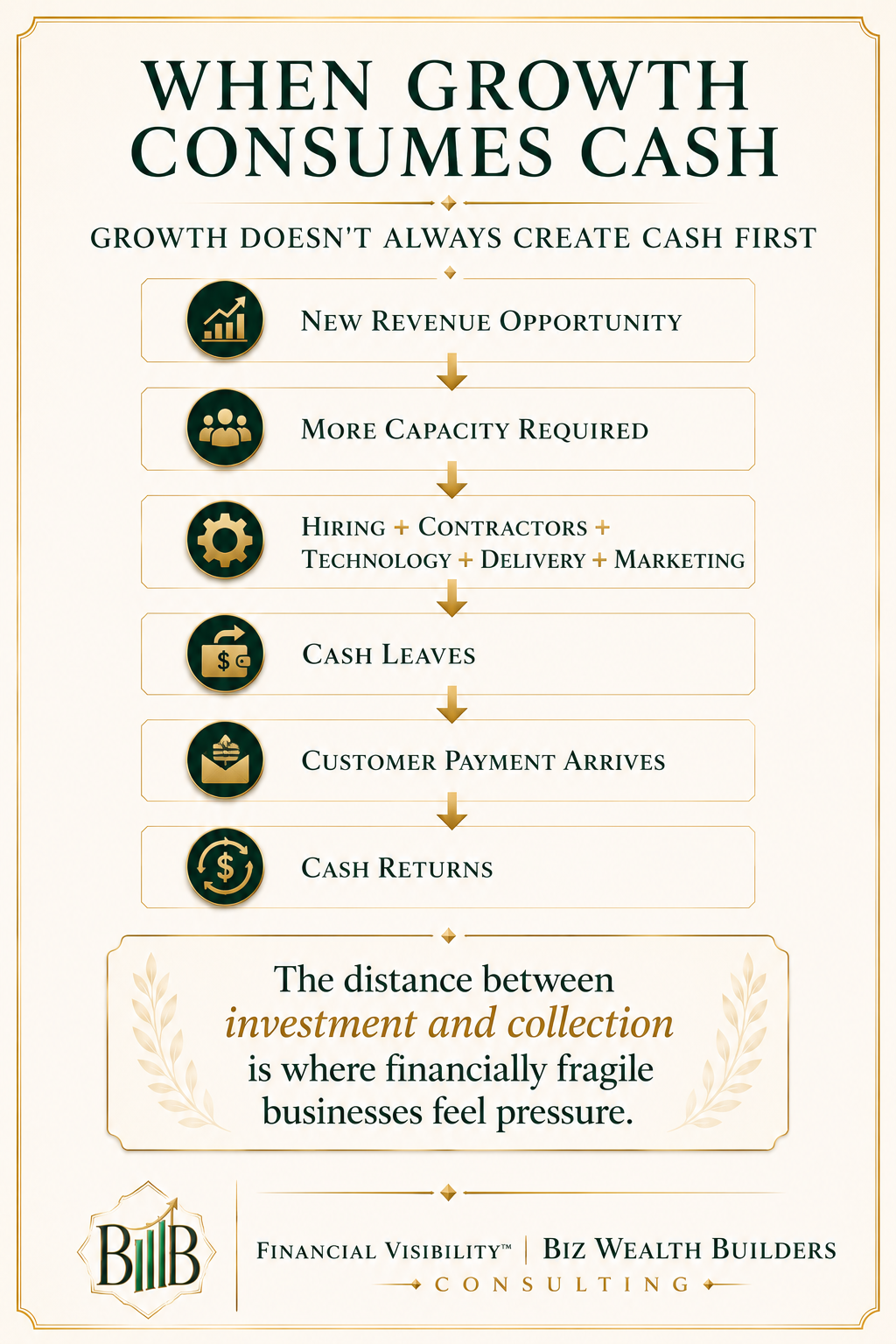
This surprises founders because we tend to assume growth creates money.
Sometimes growth requires money first.
You land a major new contract.
Great.
But now you need:
Another employee.
Additional software.
More inventory.
More contractors.
More marketing.
Additional insurance.
More delivery capacity.
Perhaps a larger space.
Those expenses may occur before the new revenue fully converts to cash.
So revenue increases.
Profitability may even improve eventually.
But cash temporarily becomes tighter.
This is why some companies experience their greatest financial pressure while they're growing.
Growth can create a working-capital requirement.
And if leadership doesn't see that requirement coming, success itself can create financial instability.
6. The Business Doesn't Have Enough Reserves
The question isn't:
“Do we have money in the bank?”
The better question is:
“How much of that money is actually available?”
Because $100,000 in the business account doesn't necessarily mean the company has $100,000 to spend.
Some may belong to:
Taxes.
Payroll.
Upcoming vendor payments.
Debt obligations.
Client projects not yet delivered.
Operating expenses.
Planned investments.
Once those commitments are accounted for, the truly available amount may be substantially smaller.
That's why the bank balance alone can create a false sense of security.
Financial Visibility™ distinguishes between:
Cash that exists
and
cash the business can responsibly deploy.
7. Leadership Is Making Decisions From the Bank Balance
This is perhaps the clearest sign.
Should we hire?
Check the account.
Can we invest in marketing?
Check the account.
Can I pay myself?
Check the account.
Can we purchase equipment?
Check the account.
Can we afford this opportunity?
Check the account.
Your bank account is important.
But it is not a financial strategy.
The balance tells you what cash exists right now.
It doesn't tell you:
What's coming in.
What's going out.
What's committed.
What's profitable.
What's changing.
What next quarter requires.
Or what the decision you're considering will do to the business.
When leadership uses the bank balance as the primary decision-making tool, every decision becomes reactive.
The Distance Between Profitability and Financial Strength
This is the distinction I want more founders to understand.
Imagine your business currently generates:
$750,000 in revenue.
It's profitable.
But you have:
$45,000 available in cash.
$30,000 in receivables over 60 days old.
One client representing 35% of revenue.
Thin margins on your largest service.
No defined operating reserve.
Inconsistent owner compensation.
And another hire you probably need within 90 days.
Are you profitable?
Yes.
Are you financially strong?
That's a different conversation.
And that's where the distance matters.
Because your goal may be $1 million.
But moving from $750,000 to $1 million without strengthening what's underneath the current business may not create security.
It may simply increase the amount of money moving through an already-fragile system.
More Revenue Isn't Always the Solution
When money feels tight, the instinct is predictable:
We need more sales.
Sometimes that's correct.
But not always.
Imagine adding another $100,000 in revenue while maintaining the same:
Thin margins.
Slow collections.
Client concentration.
Pricing problems.
Operational inefficiencies.
Cash-management practices.
Now you have more revenue.
But you've also increased:
Delivery requirements.
Expenses.
Transactions.
Operational complexity.
And potentially the amount of cash required to operate.
This is why a revenue problem and a financial-visibility problem can feel remarkably similar from the founder's seat.
Both can produce the feeling:
“We need more money.”
But the solutions are completely different.
Financial Visibility™ Changes the Question
Without visibility, leadership asks:
“Do we have enough money?”
With Financial Visibility™, leadership asks:
“What is creating the current cash position?”
Without visibility:
“Can we afford to hire?”
With visibility:
“What revenue, margin and cash thresholds make this hire financially sustainable?”
Without visibility:
“Why doesn't the business feel more profitable?”
With visibility:
“Which clients, services and cost structures are driving our margins?”
Without visibility:
“Should we grow?”
With visibility:
“What will growth require financially and operationally—and can the business currently support it?”
That's the shift.
Financial Visibility™ doesn't simply give you more numbers.
It changes the quality of the questions leadership can ask.
The Financial Stability Model™
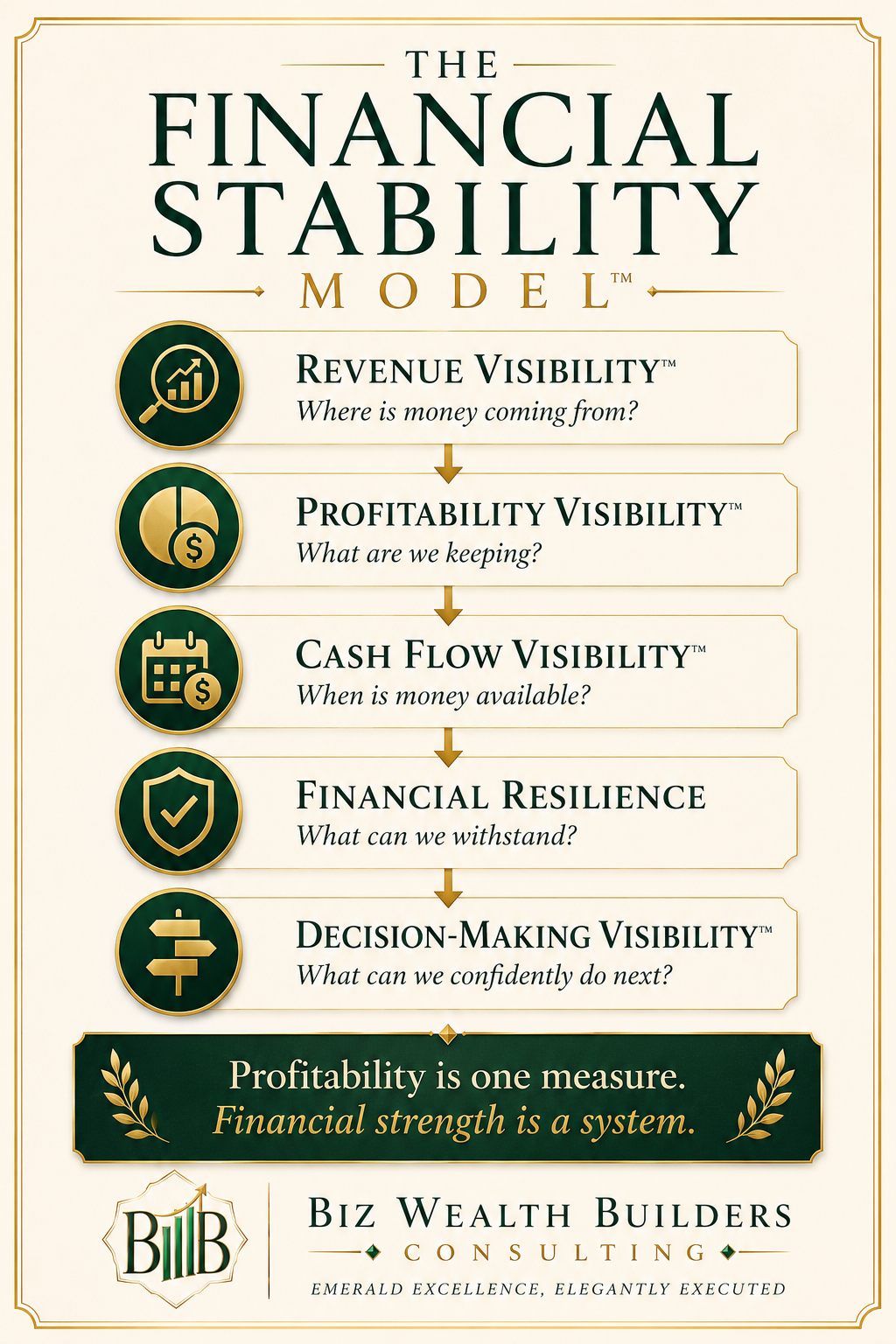
A financially strong business needs more than profit.
I think about financial stability across five interconnected areas.
1. Revenue Visibility™
Where is money coming from?
Which clients?
Which services?
How predictable is it?
How concentrated is it?
How much is recurring?
2. Profitability Visibility™
What is the business actually keeping?
Which services generate strong margins?
Which clients consume disproportionate resources?
Where are costs rising?
Where is revenue masking weak economics?
3. Cash Flow Visibility™
When does money actually become available?
When are receivables expected?
What obligations are approaching?
What cash is committed?
What does the next 30, 60 and 90 days look like?
4. Financial Resilience
What happens when something doesn't go according to plan?
Can the business absorb:
A late payment?
A lost client?
An unexpected expense?
A slow month?
A necessary investment?
Resilience determines whether disruption becomes inconvenience or crisis.
5. Decision-Making Visibility™
Finally:
What can the business confidently do next?
Hire?
Invest?
Expand?
Increase owner compensation?
Build reserves?
Pay down debt?
Pursue an opportunity?
Financial information becomes strategically valuable when it improves decisions.
What Financial Strength Actually Feels Like
It doesn't necessarily mean millions sitting in the bank.
It doesn't mean you'll never worry about money again.
And it certainly doesn't mean every month is predictable.
It means leadership has context.
A client pays late.
You know the impact.
Revenue dips.
You understand the threshold.
An opportunity appears.
You can evaluate it.
You need to hire.
You understand what the business can support.
Cash declines.
You know why.
A large expense arrives.
You've prepared for it.
The numbers may still require difficult decisions.
But they stop creating unnecessary surprises.
That's the difference between simply having financial information and having Financial Visibility™.
Run This Financial Fragility Test
Ask yourself:
If my largest client paid 30 days late, what would happen?
If revenue fell 20% next month, what would change first?
Could I pay myself consistently for the next six months?
Do I know which service produces my strongest margin?
How much cash does the business actually need to operate each month?
How much of the cash currently in my bank account is truly available?
What percentage of revenue comes from my largest client?
Could the business absorb an unexpected $10,000 expense?
If revenue increased 25%, how much additional cash would growth require?
Can I explain what my cash position will likely look like 90 days from now?
You don't need perfect answers.
But pay attention to how many begin with:
“I think...”
That uncertainty is information.
And it may be pointing directly toward the financial visibility gaps underneath the pressure you're experiencing.
Profit Should Eventually Create Power
Profit is important.
But profit isn't the destination.
The business should eventually develop the financial strength to give its leadership options.
The option to invest.
The option to hire.
The option to say no to a bad-fit client.
The option to survive a slow quarter.
The option to pursue an opportunity.
The option to compensate the owner appropriately.
The option to make a long-term decision instead of the decision required by this week's bank balance.
That's what financial strength creates.
Choice.
And choice changes the way a CEO leads.
You stop asking:
“Can we survive this?”
And start asking:
“What creates the strongest business from here?”
That's a very different leadership position.
Your Next Step
If your company is profitable but still feels financially unpredictable, don't automatically assume you need more revenue.
First understand what's happening underneath the revenue you already have.
The Executive Financial Visibility Assessment™ is designed to help founders and CEOs identify gaps across financial visibility, profitability, cash flow, operations, decision-making, and sustainable growth.
TAKE THE EXECUTIVE FINANCIAL VISIBILITY ASSESSMENT™ →
Because the goal isn't simply to build a business that makes money.
It's to build one strong enough to give you choices about what happens next.
Continue the Conversation
Financial pressure can be surprisingly isolating when you're the person everyone assumes has the answers.
That's one reason I created Legacy Leaders Collective™—a relationship-centered community for women founders, CEOs, business owners, managing partners, presidents and established consultants navigating the real decisions behind growth.
No performance.
No pretending everything is perfect because the business looks successful from the outside.
A place to bring the questions leadership doesn't always give you somewhere to ask.
JOIN LEGACY LEADERS COLLECTIVE™ →
Pull up a chair.
Jasmyn Camp
Founder & CEO
Biz Wealth Builders Consulting
Helping Founders & CEOs Build Better Businesses Through Financial Visibility™