

What Should Still Require You? The Leadership Decisions Founders Shouldn't Delegate
Sep 14, 2026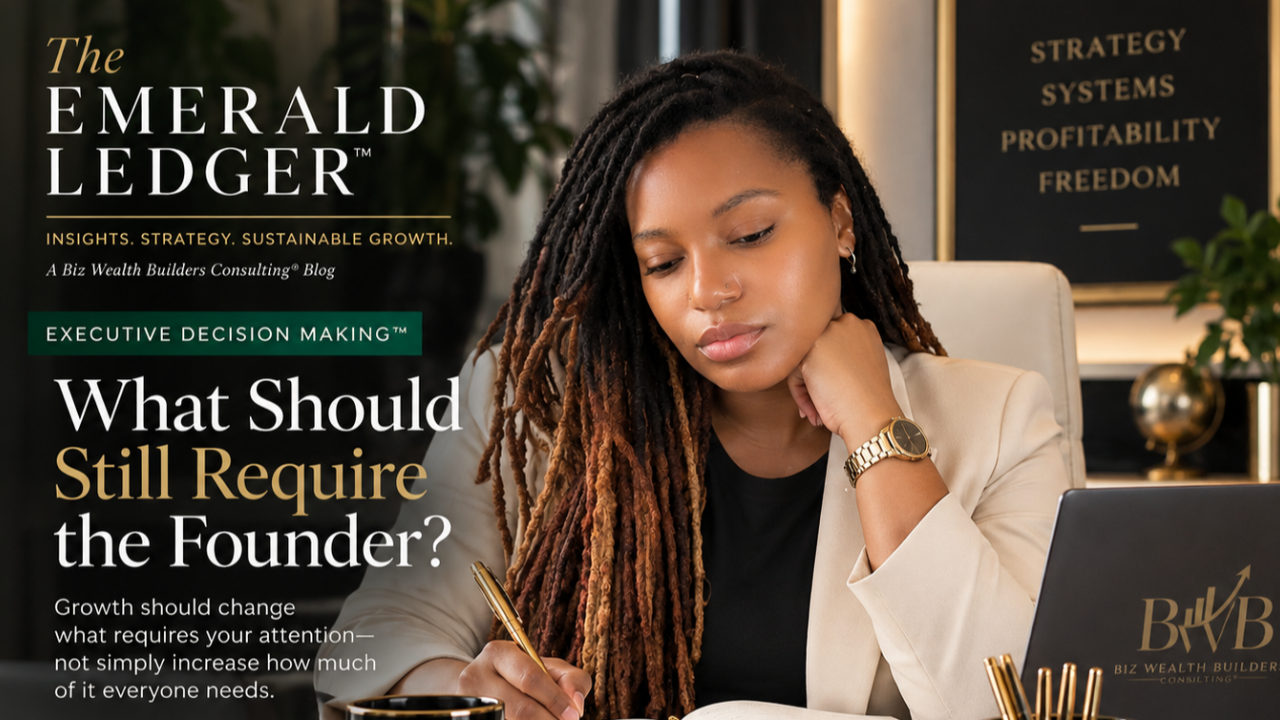
Growth should change what requires your attention—not simply increase how much of it everyone needs.
At some point in business growth, being needed everywhere stops being evidence of leadership.
At first, it makes sense.
You built the business. You understand the clients. You know why you made certain decisions. You can spot when something feels off before anyone else sees it. And when a problem lands on your desk, you can usually solve it faster than explaining the entire history to someone else.
So the questions keep coming.
Can you approve this?
What do you think we should do here?
Can you look at this before I send it?
The client asked for something different. What should I tell them?
Can we afford this?
Individually, none of these moments seem particularly concerning.
Collectively, they reveal something important about how the business operates:
Too much still requires you.
And as the company grows, the question isn't simply whether you need to delegate more.
The better question is:
What should still require the founder?
Founder Observation: Growth Has Made You More Needed, Not Less
One of the strange contradictions of growth is that success can increase founder dependency before it reduces it.
More clients create more decisions.
More revenue creates more financial responsibility.
More people create more questions.
More opportunities create more choices.
More complexity creates more situations that don't fit neatly into the way things have always been done.
So the business grows—and somehow your role expands right alongside it.
You may even have a team now.
You may have software, processes, contractors, or outside support that you didn't have when you started.
Yet you are still the person everyone eventually finds.
That can be confusing.
You did what growing founders are told to do.
You hired.
You delegated.
You implemented systems.
You created processes.
So why does everything still seem to make its way back to you?
Because having more people and processes does not automatically create a business capable of making decisions without its founder.
And that distinction matters.
Founder Psychology: Being Needed Can Feel a Lot Like Being Valuable
Founders spend the earliest stages of business becoming extraordinarily useful.
You learn how to sell.
How to deliver.
How to fix problems.
How to calm clients.
How to stretch money.
How to make decisions with incomplete information.
How to keep moving when there isn't a process, employee, department, or manual telling you what happens next.
Your ability to carry responsibility becomes part of why the business survives.
Then the business grows.
And suddenly, some of the behaviors that helped build it begin limiting what it can become.
That's a difficult transition because being needed can feel a lot like being valuable.
Being copied on every conversation can feel like visibility.
Approving everything can feel like responsibility.
Reviewing everyone's work can feel like protecting your standards.
Knowing everything happening inside the business can feel like control.
And sometimes your involvement is necessary.
But sometimes you're carrying something simply because you've always carried it.
There is a difference between:
“This requires my judgment.”
and
“They need me because we haven't built another way for this to happen.”
That distinction is where the founder's role begins to evolve.
You aren't becoming less important.
You're deciding where your importance belongs now.
Business Diagnosis: Your Business May Not Have a Delegation Problem
Delegation is often treated as the universal solution to founder overwhelm.
Just hand more things off.
But delegate what?
Imagine that your company is considering changing its pricing model.
That decision could affect revenue, profitability, positioning, customer behavior, and future growth.
Founder involvement makes sense.
Now imagine that someone needs approval to send a routine client invoice.
That may involve money too, but it does not require the same level of executive judgment.
Yet inside many growing businesses, both decisions eventually reach the founder.
That's the problem.
The organization hasn't clearly distinguished between operational decisions and executive decisions.
So everything moves upward.
Not necessarily because the team is incapable.
Not necessarily because the founder refuses to let go.
But because the business has never clearly answered:
Who has authority to decide this?
When decision ownership is unclear, the founder becomes the default.
When standards are unclear, the founder becomes quality control.
When financial parameters are unclear, the founder becomes the approval process.
When escalation criteria are unclear, every unusual situation becomes a founder problem.
And when enough of those things accumulate, growth starts to feel heavier than the revenue suggests it should.
The founder isn't simply running the company anymore.
She's compensating for what the company has not yet learned to carry.
Financial & Operational Visibility: You Cannot Responsibly Release What You Cannot See
This is where the conversation becomes bigger than delegation.
Because there is another reason founders remain involved:
They don't trust what they cannot see.
And sometimes they shouldn't.
Telling a founder to “let go” without giving her visibility into what happens after she does isn't empowerment.
It's exposure.
You cannot responsibly delegate financial authority when you don't have reliable visibility into cash flow.
You cannot comfortably release client delivery when there are no clear indicators of whether standards are being maintained.
You cannot distribute purchasing decisions when nobody knows the financial parameters.
You cannot give someone operational ownership when there is no agreement about what should trigger escalation.
Without visibility, stepping away feels like guessing.
So the founder stays close.
She checks.
She approves.
She asks for updates.
She gets copied.
She reviews.
And gradually, her personal involvement becomes the mechanism the business uses to create certainty.
That's why delegation without visibility isn't freedom.
The alternative isn't more control.
It's better visibility.
A growing business should increasingly allow the founder to understand:
What is happening?
What is changing?
What is within an acceptable range?
What requires attention?
What can be handled without me?
What actually requires my judgment?
Financial reporting, performance indicators, decision authority, operating standards, accountability, and escalation criteria give the founder another way to remain informed.
Not through constant involvement.
Through visibility.
Executive Decision: Decide What Deserves Access to You
As the business grows, your attention becomes increasingly valuable.
That means not every decision should have equal access to it.
Founder involvement should become concentrated around the areas where your judgment creates disproportionate value.
Direction.
Where are we going?
Which opportunities support that direction?
Which opportunities look attractive but distract us from what we're building?
What should the next stage of this company look like?
Capital.
Where should money, people, and capacity be invested?
Can we responsibly afford the next hire?
What should we fund now—and what needs to wait?
Where will the next dollar create the greatest return?
Standards.
What should clients consistently experience from this company?
What quality are we unwilling to sacrifice for speed?
What does excellence mean here?
What kind of company are we actually building?
High-consequence decisions.
Major partnerships.
Significant financial commitments.
Key hires.
Pricing changes.
Business-model decisions.
Strategic opportunities.
Decisions where getting it wrong materially changes the company's financial position, reputation, capacity, or future.
These are not interruptions to the founder's work.
They are the founder's work.
The problem is when that work has to compete with approving invoices, correcting routine work, answering questions someone else should be equipped to answer, and solving problems the business should already know how to solve.
Sustainable Growth: Your Importance Should Become More Concentrated
The goal isn't to build a company that doesn't need you.
That idea has never fully captured what leadership becomes as a company matures.
The business should still need your judgment.
Your vision.
Your discernment.
Your leadership.
Your ability to see what isn't obvious yet.
What should change is how frequently the business requires your presence to continue functioning.
Early in the business, you are often the answer.
Later, your responsibility is to create an organization capable of producing more answers without you.
That means moving from:
answering every question
to establishing decision authority.
Checking everything
to establishing standards.
Knowing everything
to creating visibility.
Solving every problem
to defining escalation.
Carrying responsibility
to building accountability.
Your role begins moving from answering to governing.
And that shift does something important.
It gives you back the capacity to think.
To notice.
To build relationships.
To evaluate opportunities.
To look at the numbers.
To anticipate what is coming.
To make the decisions that actually require the perspective of the founder.
Because growth should not simply increase the number of things competing for your attention.
It should increase the value of where you choose to place it.
Executive Reflection
Look at the last seven days.
Not your entire business.
Just seven days.
Think about every question, approval, problem, decision, review, and request that came back to you.
Then ask yourself:
Which of these genuinely required my judgment?
And then ask the harder question:
Which required me only because the business has not developed another reliable way for it to happen?
Some things may require knowledge that still exists only in your head.
Transfer the knowledge.
Some may require you because nobody has been given clear authority.
Define the authority.
Some may require you because there isn't a standard.
Create the standard.
Some may require you because you cannot see what is happening without personally participating.
Strengthen the visibility.
And some should continue requiring you because they involve the direction, capital, standards, relationships, and high-consequence decisions that belong at the executive level.
Protect those.
Because the goal isn't to become unnecessary to the business you built.
It's to stop being necessary everywhere.
The Executive Decision
Before you ask yourself what else you can delegate, ask:
What should still require me at this stage of the business?
Then build the company around that answer.
Because sustainable growth isn't created by teaching the founder to carry increasingly more responsibility.
It's created by strengthening what the business can responsibly carry without her.
And when that happens, your role doesn't become smaller.
It becomes more valuable.
Continue the Conversation at the Executive Growth Roundtable™
If you've been asking yourself why growth has brought more responsibility instead of more capacity, this month's Executive Growth Roundtable™: Visibility Before Velocity™ is where we're taking the conversation deeper.
This isn't another webinar designed to give you more information to add to your already-full plate.
It's an executive conversation about what your business may need to carry differently as it grows—and what should still require you.
Join us September 17, 2026, for the Executive Growth Roundtable™.
Come prepared to look at your business differently.
You may discover that the next stage doesn't require more from you.
It requires more from the business you've built.
Visibility Before Velocity™.