

Revenue Is Growing. So Why Isn't Your Business Keeping More of It?
Nov 02, 2026
Estimated reading time: 6–7 minutes
By Jasmyn Camp | Founder, Biz Wealth Builders Consulting
The Executive Visibility Brief™ | November 2, 2026
Your business generated more revenue this quarter than it did last quarter.
Your client roster is expanding. Your calendar is full. You're signing larger contracts and bringing in more money.
On paper, the business is growing.
So why doesn't it feel like you're keeping more of what you earn?
This is one of the most important financial questions a growing service-based business owner can ask.
Because revenue growth and profitability growth are not the same thing.
A business can increase sales, expand its operations, and serve more clients while simultaneously weakening its profit margins.
And without a clear view of what happens between revenue earned and profit retained, that problem can remain hidden behind impressive sales figures.
The Revenue Growth Illusion
Revenue is often the most visible measure of business success.
It's the number founders celebrate when they reach a new milestone. It's the figure highlighted in business updates and used to measure momentum.
But revenue tells you how much business you're generating.
It doesn't tell you how efficiently your business converts that revenue into profit.
Consider a growing consulting business.
The founder has increased monthly revenue by 40% over the past year.
From the outside, the business appears to be thriving.
But behind the growth, several changes have occurred:
-
Contractor expenses increased to support additional clients.
-
Software subscriptions expanded as the team adopted new systems.
-
Marketing costs increased to sustain lead generation.
-
Administrative expenses grew as operations became more complex.
-
The founder continued paying themselves inconsistently.
The business is generating more revenue.
But is it actually becoming more profitable?
To answer that, we need to look beyond the top line.
A Business Generating $50,000 Can Be Less Profitable Than One Generating $35,000
Let's examine an illustrative service-based consulting business.
The company has experienced significant revenue growth over twelve months.
Here's what its monthly financial performance looks like before and after that growth.
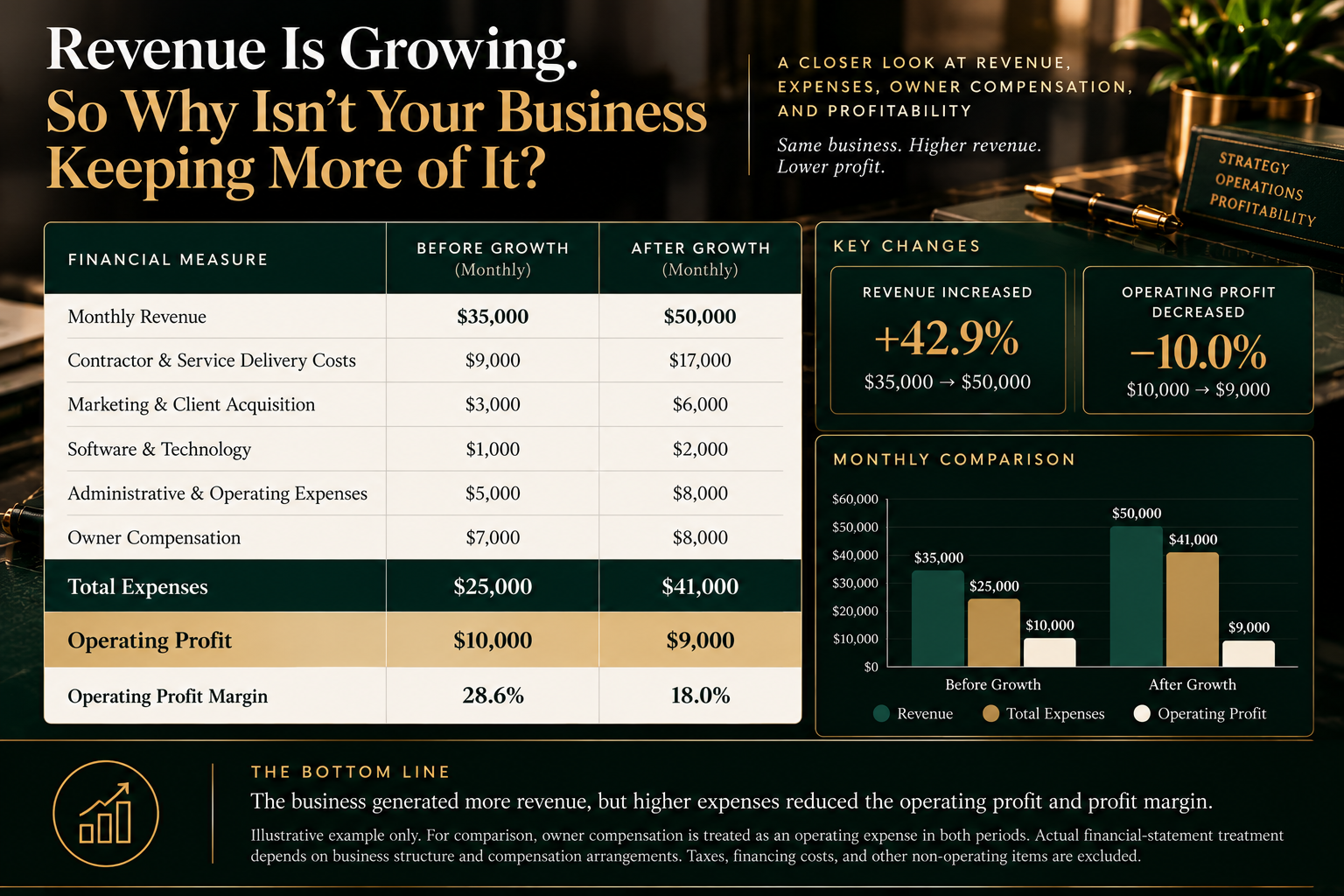
Look closely at what happened.
Revenue increased by $15,000 per month, or approximately 42.9%.
Yet operating profit declined from $10,000 to $9,000.
The business generated more sales but retained less operating profit.
Its operating profit margin fell from 28.6% to 18.0%.
That is a decline of approximately 10.6 percentage points.
The business grew. Its profitability weakened.
This is why increasing revenue without understanding the cost structure behind it can create the appearance of success without producing stronger financial results.
Where Is the Money Actually Going?
When revenue increases, but profitability doesn't follow, the answer is usually found by examining how the business earns, spends, and retains money.
Four areas deserve particular attention.
1. Service Delivery Costs: Are You Spending More to Earn More?
For consultants, agencies, coaches, and professional-service firms, delivering additional work often requires additional resources.
That may include contractors, employees, subcontracted specialists, project management, or outsourced support.
These costs aren't inherently problematic.
The issue is whether the additional revenue generated by each engagement adequately supports the cost of delivering it.
In our example, contractor and service delivery costs increased from $9,000 to $17,000.
That's an $8,000 increase.
Before celebrating the additional revenue, the founder needs to understand how much of that revenue is being absorbed by service delivery.
A useful question is:
Which services, clients, or projects are producing the strongest contribution after direct delivery costs?
Without that visibility, a business may continue selling offers that generate impressive revenue but relatively little profit.
2. Operating Expenses: Has Growth Introduced Unnecessary Complexity?
As businesses expand, expenses often increase gradually.
A new software platform here. An additional contractor there. A marketing subscription, administrative service, or operating tool added to solve an immediate problem.
Individually, these decisions may appear reasonable.
Collectively, they can change the financial structure of the business.
In our example, marketing, software, and administrative expenses increased from a combined $9,000 to $16,000 per month.
That's an additional $7,000 in monthly operating costs.
The question isn't whether every expense should be eliminated.
It's whether each expense is contributing to an operational or financial outcome that justifies its cost.
Growth should create greater capacity and stronger economics—not simply a more expensive business to operate.
3. Owner Compensation: Is the Business Supporting Its Founder?
One of the most overlooked profitability questions is whether the founder's compensation is being considered consistently.
Some owners pay themselves a fixed salary.
Others take irregular distributions or draws based on what appears available.
These arrangements are not interchangeable from an accounting or tax perspective.
However, every founder needs to understand how personal compensation fits into the economics of the business.
In our illustrative example, owner compensation increased from $7,000 to $8,000 while monthly revenue increased by $15,000.
That means the founder's compensation grew by $1,000 even as the business took on substantially more revenue and operating complexity.
A founder should be able to answer:
-
What am I receiving from the business?
-
How does that compensation relate to business profitability and cash flow?
-
What level of financial performance is needed to support my compensation goals sustainably?
The purpose isn't to maximize withdrawals at the expense of the business.
It's to establish visibility into how the business supports both its operations and its owner.
4. Profitability: What Percentage of Revenue Are You Actually Keeping?
Profit margin helps reveal something that revenue alone cannot.
It shows how much operating profit remains from each dollar of revenue after the expenses included in the calculation.
In our example:
Before Growth
$10,000 Operating Profit ÷ $35,000 Revenue = 28.6% Operating Profit Margin
After Growth
$9,000 Operating Profit ÷ $50,000 Revenue = 18.0% Operating Profit Margin
For every dollar of revenue generated after growth, the business retained approximately 18 cents in operating profit.
Previously, it retained approximately 29 cents.
That difference matters.
Because a company operating at an 18% margin has a different financial position than one operating at nearly 29%, even when the first company generates substantially more revenue.
Profitability provides a more meaningful view of the financial return produced by the business's operations.
And when margins begin declining, leadership needs to understand why.
The Problem Isn't Always Spending. Sometimes It's Visibility.
It's easy to assume that declining profitability means a business simply needs to cut expenses.
But expense reduction isn't always the right first decision.
A business may have a pricing problem.
It may have an inefficient service delivery model.
It may be allocating resources to low-margin clients.
It may be investing in growth activities without measuring their financial return.
Or its financial records may not be sufficiently accurate or organized to support a reliable profitability analysis.
Each situation requires a different response.
The real starting point is understanding which financial drivers are influencing profitability.
That requires more than checking the bank balance or reviewing total monthly revenue.
It requires a consistent view of revenue, expense categories, owner compensation, and profit margins over time.
What Financially Visible CEOs Monitor Differently
A financially visible CEO doesn't simply ask:
"How much revenue did we generate?"
They ask more specific questions.
Revenue: Which services and client relationships are driving revenue growth?
Delivery Costs: How much does it cost to fulfill the work we're selling?
Operating Expenses: Which expenses are increasing, and are they producing measurable value?
Owner Compensation: How does the business support the founder while maintaining its financial obligations?
Profitability: Are our margins improving, declining, or remaining stable as revenue changes?
Trends: What changed between last month, last quarter, and the same period last year?
These questions turn financial information into a decision-making resource.
Instead of reacting when cash becomes tight or profitability declines, leadership can identify patterns earlier and evaluate appropriate adjustments.
From Revenue Tracking to Profitability Visibility
This is why I developed the CEO Profitability Dashboard™ as part of The Gilded Vault™ at Biz Wealth Builders Consulting.
The purpose is to help business owners move beyond looking at revenue as an isolated measure of success.
A structured profitability dashboard provides a way to organize and evaluate the financial measures that influence business performance, including revenue, expenses, and profitability trends.
Rather than relying on disconnected spreadsheets or occasional financial reviews, the objective is to create a more consistent process for examining business performance.
A dashboard doesn't replace accurate bookkeeping, professional accounting judgment, or strategic decision-making.
It makes financial performance easier to examine once reliable information is available.
And that distinction is important.
Because a dashboard built on inaccurate data will not correct the underlying accounting problems.
But when your records are reliable, structured financial analysis can help you identify where growth is creating value—and where it may be creating additional costs without sufficient return.
Before You Chase Your Next Revenue Milestone
Consider these five questions:
-
Has my profit margin improved or declined over the last three months?
-
Which operating expenses have grown faster than revenue?
-
Do I know how much it costs to deliver my primary services?
-
Am I accounting for owner compensation consistently when evaluating business performance?
-
Can I explain why my business retained more or less profit this month than last month?
If you cannot answer these questions confidently, increasing revenue may not resolve the underlying problem.
It may simply make the problem larger.
Revenue growth tells you the business is expanding. Profitability tells you whether that expansion is producing stronger financial results.
The goal isn't just to build a business that earns more.
It's to build one that understands what it earns, what it spends, and what it retains.
Ready to See What Your Revenue Is Actually Producing?
If your business is generating revenue but you're struggling to understand where the profit is going, it's time to look beyond the top line.
Explore the CEO Profitability Dashboard™ inside The Gilded Vault™ and begin building a more structured view of your financial performance.