

Why More Revenue Doesn't Always Fix a Growing Business
Aug 24, 2026
Your Business Doesn't Always Need More Revenue. Sometimes It Needs Better Visibility.
The dangerous assumption that keeps growing businesses chasing more while understanding less.
You had a good month.
Revenue came in.
Clients paid.
Your calendar stayed full.
Maybe you even brought in more money than you did this time last year.
From the outside, the business looks like it's growing.
But then you open the bank account.
And somehow, the number staring back at you doesn't feel like growth.
You start mentally subtracting what's still coming out.
Payroll.
Contractors.
Software.
Taxes.
Marketing.
Debt.
Operating expenses.
And whatever is left is supposed to cover you.
Suddenly, the question you've been asking yourself returns:
How can the business be making more money while I still don't feel financially secure?
So you arrive at what feels like the obvious answer.
I need more revenue.
Another client.
A higher-ticket offer.
More leads.
A better launch.
More sales.
And sometimes, that is exactly what the business needs.
But sometimes it isn't.
Sometimes you're trying to solve a visibility problem with more revenue.
And that's where growth can become expensive.
Revenue Can Grow Faster Than Your Understanding of the Business
There's an assumption many founders carry into growth:
If revenue increases, the business should automatically become financially stronger.
But revenue only tells you how much money the business generated.
It doesn't tell you enough about what happened to that money after it arrived.
Consider a service business generating $20,000 per month.
On the surface, that's a $240,000 annual revenue business.
But suppose each month includes approximately:
$7,000 in service delivery and contractors
$3,000 in operating expenses
$2,500 in marketing and client acquisition
$2,000 reserved for taxes
$1,500 in debt and other obligations
$1,500 in miscellaneous and unexpected expenses
That's $17,500 committed before the founder meaningfully compensates herself.
The problem isn't that $20,000 is insignificant.
The problem is that revenue alone never told you how much of that $20,000 was actually available to build the business—or support the woman running it.
And that's a very different conversation.

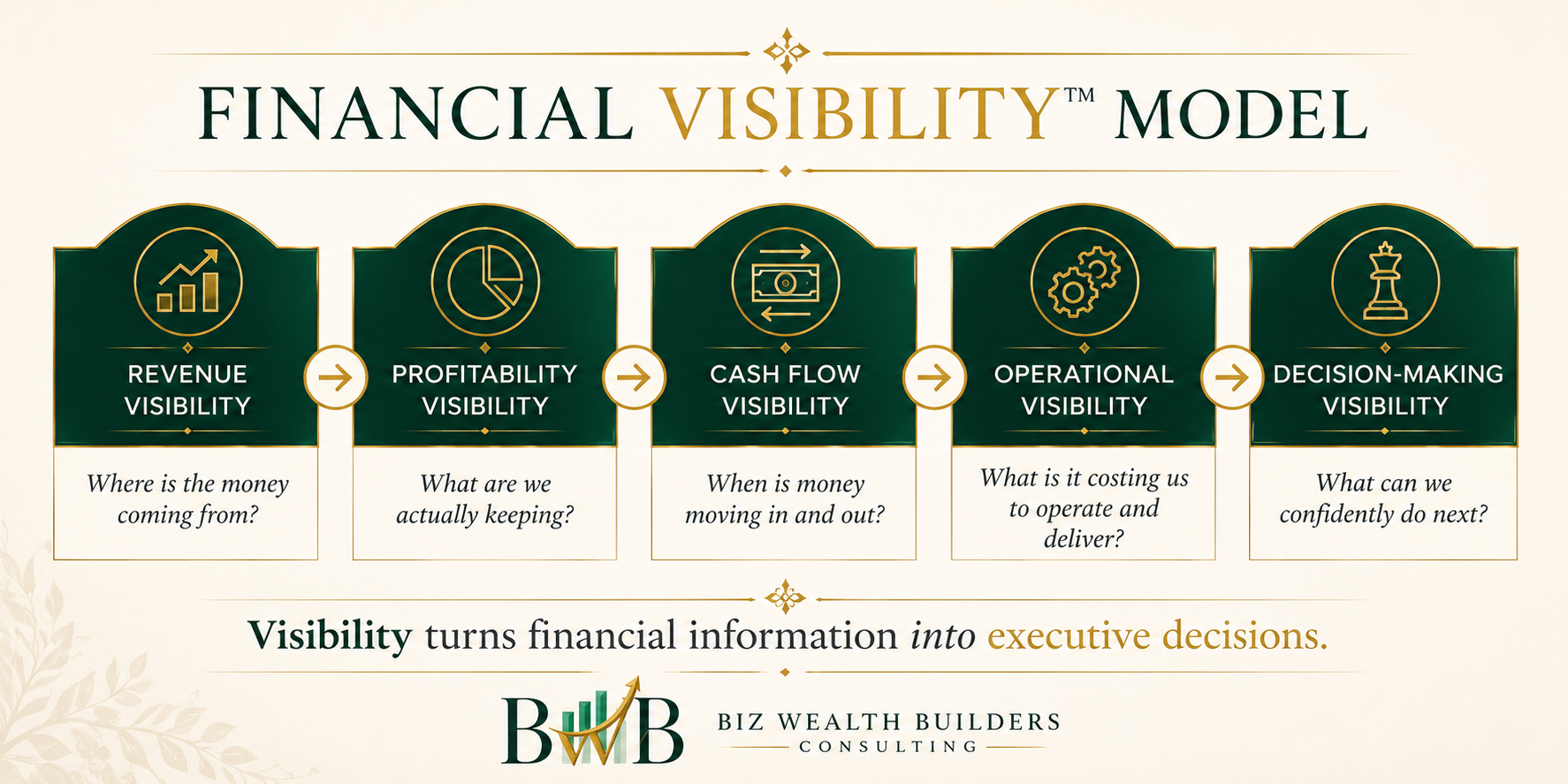
Financial Visibility™ Changes the Question
When leaders lack visibility, they tend to ask questions like:
How do I make more money?
Financial Visibility™ allows us to ask better questions.
Which revenue is actually profitable?
What does it cost us to generate and deliver that revenue?
How much cash does the business need to operate safely?
What can the business consistently afford to pay its owner?
Where is margin being lost?
Which offer should receive more investment?
Can we actually afford the hire we're considering?
What happens to cash if revenue increases 20%?
That's a fundamentally different way of running a business.
Because the goal isn't simply knowing your numbers.
The goal is being able to make better decisions because you can see what the numbers are telling you.
That's Financial Visibility™.
Growth Makes This More Important, Not Less
Here's where the distance between the business you have and the business you're trying to build begins to matter.
Imagine revenue grows from:
$20,000 → $30,000 per month.
That's a 50% increase.
Excellent.
But suppose delivering that additional revenue requires:
More contractors.
More software.
More advertising.
More administrative support.
More fulfillment capacity.
More working capital.
Suddenly, $10,000 in additional revenue may not produce anything close to $10,000 in additional financial capacity.
You grew.
But did the business actually become stronger?
That's the question revenue alone cannot answer.
And the larger the business becomes, the more expensive that blind spot can become.
The Distance Is What Founders Often Miss
Most women don't build businesses simply because they want bigger revenue numbers.
There was something behind the number.
Maybe you wanted to pay yourself consistently.
Build wealth.
Have more control over your time.
Create opportunities for your children.
Hire a team.
Stop worrying about every unexpected expense.
Take a vacation without wondering what will happen while you're gone.
Build something that eventually has value beyond your personal labor.
That's the destination.
Now look at the business today.
If revenue is increasing while you're working longer…
If the team is growing while more decisions are coming back to you…
If sales are improving while cash still feels unpredictable…
If the company is making more while you continue putting yourself last on payroll…
Then growth alone isn't necessarily moving you toward the business you intended to build.
It may simply be making the existing problem bigger.
And another six months of growth won't automatically correct that.
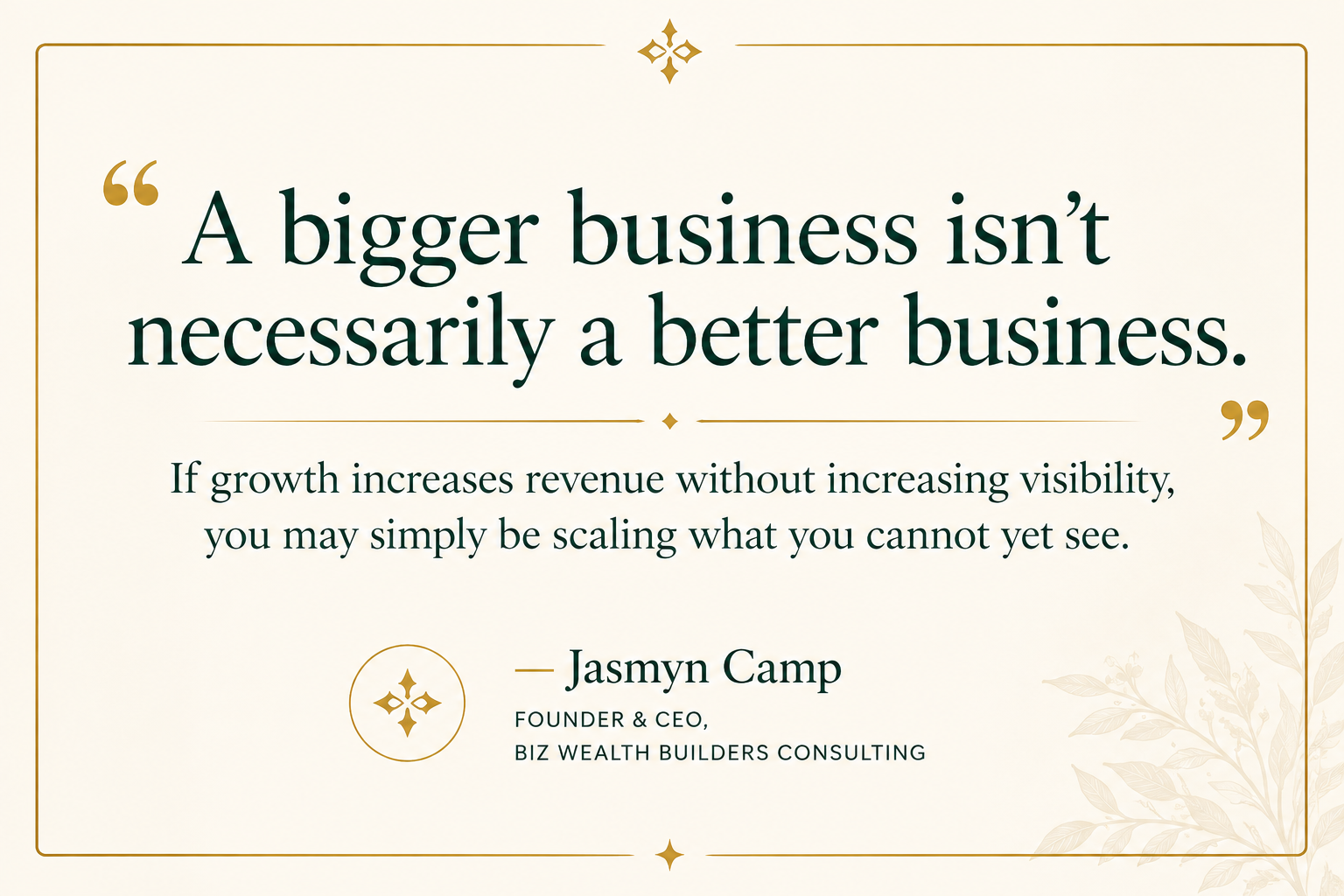
That's why visibility has to come before velocity.
What Changes When You Can Actually See the Business?
Go back to the founder who opened her bank account.
Same woman.
Same business.
Same responsibilities.
But now she understands:
Her average monthly operating requirement.
Her minimum cash threshold.
Her true delivery costs.
Her margins by offer.
Her expected tax obligations.
Her cash-flow timing.
Her owner-compensation target.
And the financial impact of the decisions she's considering.
Now when someone asks:
“Can you afford to hire?”
She doesn't open her bank account and guess.
She can model the decision.
When an offer generates $100,000 in revenue, she doesn't automatically celebrate the number.
She asks what it contributed.
When sales slow, she doesn't immediately discount her services.
She can determine what actually changed.
When an opportunity appears, she doesn't spend three days wondering whether she can afford to say yes.
She can see the answer.
That's the possibility Financial Visibility™ creates.
Not perfect numbers.
Not certainty about everything.
Decision-making capacity.
Before You Chase the Next Revenue Goal, Ask This
Before setting the next revenue target, launching another offer, increasing your marketing budget, or adding another client, ask:
If the business generated 25% more revenue next month, could I confidently explain what would happen to the additional money?
Would you know:
How much would become profit?
How much additional delivery would cost?
How much cash you'd need?
Whether you could increase your compensation?
Whether the additional revenue would actually improve the business?
If the answer begins with:
“I think…”
That's worth paying attention to.
Because your next growth problem may not begin with revenue.
It may begin with what you cannot yet see.

You Don't Have to See Everything Alone
One of the challenges of leadership is that you can become too close to the business to recognize what has become normal.
That's one reason I created Legacy Leaders Collective™.
It's a relationship-centered space for women founders, CEOs, business owners, managing partners, presidents, and established consultants navigating growth, decisions, complexity, and what comes next.
Not another room where you're expected to arrive with everything figured out.
A room where thoughtful women can bring the questions they're actually navigating.
Because sometimes another leader can see the assumption you've stopped questioning.
Sometimes she has already navigated the problem you're encountering for the first time.
And sometimes the visibility you're missing isn't sitting inside another dashboard.
It's sitting across the table.
If you're building the next stage of your business and want to be around women doing the same:
JOIN LEGACY LEADERS COLLECTIVE™ →
Don't wait until the blind spot becomes expensive to start looking at the business differently.
Pull up a chair.
Jasmyn Camp
Founder & CEO
Biz Wealth Builders Consulting
Helping Founders & CEOs Build Better Businesses Through Financial Visibility™