

Growth Exposes What the Business Was Not Built to Carry
Sep 07, 2026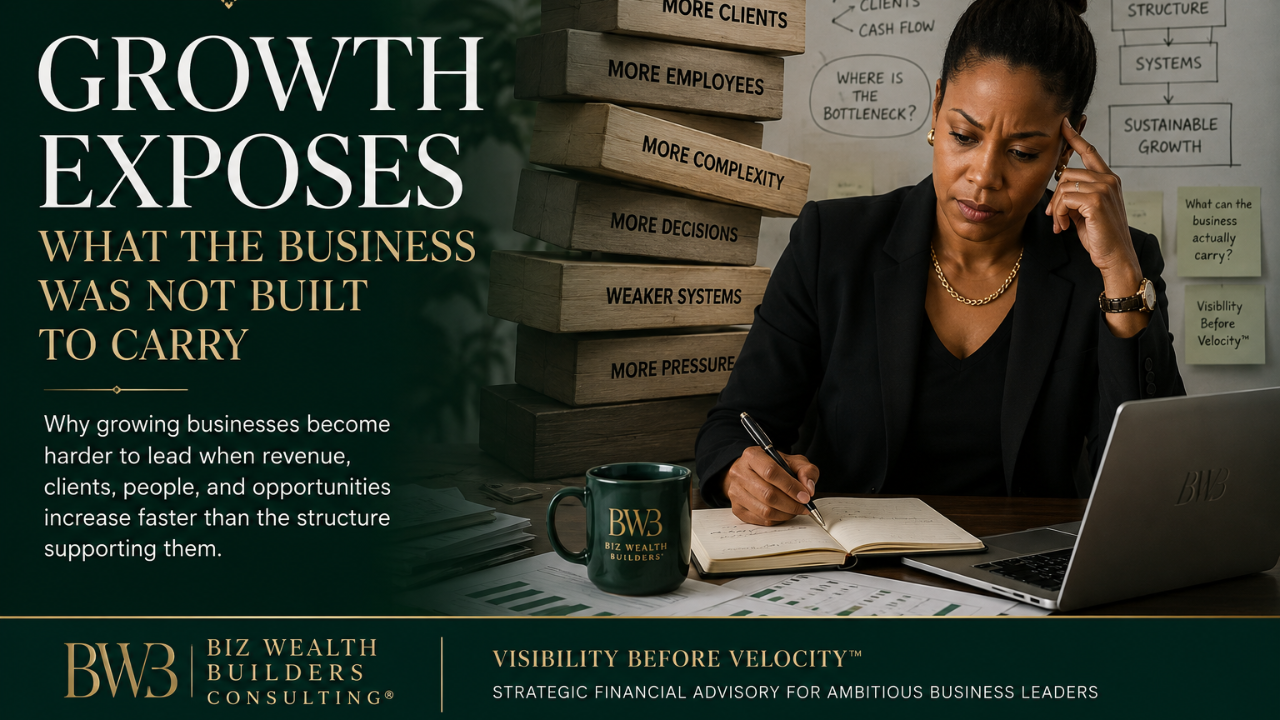
Why growing businesses become harder to lead when revenue, clients, people, and opportunities increase faster than the structure supporting them.
There is a point in business growth when success starts creating problems you didn't have before.
More clients come in.
Revenue increases.
The team gets bigger.
More opportunities start showing up.
Everything you've been working toward appears to be happening.
And somehow, the business feels heavier.
You're making more decisions than you used to.
More questions are finding their way back to you.
You're bringing in more revenue, but you're watching cash more closely.
You have a team, but there are still too many things that can't move forward without you.
And decisions that once felt simple now require conversations, reports, follow-ups, and information from several different places.
This is where founders often start questioning themselves.
Why does the business feel harder to lead when it's actually doing better?
The answer may not be that you're doing something wrong.
Your business may have simply grown beyond what its current structure was built to carry.
Growth didn't necessarily create the problem.
It exposed it.
Why Scaling a Business Can Become Harder as You Grow
Most businesses aren't built on day one for the company they'll eventually become.
They're built for what they need at the time.
In the beginning, you know almost every client.
You know what's coming in and what's going out.
You make most of the decisions.
Processes don't necessarily need to be documented because everyone knows how things work.
When something goes wrong, you step in and fix it.
And because you're close to everything, you can compensate for weaknesses in the business without even realizing you're doing it.
At that stage, it can work incredibly well.
Until the business changes.
What works with 10 clients may become difficult with 50.
What works with three employees can create confusion with 15.
What works at $250,000 in annual revenue can create very different financial and operational demands at $1 million.
The business changed.
But the financial systems, operational structure, decision-making processes, and leadership model underneath it may not have changed at the same pace.
That's when complexity begins to outpace structure.
And that's usually when the founder starts feeling the weight.
Problems With Scaling a Business Don't Always Look Like Problems
This is what makes this stage of growth easy to miss.
The business may still look successful from the outside.
Revenue is growing.
Clients are being served.
The team is working.
New opportunities are coming in.
There may be no obvious crisis.
But underneath the growth, you start noticing things that weren't happening before.
You have financial reports, but you're still trying to figure out what the numbers mean for the decision sitting in front of you.
You delegate something and find yourself checking it anyway.
The team has grown, but so has the number of questions coming back to you.
You're spending more money, but you're less certain about which investments are actually producing results.
Meetings multiply because information isn't flowing as clearly as it should.
Decisions slow down because no one is completely sure who has the authority to make them.
And eventually, you find yourself saying:
"It would be faster if I just did it myself."
That sentence tells you something.
Not because a founder should never step in.
But because if stepping in becomes the way the business continues to function, growth remains dependent on your personal capacity.
The business may be getting bigger without actually becoming more capable.
Growing Too Fast Can Expose Financial Blind Spots
One of the easiest things to celebrate in a growing business is revenue.
And understandably so.
But more revenue doesn't automatically mean a financially stronger business.
Growth can also mean more payroll.
More contractors.
More software.
More marketing.
Higher delivery costs.
More accounts receivable.
Larger tax obligations.
More operational overhead.
And more cash required to support everything you're building.
That's why one of the biggest shifts a growing CEO can make is moving beyond:
How much revenue did we generate?
and beginning to ask:
What is this growth actually producing?
Are margins improving or shrinking?
Is cash getting stronger as revenue grows?
Which services, clients, or offers are contributing most to profitability?
Where are costs increasing faster than revenue?
How much cash will the next stage of growth require?
Can the business afford the hire you're considering?
What happens financially if revenue grows another 30%?
And what happens if it doesn't?
These aren't simply accounting questions.
They're leadership questions.
And answering them requires more than having financial reports.
It requires being able to see what is happening clearly enough to understand what those numbers mean for the decisions ahead.
That's the difference between having financial information and having Financial Visibility™.
More People Don't Automatically Create More Capacity
When a growing business becomes overwhelmed, one of the first solutions is often:
We need to hire.
Sometimes that's exactly the right decision.
But adding people to unclear structure can actually create more complexity.
Now there are more people who need information.
More responsibilities that need ownership.
More communication.
More handoffs.
More payroll.
More management.
And more decisions about who has the authority to do what.
If the founder is still the primary source of context, approval, or decision-making, the team can grow without actually increasing the organization's independence.
You have more people.
But you're still hearing:
"Can you approve this?"
"What do you think we should do?"
"Who handles this?"
"Can you join this meeting?"
"I didn't want to make the decision without you."
Individually, those questions may seem insignificant.
Collectively, they're telling you something about the infrastructure supporting the business.
You've added people.
But you may not have added enough decision-making capacity, ownership, and operational clarity to support them.
When the Founder Becomes the Bridge
There's another problem that often remains hidden during business growth.
Founders become exceptionally good at compensating for what the business doesn't yet have.
When two systems don't communicate, you connect them.
When responsibilities aren't clear, you clarify them.
When the financial reports don't answer the question you're asking, you piece together the answer yourself.
When something falls through the cracks, you catch it.
When no one knows which decision to make, you make it.
When someone needs context, you provide it.
And because you keep solving the problem, the business keeps moving.
That's what makes founder dependency difficult to recognize.
The business appears to be functioning.
Clients are being served.
Revenue is coming in.
The team is working.
Problems are getting solved.
But sometimes the reason everything continues to work is because you are personally connecting everything the business hasn't learned to connect without you.
The founder becomes the bridge.
And eventually, that becomes a constraint.
Because the question is no longer simply:
Can this business continue growing?
The better question becomes:
How much more growth can this business absorb before my personal capacity becomes the ceiling?
Business Infrastructure Has to Grow With Revenue
When people think about business infrastructure for growth, they often think about technology, software, or documented processes.
Those things matter.
But infrastructure is bigger than that.
It includes how financial information moves through the business.
How decisions are made.
How responsibilities are assigned.
How performance is measured.
How leaders know when something requires attention.
How the team communicates.
How cash is managed.
How profitability is understood.
How problems are identified before they become emergencies.
And how much of all of that still depends on the founder.
The infrastructure that supported your first stage of growth may not be capable of supporting the next one.
That doesn't mean the business was poorly built.
It means the business has evolved.
And now the structure underneath it has to evolve too.
The Hidden Cost of Growth Is Decision Complexity
As a company grows, the number of decisions doesn't simply increase.
The consequences of those decisions increase too.
Should we hire?
Can we afford it?
Should we raise prices?
Should we discontinue an offer?
Which market should we prioritize?
Why did revenue increase while profit declined?
Do we have enough cash to make this investment?
Which clients are actually profitable?
Where should we invest next?
What can my team decide without me?
What still requires my involvement?
And what shouldn't require me anymore?
The challenge isn't necessarily that CEOs don't know how to make decisions.
The problem is that the business can start making the CEO work too hard to get the information required to make one.
Information may be scattered across financial statements, spreadsheets, software platforms, emails, meetings, conversations, and the founder's own memory.
Every decision requires another search for context.
Another conversation.
Another spreadsheet.
Another explanation.
Another piece of information.
That's where financial visibility and operational visibility begin to intersect.
Because as complexity grows, leaders need to be able to see the business as a whole—not just individual pieces of it.
Without that visibility, even good leaders can find themselves constantly reacting to whatever demands their attention first.
How Do You Know If Your Business Is Ready to Scale?
Most conversations about scaling focus on opportunity.
Is there enough demand?
Can we generate more leads?
Can we acquire more customers?
Can we increase revenue?
Can we expand into another market?
Those questions matter.
But they're only one side of scale.
Before asking how much more the business can produce, I believe founders should ask:
What can the business we have today actually carry?
Not what can you carry.
What can the business carry?
Could it handle 30% more clients without service quality declining?
Could revenue double without creating a cash-flow problem?
Could your team make important decisions if you weren't available for two weeks?
Do you know which clients, services, or offers are actually driving profitability?
Can you see financial problems early enough to respond before they become emergencies?
Does your team know what they own?
Do they know what they can decide without asking you?
Could the business continue operating without you connecting all of the pieces?
Those questions tell you something revenue alone can't.
They tell you whether the company is actually becoming more capable as it becomes bigger.
Visibility Before Velocity™
There is a natural temptation when something starts working to push harder.
More marketing.
More clients.
More sales.
More hiring.
More expansion.
More growth.
But there are moments when the next stage of growth requires something different.
Before adding more velocity, you need enough visibility to understand what the business can actually support.
That's the philosophy behind Visibility Before Velocity™.
It doesn't mean slowing a healthy business down unnecessarily.
It means understanding what you're accelerating before you accelerate it.
Because growth magnifies.
If your economics are strong, growth can magnify them.
If your systems are strong, growth can increase their impact.
If your team has clarity, growth can expand its capacity.
But growth can also magnify weak margins.
Cash-flow problems.
Unclear ownership.
Broken processes.
Decision bottlenecks.
Founder dependency.
And gaps in the information leaders rely on to make decisions.
Growth doesn't only amplify what's working.
It amplifies what isn't.
That's why visibility has to come before velocity.
Sometimes the Next Growth Move Isn't More Growth
This is something founders don't hear enough.
Sometimes the next move isn't another marketing campaign.
It isn't another hire.
It isn't another offer.
And it isn't another push for revenue.
Sometimes the next move is strengthening the business underneath the growth you've already created.
That might mean understanding profitability at a deeper level.
Improving cash-flow visibility.
Clarifying ownership.
Strengthening reporting.
Removing unnecessary founder approvals.
Improving decision-making rhythms.
Connecting financial information to operational performance.
Or identifying the knowledge that still lives primarily in your head.
Because when complexity has already exceeded structure, adding more growth doesn't necessarily solve the problem.
It magnifies it.
Sustainable Growth Requires the Business to Grow Too
Founders spend years learning how to grow revenue.
Eventually, another kind of growth has to happen.
The business itself has to mature.
Its financial infrastructure.
Its systems.
Its leadership.
Its decision-making.
Its accountability.
Its ability to operate without everything passing through one person.
That's why I don't think the question at this stage should simply be:
How do we grow from here?
A better question is:
What does this business need to become capable of carrying the growth we're asking it to produce?
That question changes the conversation.
You stop measuring growth only by how much the company produces.
You start looking at what the company requires from you to produce it.
You stop assuming every growing pain requires more effort.
You start examining whether the structure underneath the business has kept pace with what you've built.
Because sustainable growth isn't simply about becoming bigger.
It's about becoming capable of being bigger.
And sometimes the heaviness you're feeling isn't telling you that you've reached your limit.
It's telling you the business underneath the growth needs to catch up.
Take This Back to Your Business
Before you move on to the next thing today, sit with these questions:
Where has my business become more complex over the last 12 months?
What am I still personally carrying that the business should eventually be capable of carrying without me?
Where am I making important decisions without enough financial or operational visibility?
If the business grew another 30% over the next 12 months, what would become harder?
That last question may tell you more about your readiness to scale than another revenue projection ever could.
Don't rush to solve everything at once.
Pay attention to what your answers reveal.
Because the next constraint in your business may not be demand.
It may not be ambition.
And it may not be your ability to lead.
It may simply be that the company you've grown is asking for a different structure than the company you started.
Continue the Conversation
Growth brings questions that don't always have simple answers—and leadership can become increasingly isolating when you're carrying those questions by yourself.
The Legacy Leaders Collective™ is a relationship-centered community for women founders and business leaders navigating the decisions, pressures, opportunities, and leadership shifts that come with building something meant to last.
It's a place to step outside of the day-to-day, exchange perspective with other leaders, and have the conversations that are often difficult to have inside your own business.
Join the Legacy Leaders Collective™ and take your seat at the table.
The Emerald Ledger™
Executive perspectives on financial strategy, Financial Visibility™, decision-making, founder dependency, operational complexity, and sustainable business growth.