

Financial Visibility for Business Owners: The Hidden Cost of What You Can't See
Jun 29, 2026
The Hidden Cost of Low Financial Visibility in a Growing Business
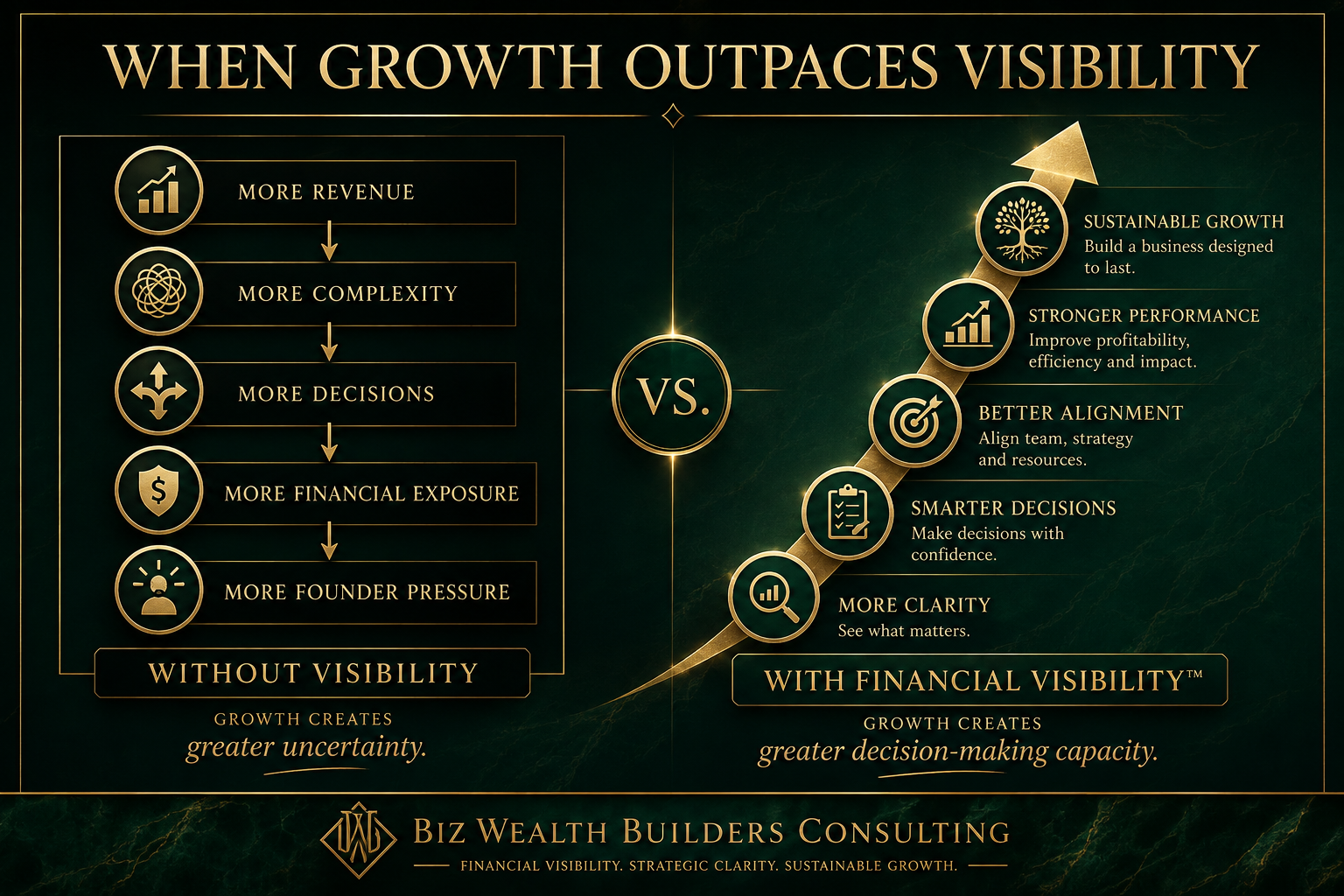
Growth doesn't become difficult simply because your business gets bigger. It becomes difficult when complexity grows faster than your ability to see what's happening inside it.
There is a moment many successful business owners eventually experience.
The business is growing.
Revenue is coming in.
Clients are being served.
There is more opportunity than there was a year ago.
From the outside, everything appears to be moving in the right direction.
But inside the business, something feels different.
Decisions take longer.
Cash feels less predictable than it should.
The team needs you more, not less.
Your calendar is full, but the most important work keeps getting pushed to tomorrow.
Revenue may even be increasing while you're quietly wondering:
Why does running this business feel harder now that we're doing better?
The instinct is usually to diagnose the pressure as a growth problem.
You need more people.
More systems.
More time.
More revenue.
Better processes.
But sometimes none of those is the real issue.
Sometimes you've reached the point where the business has become more complex than your current level of visibility can support.
And that's a very different problem.
What Is Financial Visibility?
Financial Visibility™ is a business owner's ability to clearly understand how revenue, profitability, cash flow, operational capacity, and financial decisions work together inside the business.
It isn't simply knowing how much money you made last month.
And it isn't having access to financial statements.
It's being able to use the information inside your business to confidently answer questions like:
Which revenue is actually profitable?
Where is cash going?
What can the business afford?
Which offers are strengthening the company?
Where is capacity becoming constrained?
Can we afford to hire?
What happens financially if we grow another 25%?
And perhaps most importantly:
What should we do next?
That's where financial information becomes Financial Visibility™.
And as your business grows, that distinction becomes increasingly important.
You Probably Don't Have a Time Problem
For a long time, I thought I did.
There weren't enough hours.
So I worked earlier.
Stayed up later.
Answered emails during lunch.
Worked after my sons went to bed.
Tried better planners.
Better routines.
More discipline.
More productivity.
I kept believing that if I could just get caught up, things would finally become easier.
They didn't.
Because I wasn't actually running out of time.
I was running out of visibility.
There were too many things requiring my attention because I couldn't clearly distinguish what was important from what simply felt urgent.
And that's something I now recognize in growing businesses all the time.
The founder isn't lazy.
She isn't undisciplined.
She usually isn't lacking ambition either.
Quite the opposite.
She's often working incredibly hard.
But she's trying to lead an increasingly complex business without enough visibility into what's actually creating the pressure.
So everything starts feeling important.
Every decision feels heavier.
Every problem reaches her desk.
And eventually, growth starts feeling like something she has to survive rather than something she gets to lead.
Growth Doesn't Create Every Problem. It Exposes Them.
A process that worked with 10 clients may begin breaking at 50.
Cash flow that felt manageable at $250,000 may become surprisingly complicated at $500,000.
A founder who could personally approve every decision with three employees becomes a bottleneck with 15.
A service that appeared profitable at a smaller scale may become significantly less attractive once delivery costs increase.
Reporting that once felt "good enough" may no longer provide enough information to support six-figure decisions.
Growth changes the margin for error.
And that's why one of the most dangerous assumptions a founder can make is:
"When we make more money, this will get easier."
Sometimes it does.
Sometimes more revenue simply makes the problem bigger.
Five Signs Your Business Has a Financial Visibility Problem
Visibility gaps rarely announce themselves.
You don't receive a notification saying:
"Your business has outgrown the way you've been managing it."
Instead, the problem appears through symptoms.
And because those symptoms are common among entrepreneurs, many leaders begin accepting them as the normal cost of running a growing company.
They're not always normal.
Sometimes they're signals.
1. Revenue Is Growing, but You Don't Feel Financially Stronger
This is one of the clearest.
You have a $30,000 month.
Maybe even a $50,000 month.
But when you look at the bank account, the number doesn't feel like the revenue number.
Payroll is coming.
Contractors need to be paid.
Taxes need to be reserved.
Software increased.
Marketing increased.
Delivery became more expensive.
And suddenly you're wondering:
"Where did all the money go?"
Revenue tells you what the business generated.
Financial Visibility™ helps you understand what the business kept, consumed, committed, and can actually use.
Those are very different numbers.
2. Cash Feels Unpredictable
One month feels comfortable.
The next feels tight.
So you begin managing cash reactively.
You delay an expense.
Move something to a credit card.
Wait for an invoice to clear.
Postpone paying yourself.
Then a large payment arrives, and everything feels fine again.
Until it doesn't.
That's not financial control.
That's financial reaction.
Cash is influenced by:
Receivables.
Payables.
Payment timing.
Margins.
Payroll.
Taxes.
Debt.
Operating expenses.
Growth investments.
And owner compensation.
Financial Visibility™ helps leadership understand those relationships before the bank balance creates urgency.
3. Decisions Take Longer Than They Should
Should we hire?
Can we increase marketing?
Can I pay myself more?
Should we discontinue this offer?
Can we take this client?
Can we afford this investment?
Without visibility, even reasonable decisions become exhausting.
You pull another report.
Ask another person.
Wait another week.
Check the bank balance again.
Then tell yourself:
"I just need a little more information."
But delayed decisions have costs too.
Opportunities close.
Teams lose momentum.
Problems become larger.
Good candidates accept other positions.
Investments become more expensive.
Visibility doesn't eliminate risk.
It reduces unnecessary uncertainty.
And that makes timely decisions possible.
4. Everything Still Depends on You
Every question comes to you.
Every exception requires your approval.
Every important decision waits for you.
And you've started wondering why your team can't operate more independently.
Sometimes that's a people problem.
But sometimes it's a visibility problem.
If your team cannot clearly see:
Priorities.
Performance expectations.
Decision boundaries.
Financial constraints.
Operational capacity.
Accountability.
Then escalating decisions to the person who knows the most about the business makes perfect sense.
And usually, that's the founder.
Eventually, the founder becomes the operating system.
That's when growth becomes founder dependency.
5. You Keep Solving Problems After They've Become Expensive
You discover the margin problem after profitability declines.
You discover the capacity problem after the team burns out.
You discover the cash problem when the balance gets uncomfortable.
You discover the pricing problem after months of undercharging.
You discover the client-concentration problem after losing the client.
These problems didn't appear overnight.
They became visible overnight.
That's the distinction.
One of the greatest advantages of Financial Visibility™ is not simply solving problems better.
It's seeing them earlier.
And timing can dramatically change what a problem costs.
The Real Cost of Low Financial Visibility
The greatest cost isn't necessarily sitting on your P&L.
Some of it is.
Lower margins.
Unnecessary expenses.
Poor pricing.
Inefficient labor.
Missed collections.
Unprofitable services.
But some of the most expensive costs are harder to quantify.
The opportunity you didn't pursue because you weren't sure you could afford it.
The employee you didn't hire because cash felt uncertain.
The partnership you delayed because you couldn't evaluate the financial implications.
The months you continued selling an offer that generated revenue but consumed too much capacity.
The nights you spent thinking about problems you couldn't clearly diagnose.
That's why low visibility becomes expensive long before a company recognizes it as a financial problem.
The Distance Between Where You Are and Where You Want to Be
This is the part founders don't always calculate.
Suppose you're currently generating $400,000 and your goal is $1 million.
On paper, the distance is simple:
$600,000.
But that's only the revenue distance.
What will another $600,000 require?
How many additional clients?
How many employees?
How much working capital?
How much marketing?
How much additional delivery?
How much management capacity?
How much technology?
How much of you?
And after paying for everything required to generate the additional $600,000...
What will the business actually gain?
That's the question Financial Visibility™ allows you to answer.
Because scaling revenue without understanding the economics underneath it can create a bigger company without creating a better one.
And that's not the destination most founders had in mind when they decided to grow.
The Visibility-to-Growth Framework™
This is where the work becomes transformational.
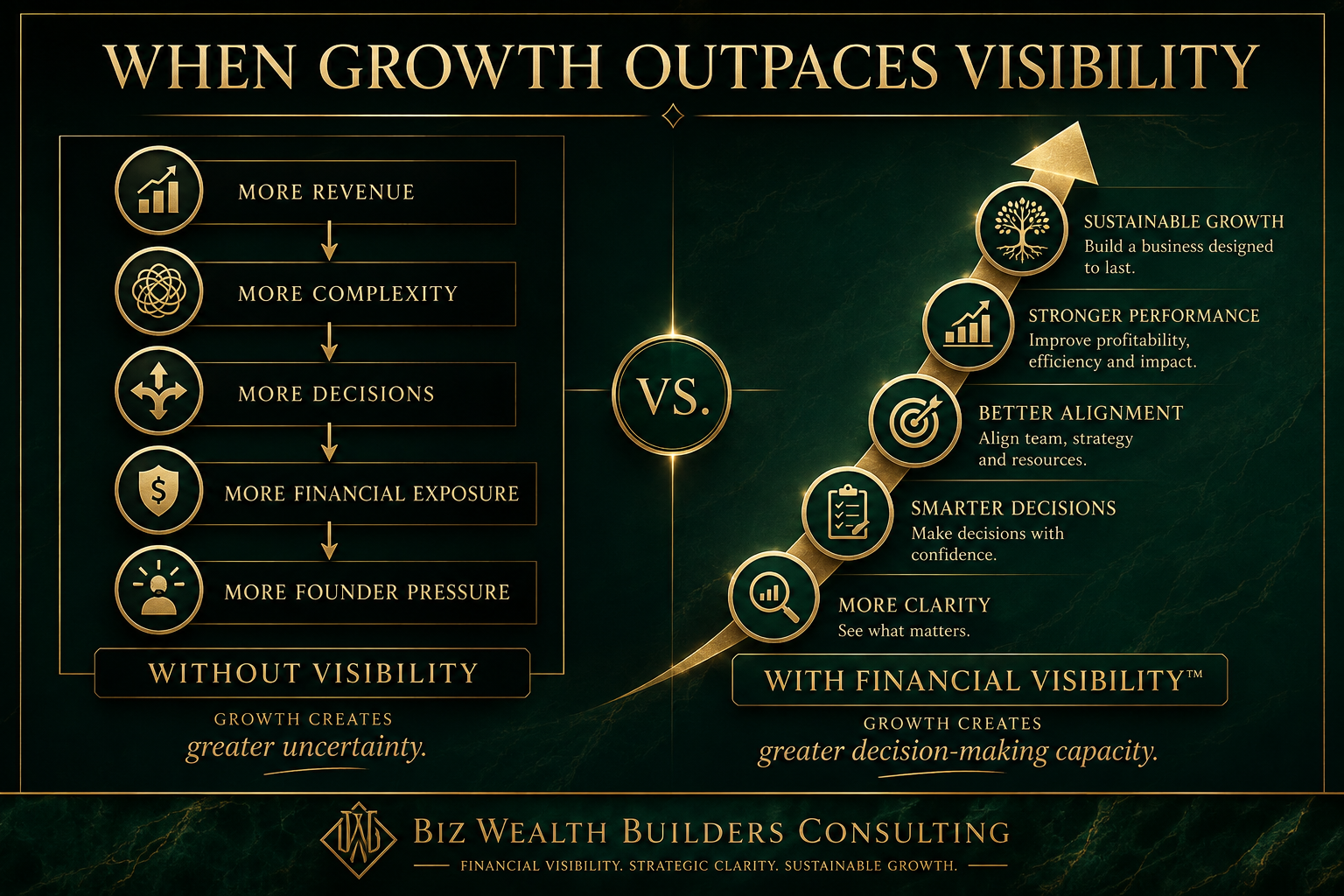
Sustainable growth follows a progression.
VISIBILITY
First, you see what's actually happening.
Not what you assume is happening.
Not what last month's bank balance suggested.
What's happening.
↓
CLARITY
Once the business becomes visible, priorities become clearer.
You stop treating every issue as equally important.
↓
CONFIDENCE
Clarity strengthens decision-making.
Not because risk disappears.
Because you understand the tradeoffs.
↓
EXECUTION
Better decisions create better execution.
Resources are allocated more intentionally.
Teams understand priorities.
Leadership moves faster.
↓
SUSTAINABLE GROWTH
Now growth isn't simply more.
It's stronger.
More intentional.
More profitable.
More sustainable.
And less dependent on the founder carrying the entire business.
Visibility → Clarity → Confidence → Execution → Sustainable Growth
That's the Visibility-to-Growth Framework™.
What Financial Visibility Looks Like in Practice
Imagine you're considering hiring a $70,000 employee.
Without visibility, the conversation often sounds like:
"The bank account looks okay."
"We're busy enough."
"I think we can afford it."
"We really need the help."
Now imagine approaching the same decision with visibility.
You understand your expected revenue.
Your gross margin.
Current payroll.
Cash reserves.
Receivable timing.
Additional employment costs.
Expected productivity.
Capacity constraints.
And the financial threshold the new position needs to support.
Now you're no longer asking:
"Do I feel comfortable hiring?"
You're asking:
"Under what conditions does this hiring decision make financial and operational sense?"
That's an executive question.
And that's what visibility creates.
The Question I Want Every Growing Founder to Ask
Before pursuing your next revenue goal, ask yourself:
If my business grew 25% next month, could I confidently explain what would happen inside the business?
What would happen to profitability?
Cash?
Delivery?
Team capacity?
Your workload?
Owner compensation?
Customer experience?
Would the business become stronger?
Or simply busier?
If your answer begins with:
"I think..."
Don't judge yourself for it.
Investigate it.
Because that hesitation may be showing you exactly where your next visibility gap exists.
Growth Should Create Capacity, Not Just Complexity
Most founders don't build businesses because they want to spend their lives chasing increasingly larger revenue numbers.
There's something behind the number.
Freedom.
Security.
Impact.
Wealth.
Time.
Choice.
Legacy.
The ability to support your family differently.
The ability to create opportunities for other people.
The ability to build something valuable beyond your own labor.
That's what growth was supposed to create.
So if the business is making more money while those things keep moving farther away, don't automatically assume the solution is another revenue goal.
Look underneath the number.
Because the problem may not be that your business isn't growing.
You may not be able to see enough of the business you're growing.
EXECUTIVE REFLECTION VISUAL
Premium ivory background, emerald typography, thin gold border.
The goal isn't to know every number in your business.
It's to know which numbers should change your next decision.
Financial Visibility™
— Jasmyn Camp
Founder & CEO, Biz Wealth Builders Consulting
Where to Begin
You don't need 47 KPIs.
You don't need another complicated dashboard.
And you certainly don't need to spend every morning staring at spreadsheets.
Start with the decisions you're currently struggling to make.
Then ask:
What don't I know that would make this decision easier?
Maybe it's profitability by service.
Maybe it's 90-day cash requirements.
Maybe it's client concentration.
Maybe it's capacity.
Maybe it's owner compensation.
Maybe it's recurring versus nonrecurring revenue.
That answer tells you what needs to become more visible.
Because Financial Visibility™ isn't about collecting more information.
It's about seeing enough of the right information to lead the business differently.
Your Next Step
If you're leading a growing business and decisions have started feeling heavier than they should, don't immediately assume you need another strategy.
First determine what you can—and cannot—clearly see.
The Executive Financial Visibility Assessment™ was designed to help founders and CEOs identify visibility gaps across the financial, operational, decision-making, and growth areas of their business.
TAKE THE EXECUTIVE FINANCIAL VISIBILITY ASSESSMENT™ →
Because before you decide what the business needs next...
you need to see the business you already have.
Continue the Conversation
Financial Visibility™ is only one part of building a business capable of sustainable growth.
Inside Legacy Leaders Collective™, women founders and executives come together to think more deeply about the decisions, challenges, opportunities, and responsibilities that come with leadership.
No performance.
No pretending you have everything figured out.
Just thoughtful women having the kinds of conversations leaders don't always have space to have elsewhere.
JOIN LEGACY LEADERS COLLECTIVE™ →
Pull up a chair.
Jasmyn Camp
Founder & CEO
Biz Wealth Builders Consulting
Helping Founders & CEOs Build Better Businesses Through Financial Visibility™