

Can Your Business Actually Afford Its Next Move?
Oct 19, 2026
Cash Flow Forecasting for Small Businesses: A CEO's Guide to Financially Sustainable Growth
Your business is growing. Revenue is coming in. Clients are signing contracts. Opportunities are presenting themselves.
And now you're considering your next move.
Maybe it's hiring an employee, investing in new software, expanding your services, or bringing on additional operational support.
On paper, the decision makes sense. Your business is generating revenue, and the opportunity appears aligned with your growth goals.
But there's one question that deserves more attention before you commit:
Can your business actually afford the decision—not just today, but over the coming weeks and months?
For many established service-based business owners, the challenge isn't necessarily generating revenue. It's understanding how much cash will be available, when it will arrive, and which financial obligations must be covered before making another commitment.
That's where cash flow forecasting becomes essential.
Revenue Doesn't Tell You What Your Business Can Afford
One of the most common financial challenges growing businesses face is confusing revenue, profitability, and available cash.
These three measures are connected, but they tell different stories.
Revenue represents the income your business generates from its products or services.
Profitability reflects what remains after accounting for business expenses.
Cash flow reflects the actual movement of money into and out of your business.
A company can generate significant revenue and report a profit while still experiencing cash shortages.
Consider a consulting business that generates $30,000 in monthly revenue.
That number may suggest the business has room to hire additional support. However, some clients may have 30-day or 60-day payment terms. Meanwhile, payroll, software subscriptions, contractors, taxes, and other obligations require payment on specific dates.
If the business owner makes a new financial commitment based solely on revenue, they may discover that the timing of incoming cash doesn't align with upcoming expenses.
A profitable business can still experience cash flow pressure when the timing of payments and financial obligations isn't properly managed.
This is why financial decisions require more than knowing how much money the business earns.
They require understanding when that money becomes available.
What Is Cash Flow Forecasting for Small Businesses?
Cash flow forecasting is the process of estimating how much money will enter and leave your business over a defined period.
A forecast helps business owners anticipate their future cash position by examining expected customer payments, recurring expenses, upcoming obligations, and planned investments.
Rather than relying exclusively on current bank balances or historical financial reports, forecasting introduces a forward-looking perspective.
A practical business cash flow forecast considers:
-
Your current available cash balance
-
Expected customer payments and collection dates
-
Recurring operating expenses
-
Payroll and contractor obligations
-
Loan payments and tax obligations
-
Planned purchases or business investments
-
The projected cash remaining at the end of each period
The objective isn't to predict the future with absolute certainty.
It's to give business owners a clearer understanding of potential financial pressures before those pressures become immediate problems.
The Hidden Risk of Making Growth Decisions Without a Cash Flow Forecast
Growth introduces financial commitments.
Hiring increases payroll obligations. Expanding services may require additional software, training, or contractor support. Larger client engagements can create upfront delivery costs before customer payments arrive.
Without cash flow planning, business owners may make decisions that are strategically reasonable but financially difficult to sustain.
1. Hiring before the business has sufficient cash capacity
Hiring can increase capacity and support growth.
However, the true financial commitment extends beyond the employee's salary. Payroll taxes, benefits, onboarding, equipment, and recurring administrative expenses may also affect cash requirements.
A forecast helps evaluate whether expected cash inflows can support these obligations over time.
2. Investing based on expected revenue rather than collected cash
A signed contract represents an important business opportunity, but it doesn't necessarily represent cash currently available.
If your business must incur expenses before receiving payment, the timing difference can create financial pressure.
Forecasting helps make those timing gaps visible.
3. Overlooking the cumulative effect of recurring expenses
An individual subscription or contractor expense may appear manageable.
But when several recurring commitments accumulate, they can significantly reduce financial flexibility.
Cash flow forecasting helps business owners understand how those obligations affect future cash availability.
4. Waiting until cash becomes tight to make adjustments
When financial planning is reactive, business owners may discover problems only after expenses are due.
With a forecast, potential shortages can become visible earlier, creating more time to evaluate options.
The goal is not to eliminate financial uncertainty. It's to make better decisions with the information available.
Why a 13-Week Cash Flow Forecast Can Be Valuable
A 13-week cash flow forecast provides a rolling view of anticipated cash inflows and outflows over approximately three months.
For growing service-based businesses, this timeframe can be especially useful because it offers enough visibility to anticipate near-term obligations without relying entirely on distant financial assumptions.
A basic 13-week forecast starts with your current cash balance.
Each week, you estimate the cash you expect to receive and the payments you expect to make.
The projected ending balance becomes the beginning balance for the next week.
For example:
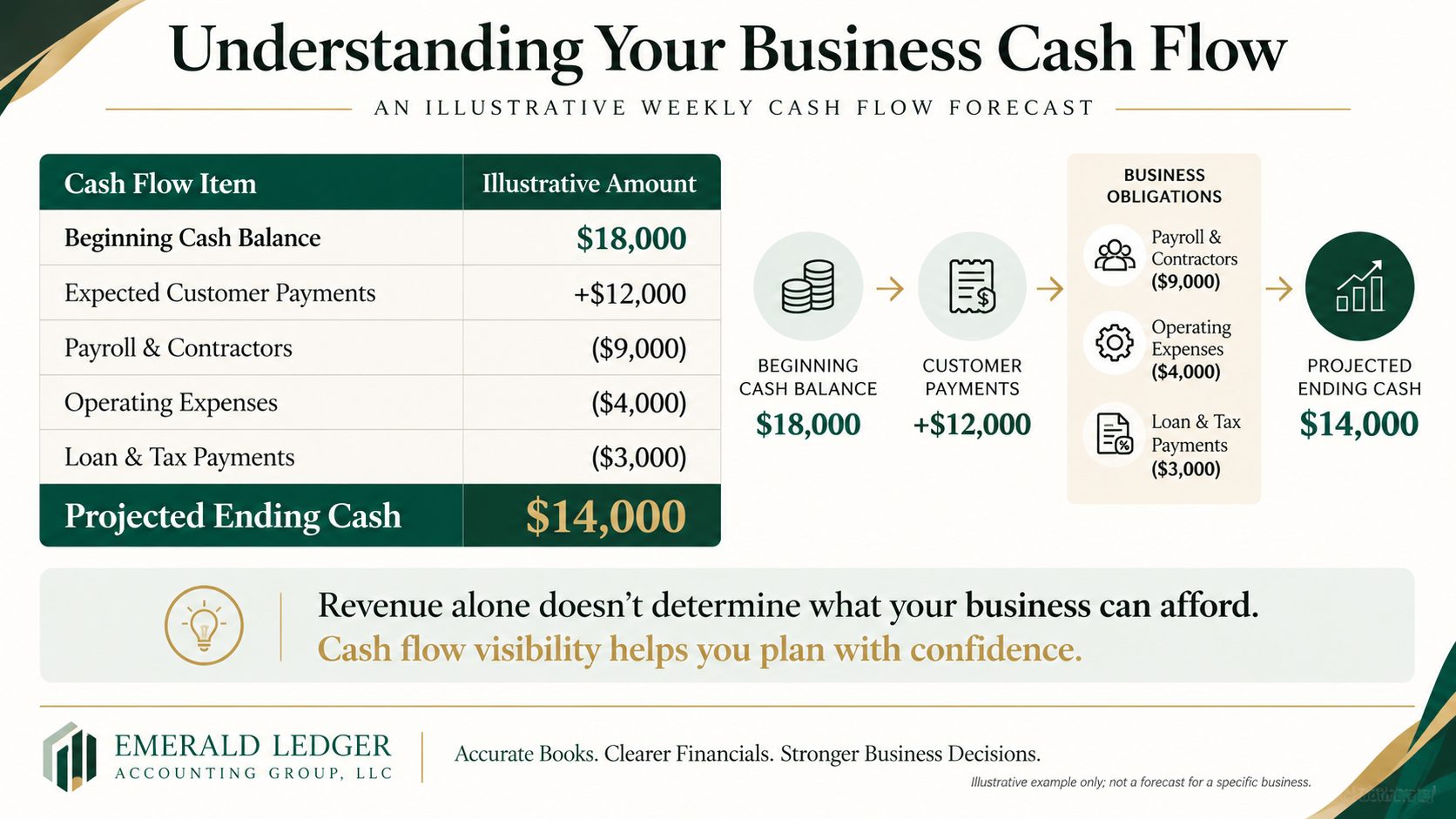
Illustrative example only; not a forecast for a specific business.
The projected $14,000 ending balance doesn't automatically mean the business can afford another $14,000 commitment.
The owner must also consider obligations due in subsequent weeks, minimum operating cash needs, and the reliability of anticipated collections.
By reviewing the forecast regularly, the business can compare expected cash movements with actual results and adjust its assumptions.
This creates a more disciplined approach to financial planning.
Five Questions to Ask Before Your Next Major Business Decision
Before hiring, expanding, or committing to another significant expense, consider these questions.
1. How much cash is actually available?
Start with your current cash position, but distinguish between cash in the bank and cash already committed to upcoming obligations.
2. When will outstanding invoices be collected?
Revenue recorded in your accounting system isn't necessarily money you've received.
Review outstanding invoices, payment terms, and customer payment patterns.
3. What financial obligations are approaching?
Consider payroll, contractor payments, operating expenses, debt obligations, taxes, and other scheduled payments.
4. What happens if expected revenue is delayed?
A useful forecast should account for uncertainty.
Consider how your financial position changes if a major customer pays later than expected or anticipated sales don't materialize.
5. Will this decision strengthen or restrict financial flexibility?
A growth investment may be worthwhile, but understanding its effect on future cash availability helps you evaluate the timing and financial risk.
These questions don't replace strategic judgment. They give that judgment a stronger financial foundation.
Your Cash Flow Forecast Is Only as Reliable as Your Financial Records
There's an important limitation that business owners sometimes overlook.
You cannot build a dependable financial forecast on accounting information that is incomplete, outdated, or inaccurate.
If your bookkeeping is several months behind, bank accounts haven't been reconciled, or outstanding invoices aren't accurately recorded, your forecast may begin with incorrect assumptions.
For example, an inaccurate accounts receivable balance could cause you to overestimate incoming cash.
Unrecorded expenses could cause you to underestimate upcoming obligations.
Unreconciled accounts could distort your understanding of the business's current financial position.
This is why reliable bookkeeping is foundational to effective cash flow management.
Before developing a forecast, business owners should have confidence that their financial records accurately reflect the business's transactions, balances, and outstanding obligations.
For some businesses, that means maintaining consistent monthly bookkeeping.
For others, it means completing bookkeeping cleanup or catch-up work before relying on the numbers for major decisions.
Financial Visibility Starts With Reliable Accounting
Financial visibility isn't simply having access to a dashboard or a collection of reports.
It begins with understanding what your financial information is telling you—and having confidence that the information is accurate.
For established service-based businesses, reliable accounting records can help answer questions such as:
-
How much revenue has the business actually earned?
-
Which expenses are affecting profitability?
-
How much money is owed by customers?
-
What financial obligations are coming due?
-
How is the business's financial position changing over time?
When bookkeeping is accurate, current, and organized, business owners have a stronger foundation for budgeting, forecasting, and financial decision-making.
Without that foundation, even a sophisticated forecasting tool may produce misleading conclusions.
Growth Should Be Supported by Financial Clarity
Every stage of business growth introduces new decisions.
Some require additional investment. Others require patience, operational adjustments, or a closer examination of financial capacity.
The goal isn't to avoid making ambitious decisions.
It's to make those decisions with a clearer understanding of what your business can support.
Cash flow forecasting helps business owners move beyond reacting to their bank balance and begin anticipating their financial needs.
But meaningful forecasting starts with reliable financial information.
Before you make your next major business move, make sure your accounting records can support the decision.
Build a Stronger Financial Foundation With Emerald Ledger Accounting Group
At Emerald Ledger Accounting Group, LLC, we help established and growing businesses maintain accurate financial records, resolve bookkeeping challenges, and strengthen their accounting processes.
Our services include QuickBooks Online cleanup, catch-up bookkeeping, monthly bookkeeping, account reconciliation, and financial reporting.
Whether your books are behind or your growing business needs dependable ongoing accounting support, we help you build the financial foundation for clearer reporting and more informed decisions.
Your next business decision deserves financial information you can trust.
Emerald Ledger Accounting Group, LLC
Accurate Books. Clearer Financials. Stronger Business Decisions.