
Revenue increased. So why did the business become harder to run?

You finally hit the number.
Maybe it was your first $20,000 month.
Maybe $50,000.
Maybe the business crossed $500,000 for the year.
For months, that number represented something bigger than revenue.
You thought:
Once we get there, I'll finally be able to breathe.
You'll pay yourself more consistently.
Build the cash reserve.
Hire the support you've needed.
Stop putting certain expenses on the credit card.
Maybe take a few days away without calculating what the time off will cost you.
Then the number arrives.
And something strange happens.
The business makes more money.
But it doesn't feel like it has more money.
In some cases, it actually feels tighter.
That's what I call the Revenue Paradox:
The business can increase revenue while simultaneously decreasing the financial flexibility that growth was supposed to create.
And if leadership cannot see why that's happening, the natural response is usually to chase even more revenue.
That's where the problem can compound.
THE EXECUTIVE ISSUE
Revenue is one of the easiest numbers in a business to celebrate.
It's also one of the easiest numbers to misunderstand.
Imagine two businesses.
Both generate:
$30,000 per month.
From a revenue perspective, they look identical.
But look underneath the number.
BUSINESS A
$30,000 Revenue
$8,000 Delivery Costs
$4,000 Operating Expenses
$3,000 Marketing
$2,000 Payroll/Admin
$3,000 Taxes/Obligations
$10,000 remaining before additional allocations
BUSINESS B
$30,000 Revenue
$14,000 Delivery Costs
$5,000 Operating Expenses
$4,000 Marketing
$3,000 Payroll/Admin
$3,000 Taxes/Obligations
$1,000 remaining
Same revenue.
Completely different businesses.
One has financial capacity.
The other has financial pressure.
And if you're only watching the top line, you may not recognize the difference until cash becomes uncomfortable.

WHY MORE REVENUE CAN CREATE LESS FREEDOM
Here's where this becomes an executive issue rather than an accounting issue.
Growth consumes resources.
A new client doesn't simply create revenue.
The client may require:
More labor.
Additional contractor hours.
More software licenses.
More administrative support.
Additional customer service.
Greater working capital.
More management time.
More marketing to maintain the acquisition pipeline.
And sometimes something even more expensive:
More of you.
That's why a business can grow from $250,000 to $400,000 and leave its founder wondering why she has less time, more responsibility, greater financial pressure, and only slightly more personal income.
The revenue increased.
But the economics underneath the revenue didn't improve proportionately.
That's not necessarily a sales problem.
That's a visibility problem.
THE DISTANCE GROWTH CAN HIDE
This is the part I believe founders need to examine more carefully.
Suppose your goal is to build a $1 million business.
You're currently at $400,000.
It would be easy to measure the distance as:
$600,000.
But that's only the revenue distance.
What if reaching $1 million with your current model requires:
Twice the team.
Three times the management responsibility.
Significantly higher acquisition spending.
More delivery complexity.
Greater founder involvement.
And working capital the business currently doesn't generate?
Then the real distance between $400,000 and $1 million isn't simply another $600,000 in sales.
It's the infrastructure required to support the additional $600,000 without destroying the economics of the business.
That's a very different growth problem.
FINANCIAL VISIBILITY™ CHANGES WHAT YOU SCALE
This is where I want to take Monday's Emerald Ledger™ argument one level deeper.
Financial Visibility™ isn't simply about understanding the business you have today.
It helps determine which version of the business deserves to become bigger.
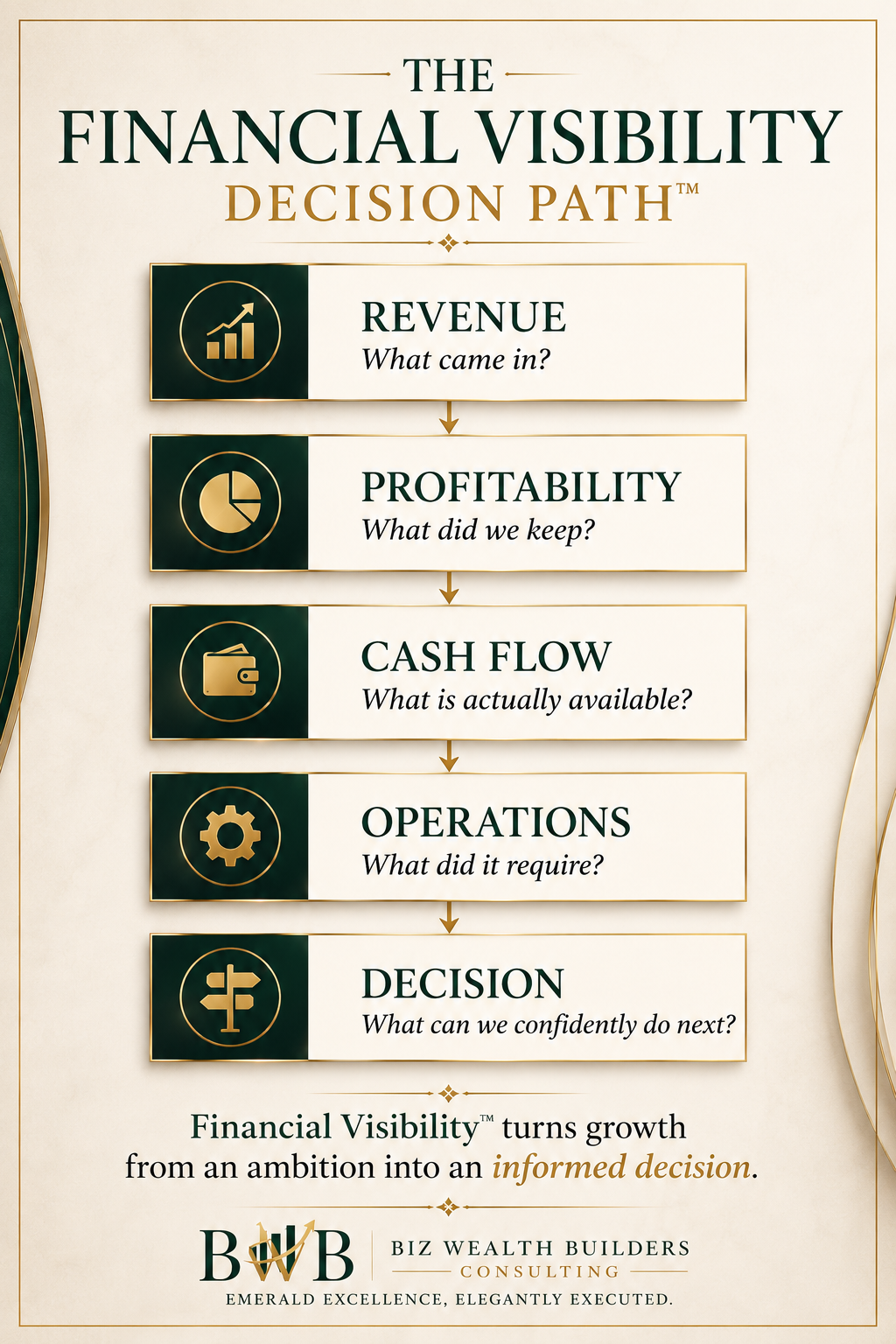
Before increasing revenue, leadership should be able to see at least five things.
01 — Revenue Visibility
Not simply:
How much did we sell?
But:
Which offers generated the revenue?
Which customers?
How predictable is it?
How concentrated is it?
How much is recurring versus transactional?
02 — Profitability Visibility
Now ask:
Which revenue actually contributes to the business?
A $10,000 client can be less valuable than a $6,000 client if fulfilling the larger engagement consumes substantially more resources.
This is why revenue alone can distort decision-making.
03 — Cash Flow Visibility
Profitability and cash are not interchangeable.
You can have profitable work and still experience cash pressure if:
Clients pay slowly.
Expenses occur before revenue arrives.
Taxes aren't adequately reserved.
Debt obligations consume operating cash.
Growth requires investment before the associated revenue is collected.
Leadership needs to understand when cash is available, not merely whether the P&L says the business earned money.
04 — Operational Visibility
Now connect the financial information to operations.
What happens operationally if sales increase 25%?
Can the existing team absorb it?
Does another hire become necessary?
Does fulfillment time increase?
Will service quality decline?
Does the founder become the bottleneck?
Financial growth without operational visibility can create revenue that the business isn't structurally prepared to support.
05 — Decision-Making Visibility
Ultimately, all of this information has one job:
Help leadership make better decisions.
Can we hire?
Can we increase owner compensation?
Can we invest another $20,000 in marketing?
Should we discontinue this offer?
Can we accept this large client?
Can we reduce our workload without damaging profitability?
Should we grow faster—or strengthen the business first?
Financial Visibility™ should make those questions easier to answer.
THE 25% GROWTH TEST
Here's this week's executive exercise.
Take your current average monthly revenue.
Multiply it by 1.25.
If you're averaging $20,000:
Your number is $25,000.
If you're averaging $40,000:
Your number is $50,000.
If you're averaging $100,000:
Your number is $125,000.
Now assume that revenue arrives next month.
Don't ask what you'd like to do with the additional money.
Ask what would actually happen.
Would fulfillment costs increase?
Would you need another employee or contractor?
Would marketing spending increase?
Would your tax allocation change?
Would you need additional software?
Would the founder's workload increase?
Would owner compensation increase?
How much additional profit would remain?
And here's the most important question:
Could you answer those questions before the growth happens?
If not, that's where I would start.
Because growth shouldn't be the experiment you use to discover the economics of your business.
YOUR EXECUTIVE VISIBILITY QUESTION™
There is one question I want you carrying into this week:
If I doubled the revenue of this business without changing anything else, would I want the business it created?
Not:
Would you want the revenue?
Of course you would.
Would you want:
The workload?
The team requirements?
The complexity?
The expenses?
The cash requirements?
The responsibilities?
The lifestyle?
The margins?
The business itself?
That's a much harder question.
And it's one worth answering before you scale.

THE EXECUTIVE TAKEAWAY
More revenue is not inherently the wrong goal.
But uninformed revenue growth can become an expensive one.
The objective isn't to make founders afraid of growth.
It's to make sure they're able to see what growth will require before they commit to creating it.
That's the difference between chasing a number and leading a business.
Before asking:
How do we get to the next revenue level?
Ask:
What happens to this business when we do?
If you can answer that clearly, you're not simply growing.
You're leading with visibility.
CONTINUE THE CONVERSATION
Monday's edition of The Emerald Ledger™ introduced the foundational argument:
Your Business Doesn't Always Need More Revenue. Sometimes It Needs Better Visibility.
If you haven't read it yet:
And if this week's Brief surfaced a question about your own business that you haven't been able to answer clearly, don't ignore it.
That's often where the most important work begins.
Inside Legacy Leaders Collective™, we're creating space for women leaders to bring those questions into conversations with other women who understand what it means to build, lead, grow, and make decisions when the answer isn't always obvious.
ENTER LEGACY LEADERS COLLECTIVE™ →
Until next week,
Jasmyn Camp
Founder & CEO
Biz Wealth Builders Consulting
Helping Founders & CEOs Build Better Businesses Through Financial Visibility™
P.S. You can always set another revenue goal.
But before you do, answer this:
If you got exactly the growth you're asking for, is your business prepared for what comes with it?
Because sometimes the biggest risk isn't failing to reach the next level.
It's reaching it before you can see what it will cost you.




Responses